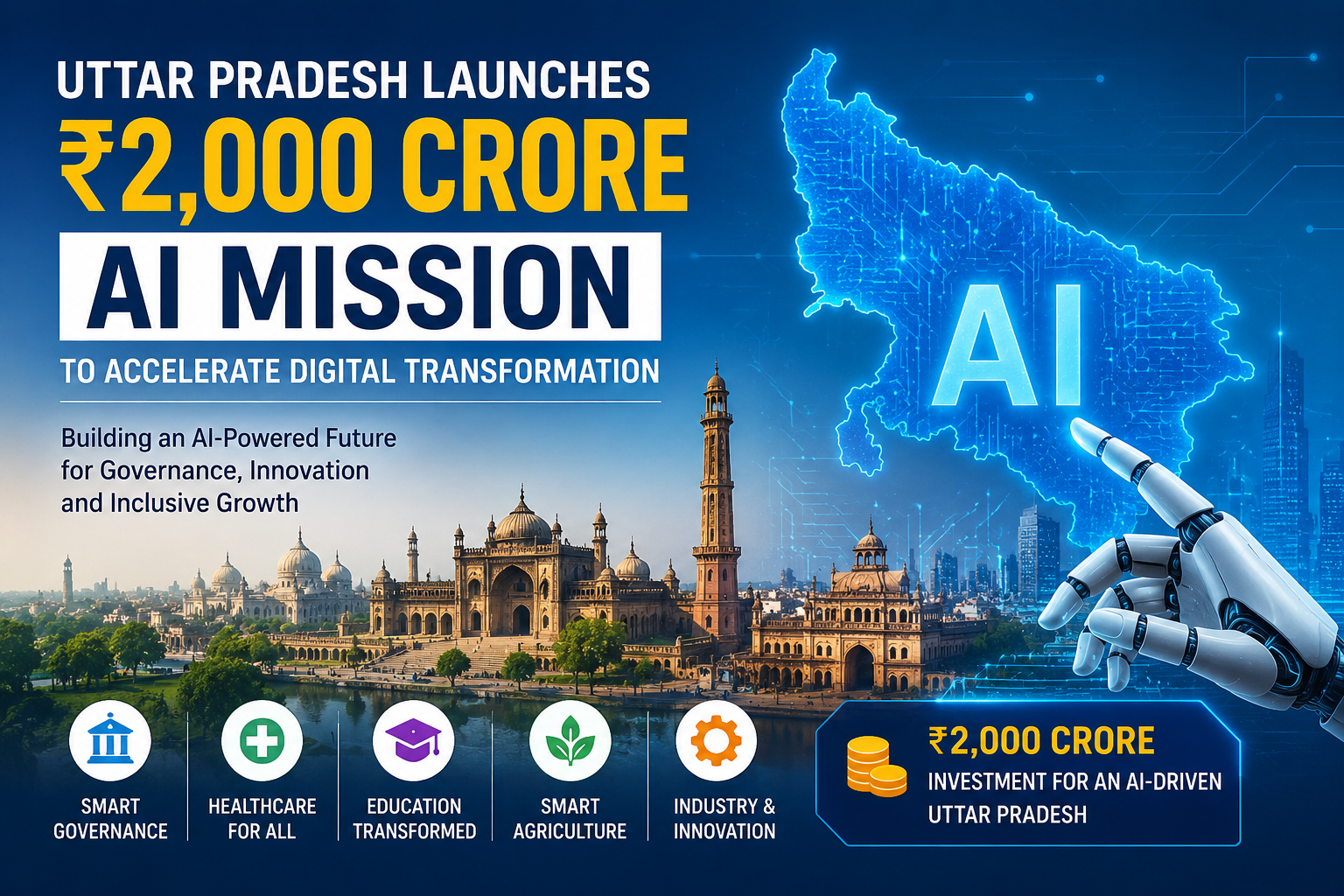
UP Government Commits ₹2,000 Crore to State AI Mission

Artificial Intelligence (AI) is emerging as a cornerstone of Uttar Pradesh’s digital transformation strategy.
In a major push towards becoming one of India’s leading AI-powered states, the Government of Uttar Pradesh
has committed ₹2,000 crore to its ambitious State AI Mission.
The initiative aims to accelerate AI adoption across governance, healthcare, education, agriculture,
public services, and industrial development, laying the foundation for a technology-driven economy.

AI at the Centre of Digital Governance

The State AI Mission is designed to integrate Artificial Intelligence into government operations,
enabling smarter decision-making, faster public service delivery, and improved administrative efficiency.
By leveraging AI technologies, Uttar Pradesh aims to modernize governance while enhancing transparency,
digital inclusion, and citizen-centric service delivery.

₹2,000 Crore Investment to Build a Robust AI Ecosystem

The dedicated investment will support the development of AI infrastructure, digital platforms,
research initiatives, innovation centres, and skill development programmes.
The mission also seeks to encourage collaboration between government departments,
academic institutions, startups, and private enterprises to build a sustainable
AI ecosystem across the state.

Key Sectors Set to Benefit

1. Healthcare

Artificial Intelligence will strengthen healthcare through AI-assisted diagnostics,
predictive healthcare, disease surveillance, medical data analysis, and improved
access to quality healthcare services across urban and rural areas.

2. Education

The AI Mission aims to transform education by enabling personalized learning,
AI-powered classrooms, smart educational content, teacher support tools,
and improved digital learning experiences for students.

3. Agriculture

Farmers are expected to benefit from AI-powered crop monitoring, weather forecasting,
soil analysis, precision farming, and intelligent advisory systems that can improve
agricultural productivity and sustainability.

4. Governance

Government departments will increasingly use AI for policy planning,
automation of public services, efficient grievance redressal,
data-driven decision-making, and enhanced citizen engagement.

5. Industry & Manufacturing

The initiative is expected to encourage AI adoption in manufacturing,
logistics, MSMEs, industrial automation, and emerging technology startups,
attracting both domestic and global investments.

Strengthening Uttar Pradesh’s Innovation Ecosystem

Beyond public sector applications, the State AI Mission aims to strengthen
Uttar Pradesh’s innovation ecosystem by promoting research,
entrepreneurship, startup incubation, and industry-academia collaboration.
Investments in AI infrastructure and digital skills are expected to create
new opportunities for students, researchers, startups, and technology companies.

Driving Economic Growth Through AI

Artificial Intelligence is increasingly becoming a catalyst for economic growth,
and Uttar Pradesh is positioning itself as a preferred destination for AI-driven
innovation. By encouraging AI adoption across multiple sectors,
the state aims to improve productivity, generate high-skilled employment,
attract technology investments, and strengthen its digital economy.

Future Outlook

The ₹2,000 crore State AI Mission represents one of Uttar Pradesh’s most ambitious
technology initiatives. As AI continues to reshape industries and public services,
this investment is expected to accelerate digital transformation,
improve governance, support innovation, and establish Uttar Pradesh
as one of India’s leading Artificial Intelligence hubs.

Conclusion

With a strong policy framework, significant financial investment,
and a clear vision for AI-led development,
Uttar Pradesh is taking decisive steps toward building a smarter,
more inclusive, and technology-driven future.
The State AI Mission has the potential to transform governance,
healthcare, education, agriculture, and industry while creating
new opportunities for innovation, entrepreneurship,
and sustainable economic growth.
Uttar Pradesh Unveils Comprehensive AI Roadmap to Accelerate Digital Innovation

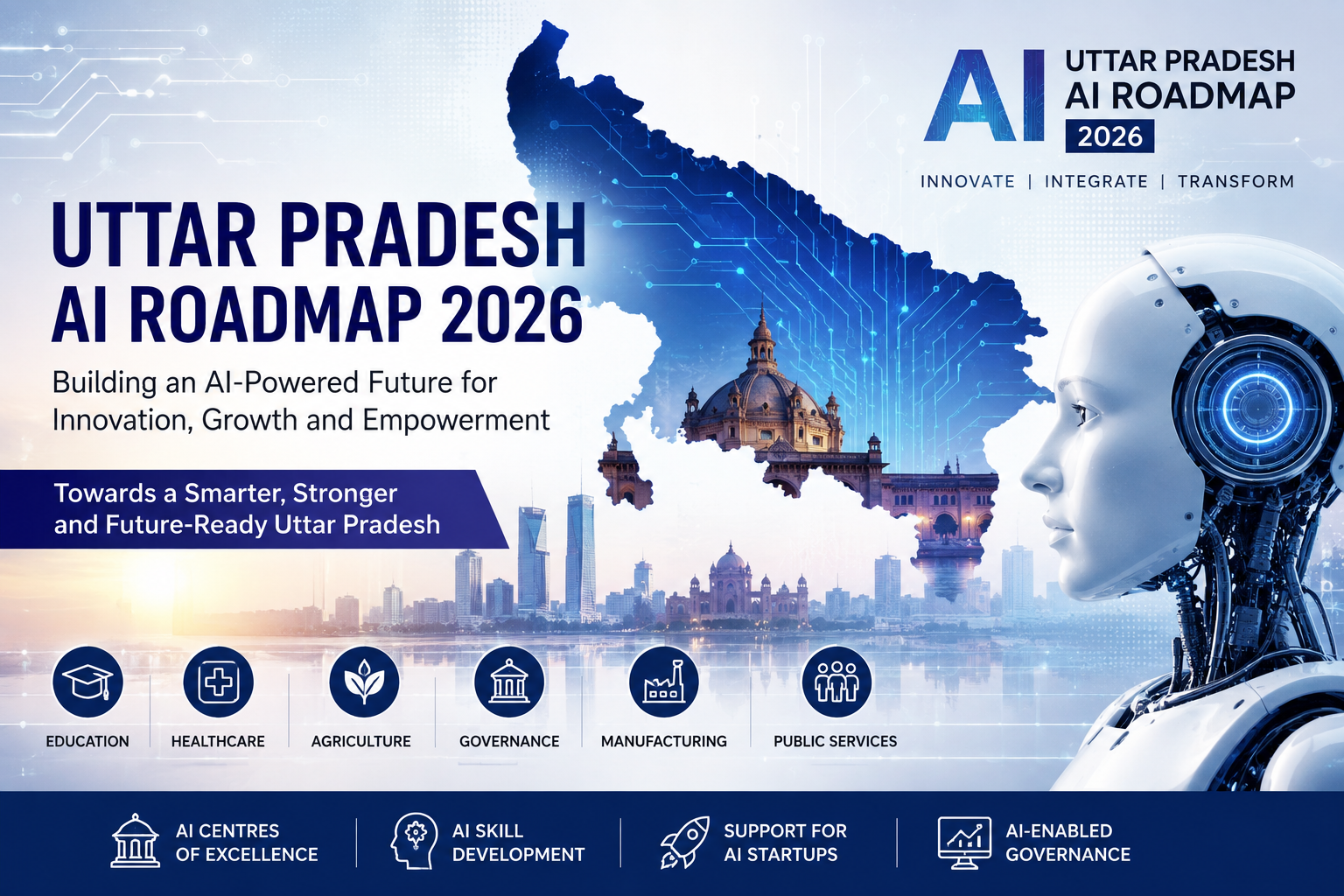
The Government of Uttar Pradesh has introduced a comprehensive Artificial Intelligence (AI) roadmap aimed at positioning the state as a leading hub for AI-driven innovation and digital transformation in India.

The new strategy focuses on integrating AI across key sectors, including education, healthcare, agriculture, governance, manufacturing, and public services. By adopting advanced technologies, the state aims to improve service delivery, increase operational efficiency, and create new opportunities for economic growth.

As part of the initiative, Uttar Pradesh plans to establish AI Centres of Excellence that will promote research, innovation, and collaboration between academic institutions, industry experts, and technology organizations. These centres are expected to play a key role in developing AI solutions tailored to real-world challenges.

The roadmap also places significant emphasis on AI skill development. Through specialized training programs, students, professionals, and entrepreneurs will gain practical knowledge in Artificial Intelligence, Machine Learning, Data Science, and other emerging technologies. The objective is to prepare a future-ready workforce capable of supporting India’s growing digital economy.

To strengthen the state’s innovation ecosystem, the government also intends to encourage AI startups by creating a supportive environment for research, investment, and technology adoption. This initiative is expected to attract entrepreneurs, investors, and technology companies looking to build AI-powered solutions.

Another major focus of the roadmap is improving public administration through AI-enabled governance. The government aims to leverage intelligent technologies to enhance decision-making, optimize public services, improve healthcare outcomes, modernize agricultural practices, and deliver citizen-centric digital services more efficiently.

The roadmap was highlighted during the CII Uttar Pradesh AI Tech Summit 2026, where government officials, technology leaders, industry experts, startups, and academic institutions discussed strategies for accelerating AI adoption across the state.

With this initiative, Uttar Pradesh is taking a significant step toward becoming one of India’s leading AI-driven states. The roadmap reflects the government’s vision of building a technology-enabled ecosystem that supports innovation, attracts investment, creates employment opportunities, and drives sustainable digital growth.

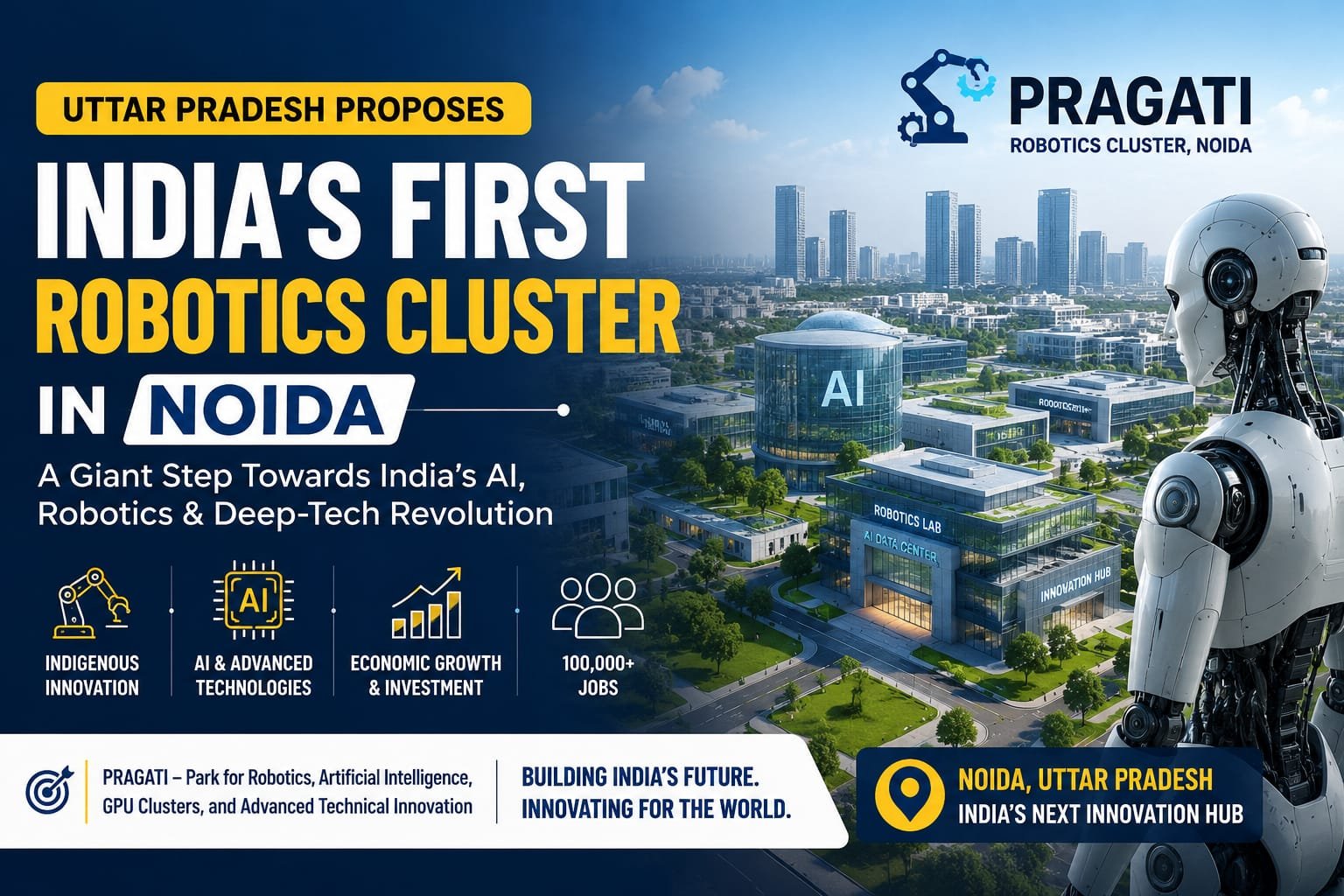
Uttar Pradesh Plans India’s First Robotics Hub in Noida

Uttar Pradesh Proposes India’s First Robotics Cluster in Noida

Uttar Pradesh is taking a major step toward becoming India’s next artificial intelligence and robotics powerhouse. The state government has proposed the establishment of India’s first dedicated robotics cluster in Noida, aiming to reduce the country’s dependence on imported robotics technologies while strengthening domestic innovation.

The proposed initiative reflects the state’s long-term vision of creating a globally competitive ecosystem for robotics, AI, advanced manufacturing, and deep-tech innovation. By bringing research institutions, startups, manufacturers, investors, and technology experts under one roof, Uttar Pradesh hopes to accelerate technological growth and position Noida as one of India’s leading innovation hubs.

Why This Robotics Cluster Matters

Artificial intelligence and robotics are transforming industries worldwide—from healthcare and manufacturing to logistics and defense. However, India still relies heavily on imported robotics systems and high-end automation technologies.

To address this challenge, the Uttar Pradesh government has proposed a dedicated robotics cluster that will support indigenous innovation, encourage local manufacturing, and strengthen India’s position in the global robotics market.

The initiative aligns with national goals such as Make in India, Digital India, and Atmanirbhar Bharat while creating new opportunities for businesses, startups, researchers, and skilled professionals.

What is PRAGATI?

The proposed robotics cluster is part of an ambitious project called PRAGATI (Park for Robotics, Artificial Intelligence, GPU Clusters, and Advanced Technical Innovation).

Spread across approximately 75 acres in Noida, PRAGATI is designed as an integrated ecosystem where innovation, research, testing, manufacturing, and commercialization can take place within a single campus.

The proposed facilities include:

  1. Robotics testing and certification centers
  2. AI computing infrastructure
  3. High-performance GPU clusters
  4. Motion capture laboratories
  5. Advanced manufacturing facilities
  6. Rapid prototyping labs
  7. Physical AI data centers
  8. Startup incubation centers
  9. Research and development spaces

Instead of creating separate facilities, the project aims to connect every stage of robotics development—from idea generation and research to testing, manufacturing, and commercial production.

Creating a Strong AI and Robotics Ecosystem

One of the biggest strengths of the proposed robotics cluster is its collaborative approach. The Uttar Pradesh government plans to bring together key stakeholders from across the AI and robotics ecosystem to encourage innovation and accelerate technological development.

The initiative will connect:

  1. AI startups
  2. Robotics companies
  3. Universities
  4. Research institutions
  5. Investors
  6. Technology experts
  7. Manufacturing industries

This integrated ecosystem can help reduce development costs, improve collaboration, and accelerate the commercialization of innovative technologies. By bringing diverse organizations together, the cluster aims to create a supportive environment for research, product development, and business growth.

Rather than working independently, organizations will be able to share infrastructure, research facilities, testing centers, and advanced computing resources, making innovation faster, more efficient, and cost-effective.

Economic Impact and Job Creation

The proposed robotics cluster is expected to become a major economic driver for Uttar Pradesh. By promoting innovation, advanced manufacturing, and AI-driven technologies, the initiative aims to strengthen the state’s economy while creating new opportunities for businesses and skilled professionals.

Government projections estimate that the initiative could:

  1. Generate more than 100,000 direct and indirect jobs.
  2. Contribute over ₹2,000 crore in gross value addition during the next five years.
  3. Attract both domestic and international investments.
  4. Support India’s growing advanced manufacturing industry.
  5. Encourage deep-tech entrepreneurship and startup innovation.

These projections highlight Uttar Pradesh’s ambition to become a national hub for emerging technologies, high-value manufacturing, and AI-powered industrial growth, while creating long-term economic benefits for the state.

Strengthening India’s Robotics Industry

Robotics adoption is growing rapidly across the world, transforming industries through automation, artificial intelligence, and smart technologies. From healthcare to manufacturing, organizations are increasingly investing in robotics to improve efficiency, productivity, and innovation.

Key sectors benefiting from robotics include:

  1. Healthcare
  2. Manufacturing
  3. Defence
  4. Warehousing
  5. Agriculture
  6. Smart logistics
  7. Electronics production

Although India has significant growth potential in robotics and automation, the country still depends on imported robotics components and advanced automation solutions for many industries.

By establishing a dedicated robotics cluster in Noida, Uttar Pradesh aims to strengthen domestic manufacturing, encourage the development of AI-powered robotics hardware and automation systems, and reduce reliance on imported technologies. This initiative could play an important role in building a more self-reliant and globally competitive robotics ecosystem for India.

Why Noida?

Noida has rapidly emerged as one of India’s fastest-growing technology and manufacturing destinations. Its modern infrastructure, strategic location, and expanding innovation ecosystem make it an ideal choice for establishing a large-scale robotics and AI cluster.

The city already offers:

  1. Strong electronics manufacturing infrastructure
  2. A growing startup ecosystem
  3. Excellent connectivity through expressways
  4. Upcoming Jewar International Airport
  5. Proximity to Delhi-NCR
  6. An expanding data center ecosystem
  7. Access to a highly skilled technical workforce

These advantages make Noida a strategic location for developing a world-class AI and robotics ecosystem. The proposed cluster is expected to attract global technology companies, investors, startups, and research institutions, further strengthening Uttar Pradesh’s position as a leading innovation and manufacturing hub.

The Road Ahead

Although the robotics cluster is currently at the proposal stage, it reflects Uttar Pradesh’s strong commitment to advancing artificial intelligence, robotics, and other emerging technologies. If approved and implemented successfully, the initiative could transform the state’s innovation ecosystem and strengthen India’s position in the global technology landscape.

The project has the potential to:

  1. Accelerate AI research and commercialization.
  2. Promote indigenous robotics innovation.
  3. Strengthen India’s manufacturing capabilities.
  4. Create thousands of high-skilled jobs.
  5. Position Uttar Pradesh as a leader in AI, robotics, and deep-tech innovation.

More than just an infrastructure project, this initiative represents a long-term vision to build a future-ready technology ecosystem that encourages innovation, supports entrepreneurship, attracts global investment, and drives sustainable economic growth across Uttar Pradesh.

Final Thoughts

The proposed PRAGATI Robotics Cluster in Noida has the potential to transform India’s AI and robotics ecosystem. By bringing together advanced research, cutting-edge manufacturing, AI infrastructure, startups, and industry experts under one roof, Uttar Pradesh is taking a significant step toward becoming a leading technology and innovation hub.

If implemented successfully, the project could reduce India’s dependence on imported robotics technologies, strengthen domestic manufacturing, create high-skilled employment opportunities, and position Noida as a global destination for AI-driven innovation and advanced robotics. The initiative reflects Uttar Pradesh’s long-term vision of building a future-ready, self-reliant, and globally competitive technology ecosystem.

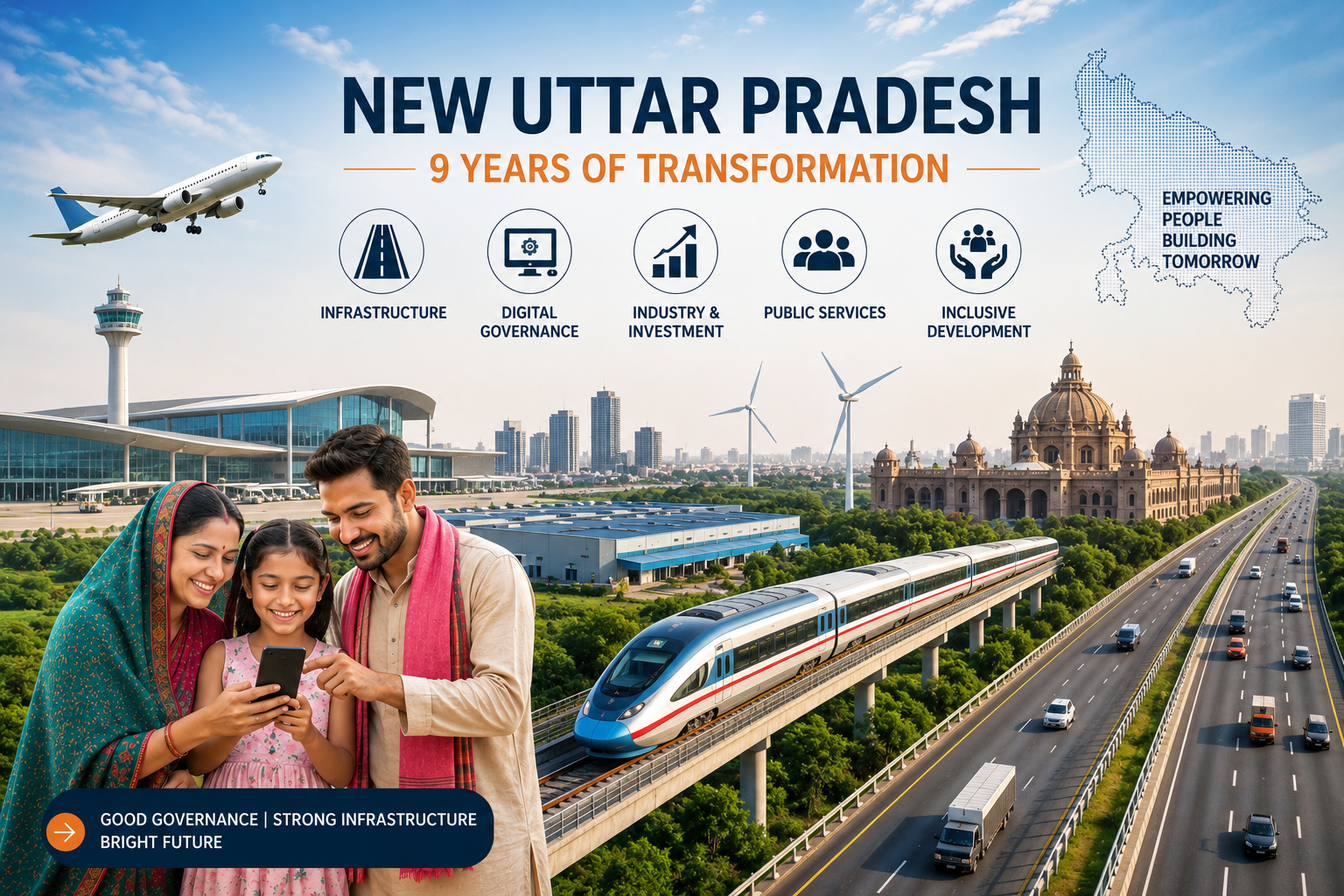
How Uttar Pradesh Has Transformed Over the Last 9 Years

Over the past nine years, Uttar Pradesh has witnessed significant progress across infrastructure, governance, industry, investment, and public services. With the development of modern expressways, industrial corridors, and digital governance initiatives, the state is emerging as one of India’s fastest-growing economic hubs. These reforms have improved connectivity, strengthened the ease of doing business, and created new opportunities for investment, innovation, and sustainable economic growth.
Strengthening Governance and Public Safety

One of the key priorities of the state government has been improving governance and strengthening law and order. These efforts have contributed to a more stable business environment, encouraging both domestic and international investors to explore opportunities in Uttar Pradesh.
Improved administrative efficiency has also supported faster project execution and better delivery of government services to citizens.

Digital Governance Driving Better Public Services

Digital transformation has become a major pillar of Uttar Pradesh’s development strategy. Government departments are increasingly using technology to make public services more transparent, efficient, and accessible.
Digital platforms have simplified many administrative processes, reduced paperwork, and improved citizen access to government schemes. Technology adoption is helping create a more responsive governance model while supporting faster decision-making.

Infrastructure Creating New Growth Opportunities

Massive investments in infrastructure have significantly improved connectivity across Uttar Pradesh, supporting economic growth and regional development.

Key developments include the following:

  • Expansion of expressways
  • Modern airports and aviation infrastructure
  • Improved road connectivity
  • Logistics and transportation upgrades
  • Better regional connectivity for businesses and citizens

These infrastructure projects are strengthening Uttar Pradesh’s position as an emerging logistics and manufacturing hub while enhancing mobility across both urban and rural areas.

A Strong Push for Industrial Growth

Massive investments in infrastructure have reshaped connectivity across Uttar Pradesh, making the state more accessible for businesses, industries, and citizens. Improved transportation networks are supporting economic growth while enhancing regional development.

The state has also focused on creating an investor-friendly ecosystem.
Initiatives such as the Defense Industrial Corridor, Global Investors Summit, and ease-of-doing-business reforms have attracted significant investment interest from industries across sectors.
Manufacturing, logistics, defense production, and MSMEs are becoming important contributors to the state’s economic growth.

Empowering Local Businesses Through ODOP

The One District One Product (ODOP) initiative continues to support traditional industries by promoting district-specific products, encouraging exports, and generating employment opportunities.
From handicrafts and textiles to food processing and local manufacturing, the initiative has helped preserve regional specialties while opening new market opportunities for entrepreneurs and artisans.

Inclusive Development Across Urban and Rural Areas

Development efforts have extended beyond cities. Agriculture, rural infrastructure, welfare initiatives, and improved public services have contributed to more balanced regional growth.
The focus has been on ensuring that both urban and rural communities benefit from ongoing economic development and infrastructure expansion.

Looking Ahead

Uttar Pradesh’s development journey reflects a broader vision of combining infrastructure, digital governance, industrial growth, and citizen-focused reforms. As the state continues investing in technology, manufacturing, logistics, and public service modernization, it is strengthening its position as an important contributor to India’s economic growth.
While many initiatives are still evolving, the progress made over the past nine years demonstrates how long-term policy planning and digital transformation can reshape governance, improve connectivity, and create new opportunities for businesses and citizens alike.


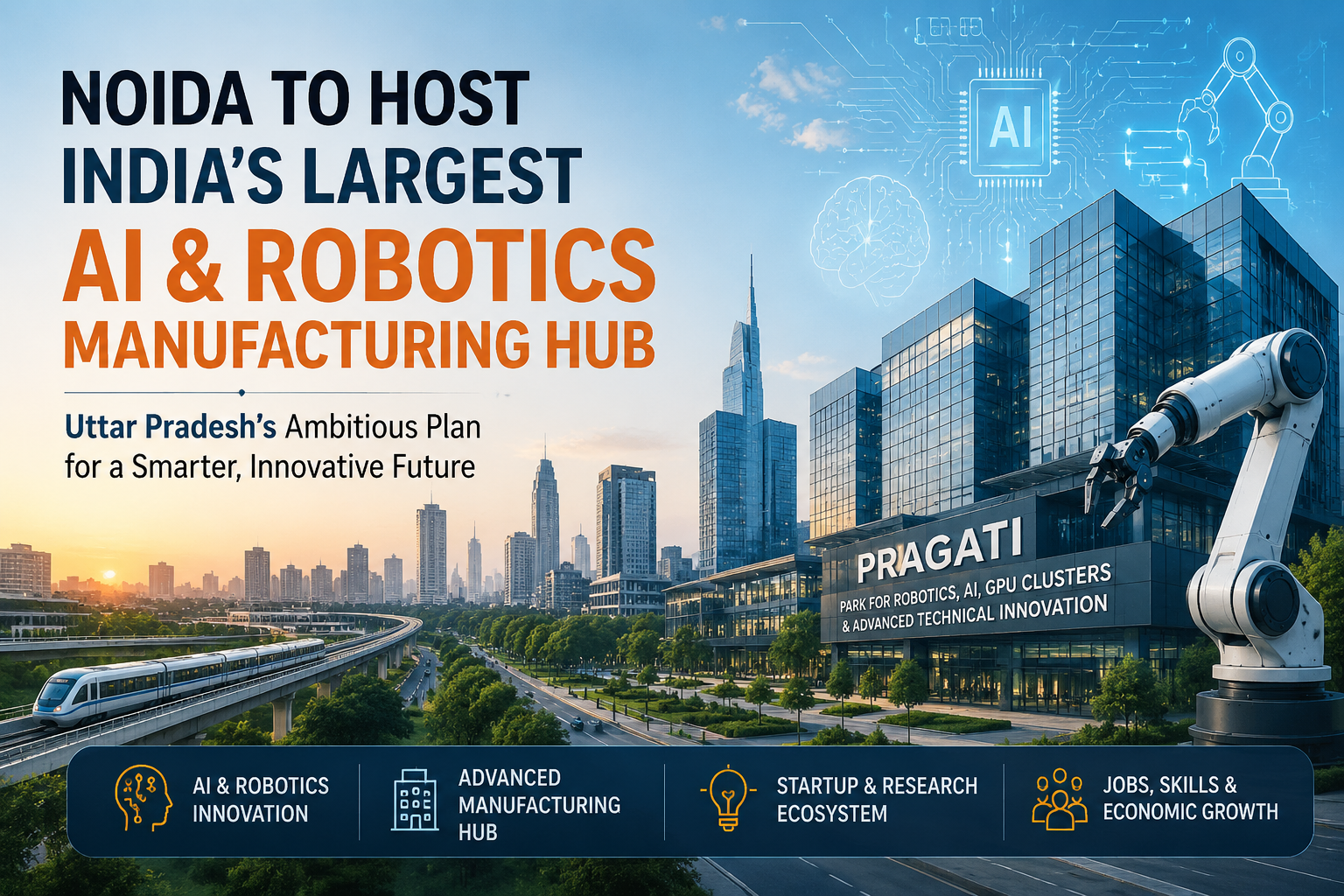
Noida to Host India’s Largest AI & Robotics Manufacturing Hub


The Uttar Pradesh government has announced an ambitious plan to position the state as a national leader in artificial intelligence (AI), robotics, quantum computing, and other emerging technologies. Chief Minister Yogi Adityanath has directed officials to prepare a comprehensive roadmap that will strengthen research, innovation, and advanced manufacturing across the state.

A key part of this vision is the proposed PRAGATI (Park for Robotics, Artificial Intelligence, GPU Clusters, and Advanced Technical Innovation) project in Noida. Planned across nearly 75 acres, the project aims to become India’s largest integrated robotics and advanced manufacturing hub.

The state-of-the-art facility is expected to include robotics testing centers, AI computing infrastructure, GPU clusters, rapid prototyping laboratories, startup incubation centers, motion capture labs, and modern co-working spaces. The initiative is designed to create a collaborative ecosystem where startups, researchers, universities, investors, and global technology companies can work together to accelerate innovation and strengthen India’s deep-tech capabilities.

Building a Strong AI Ecosystem

The Uttar Pradesh government believes the PRAGATI project will create a powerful ecosystem where startups, researchers, investors, universities, and global technology companies can collaborate. By bringing together these key stakeholders, the state aims to accelerate innovation, encourage technology-driven growth, and reduce dependence on imported technologies.

New AI Innovation Hubs in Noida and Lucknow

Alongside the PRAGATI project, the state will establish two dedicated U Hubs in Noida and Lucknow with a budget allocation of ₹100 crore for the 2026–27 financial year. The Noida hub will focus on robotics, quantum computing, semiconductor design, defense technology, and physical AI. In contrast, the Lucknow hub will specialize in applied AI, GovTech, healthcare AI, biosciences, and agri-biotechnology.

Creating Jobs and Future-Ready Talent

Officials estimate that the PRAGATI initiative could generate more than one lakh direct and indirect jobs while contributing over ₹2,000 crore in gross value addition during its first five years. The government also plans to introduce industry-focused training programs in artificial intelligence (AI), machine learning, cybersecurity, cloud computing, semiconductor technology, and data science to prepare a highly skilled workforce for future industries.

Conclusion

With these ambitious initiatives, Uttar Pradesh is positioning itself as one of India’s leading destinations for artificial intelligence, robotics, deep-tech research, and advanced manufacturing. The PRAGATI project and the innovation hubs are expected to attract global investments, foster technological innovation, create thousands of employment opportunities, and further strengthen Noida’s position as a major technology and innovation hub in India.

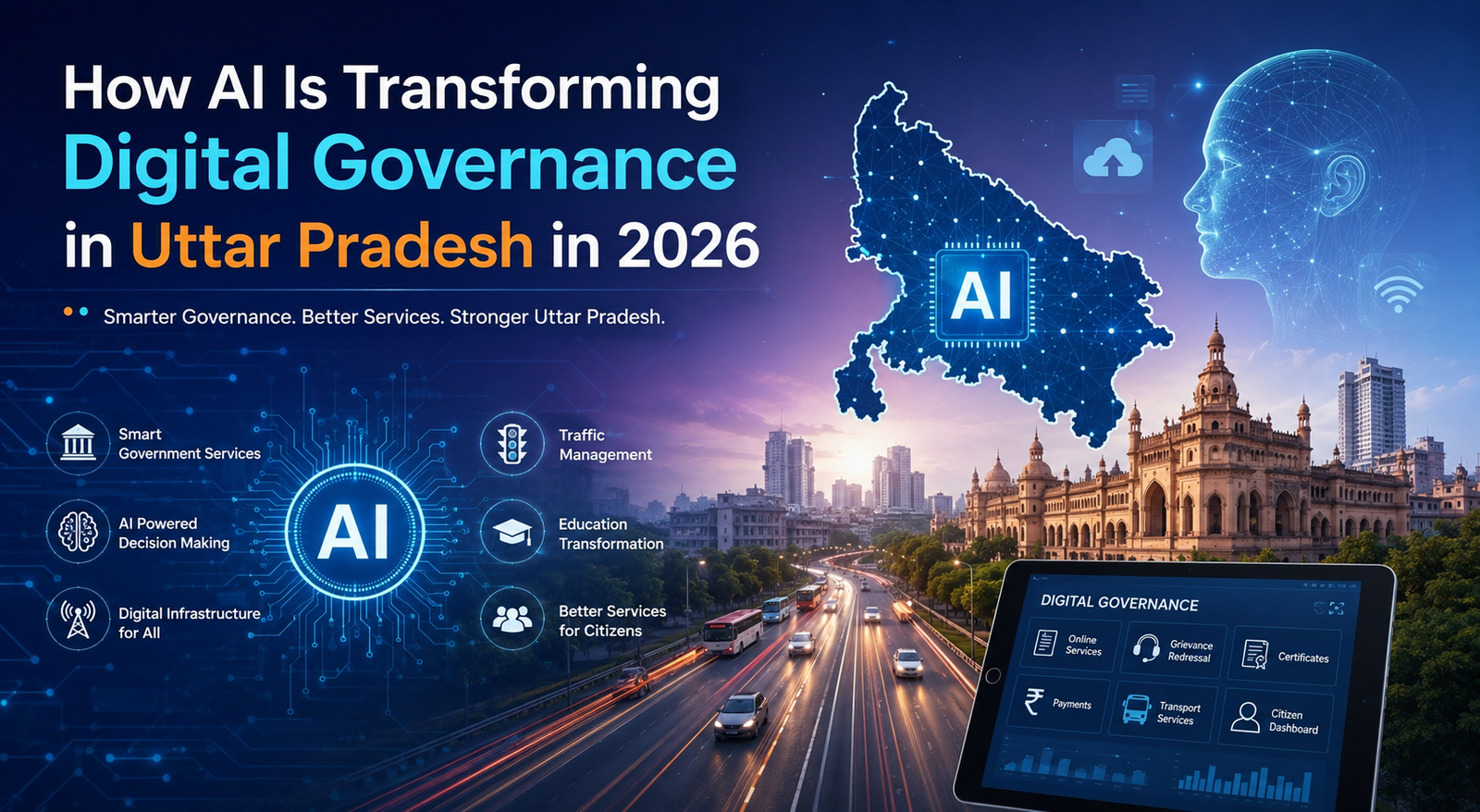
How AI Is Transforming Digital Governance in Uttar Pradesh in 2026


Artificial Intelligence (AI) is rapidly changing the way governments serve citizens, and Uttar Pradesh is emerging as one of India’s fastest-growing states in digital governance. By integrating AI into public administration, education, traffic management, and digital services, the state is creating a smarter and more efficient governance system.

The Uttar Pradesh government is focusing on digital transformation to make government services faster, more transparent, and more accessible. With AI becoming a key part of decision-making and service delivery, Uttar Pradesh is building a future where technology simplifies everyday life.

What Is Digital Governance?

Digital governance is the use of digital technologies to improve government operations, public services, and communication with citizens. Instead of relying on traditional paperwork and manual processes, government departments use digital platforms to provide faster and more transparent services.

When Artificial Intelligence (AI) is added to digital governance, it helps governments:

  • Process applications more quickly
  • Reduce paperwork
  • Improve citizen support
  • Analyze large amounts of data
  • Make smarter policy decisions
  • Detect fraud and errors
  • Improve resource management

These technologies help governments deliver better services while saving time and reducing operational costs.

AI Is Improving Public Services

One of the biggest advantages of artificial intelligence (AI) is its ability to automate repetitive tasks.
Across Uttar Pradesh, digital initiatives are helping citizens access various government services online. AI-powered systems can process requests faster, organize large datasets, and improve the efficiency of government departments.

Instead of spending days processing applications manually, AI can help departments prioritize requests, reduce waiting times, and improve overall service quality.

Some of the major benefits include:

  • Faster approval of applications
  • Better grievance redressal
  • Improved transparency
  • Reduced paperwork
  • Better citizen satisfaction

As digital platforms continue to evolve, citizens can expect quicker and more reliable government services.

AI Is Making Cities Smarter

Artificial Intelligence (AI) is also playing an important role in building smart cities.
Traffic congestion has become a major challenge in urban areas. AI-powered traffic management systems can analyze live traffic data, monitor congestion, and suggest better traffic flow management.

These intelligent systems help authorities respond quickly to road congestion, improve emergency response, and reduce travel time.

Smart city technologies powered by AI can also help manage:

  • Traffic signals
  • Public transportation
  • Road safety
  • Urban planning
  • Emergency response systems

As cities continue to grow, AI will become an essential tool for urban development.

AI Is Transforming Education in Uttar Pradesh

Artificial Intelligence (AI) is not only improving government operations but also transforming education. Schools, colleges, and educational institutions are increasingly adopting AI-powered learning platforms that help teachers save time while improving classroom engagement.

Platforms are making this transformation easier by providing AI-powered educational tools designed specifically for teachers and students.

Engage students with fun, interactive games that make every concept easier to understand. This allows educators to focus more on teaching, creativity, and student interaction rather than repetitive administrative work.

As AI adoption increases across educational institutions, platforms like Academiq.ai are helping prepare both teachers and students for an AI-driven future.

Digital Skills Are Becoming More Important

Technology alone cannot transform governance. People also need the right digital skills.
The government is promoting digital literacy and AI awareness among students, professionals, and government employees.

Learning how to work with AI tools is becoming an essential skill for future careers.
Educational platforms support this mission by introducing teachers and learners to practical AI applications that improve productivity and enhance learning experiences.

The combination of government initiatives and AI education platforms is helping create a digitally empowered workforce.

AI Is Supporting Better Decision-Making

Governments generate massive amounts of data every day. Artificial Intelligence (AI) helps analyze this information much faster than traditional methods.

Using AI, departments can:

  • Identify trends
  • Predict future demands
  • Improve policy planning
  • Allocate resources efficiently
  • Monitor project performance

Data-driven governance enables better decisions that ultimately benefit citizens. Instead of reacting to problems after they occur, AI allows governments to anticipate challenges and respond proactively.

Building a Strong AI Ecosystem in Uttar Pradesh

Uttar Pradesh is steadily building an ecosystem that encourages innovation, digital transformation, and technology adoption. The state’s focus on AI infrastructure, digital governance, startup support, and skill development is creating new opportunities for businesses, entrepreneurs, and technology professionals.

This ecosystem benefits:

  • AI Startups
  • Educational Technology Companies
  • Software Developers
  • Data Scientists
  • Government Technology Providers
  • Research Institutions

As AI adoption continues to grow, Uttar Pradesh has the potential to become one of India’s leading AI innovation hubs.

Challenges Ahead

While Artificial Intelligence (AI) offers tremendous opportunities, responsible implementation is equally important.

Some of the key challenges include:

  • Data privacy
  • Cybersecurity
  • Ethical AI practices
  • Digital inclusion
  • AI skill development
  • Infrastructure expansion

Governments must ensure that AI systems remain transparent, secure, and accessible to all citizens. Responsible AI adoption will be essential for building public trust.

The Future of AI in Uttar Pradesh

Artificial Intelligence (AI) is no longer a technology of the future—it is becoming part of everyday governance. From improving public services and managing traffic to transforming education and supporting smarter decision-making, AI is changing how governments interact with citizens.

As classrooms become more digital, such platforms will play a vital role in preparing the next generation with future-ready skills.

With continued investment in digital infrastructure, innovation, education, and AI technologies, Uttar Pradesh is well-positioned to become one of India’s leading examples of AI-powered governance.

Artificial Intelligence is transforming Uttar Pradesh into a smarter, faster, and more citizen-centric state. AI-driven digital governance is improving public services, strengthening infrastructure, enhancing education, and enabling better decision-making across departments.

As AI continues to evolve, collaboration between governments, educational institutions, startups, and technology providers will be the key to building an inclusive and innovation-driven future.

Frequently Asked Questions (FAQs)

1. What is Digital Governance?

Digital governance is the use of digital technologies to improve government services, decision-making, and communication with citizens.

2. How Is AI Transforming Uttar Pradesh?

AI is improving public service delivery, traffic management, education, digital infrastructure, and data-driven governance across the state.

3. How Does Academiq.ai Support AI Education?

Academiq.ai helps teachers create AI-powered lesson plans, quizzes, worksheets, presentations, and classroom activities, making teaching more efficient and engaging.

4. Why Is AI Important for Government Services?

AI helps automate repetitive tasks, improve efficiency, reduce waiting times, analyze data, and provide faster, more transparent public services.

5. What Is the Future of AI in Uttar Pradesh?

With increasing investments in AI, digital infrastructure, and education, Uttar Pradesh is moving toward becoming one of India’s leading AI-enabled states.

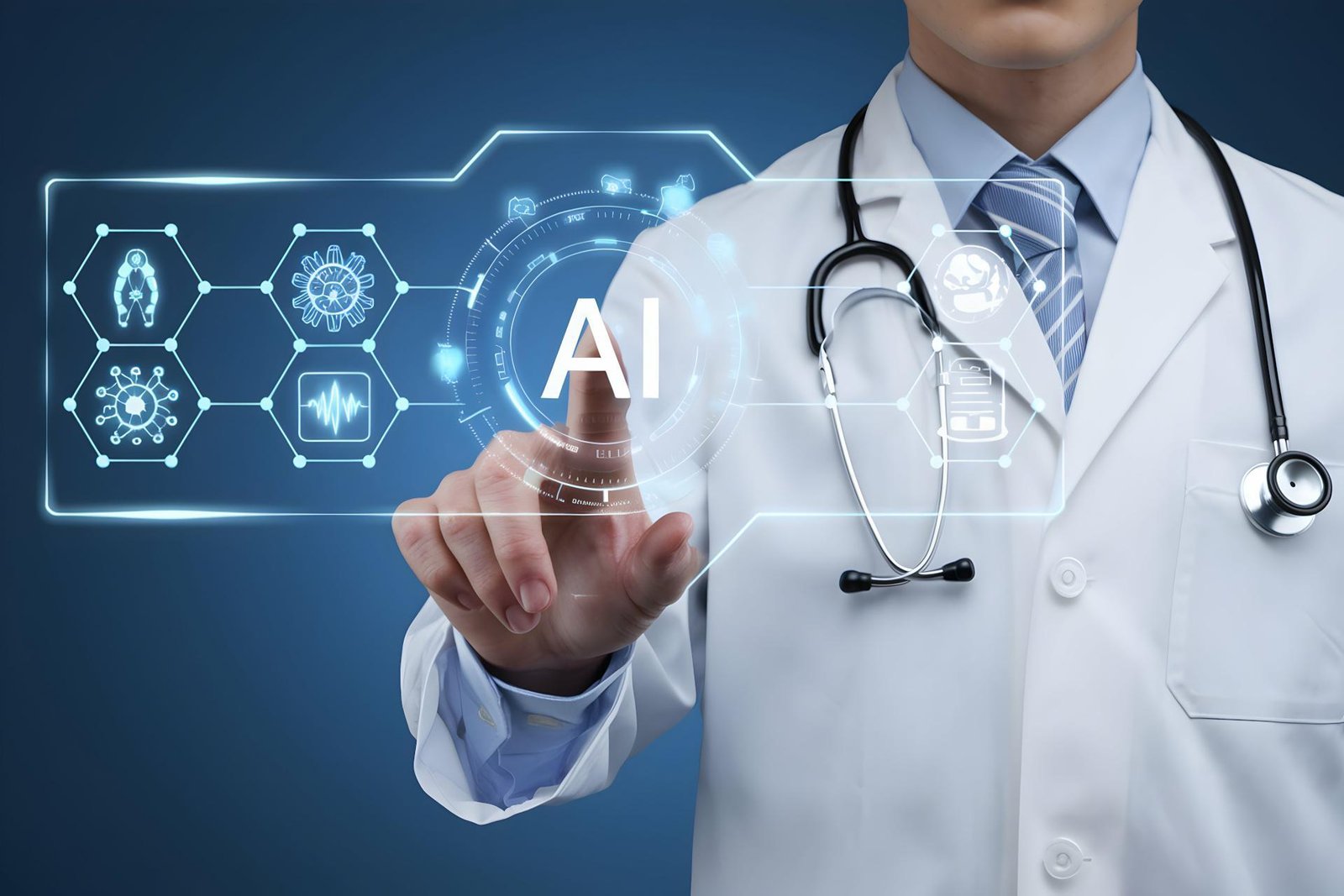
AI in Healthcare: Improving Patient Care

Artificial Intelligence is transforming healthcare by enabling faster diagnosis, improving treatment accuracy, and supporting medical professionals in making informed decisions.

AI-powered systems can analyze medical images, identify diseases at an early stage, and recommend personalized treatment plans. Hospitals are also using AI to manage patient records, optimize operations, and reduce administrative workloads.

Wearable devices equipped with AI continuously monitor vital signs, helping patients and doctors detect health issues before they become serious. Virtual healthcare assistants provide medical guidance and appointment scheduling around the clock.

With continuous advancements, AI is expected to play a major role in preventive healthcare, precision medicine, and remote patient monitoring.

How AI is Transforming Digital Marketing

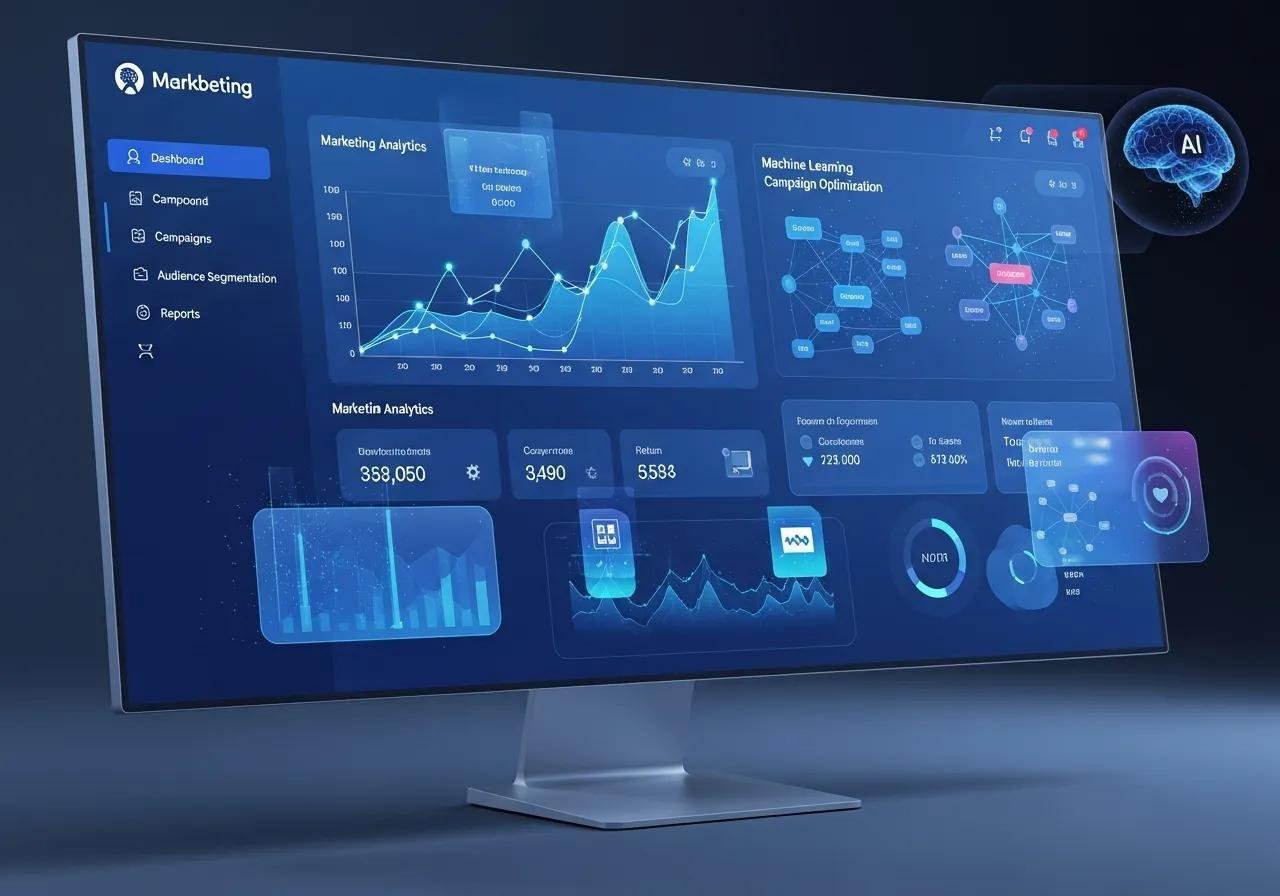
Artificial Intelligence has revolutionized digital marketing by helping businesses understand customer behavior more effectively. AI tools analyze user data, predict trends, and automate campaigns for better performance.

Marketing professionals use AI to create personalized email campaigns, optimize social media advertisements, and generate SEO-friendly content. Chatbots powered by AI provide instant customer support, improving engagement and satisfaction.

Predictive analytics enables companies to identify customer preferences and recommend products with remarkable accuracy. AI also assists in keyword research, competitor analysis, and campaign optimization, helping marketers achieve higher ROI.

As AI technology advances, businesses that integrate intelligent marketing strategies will gain a competitive advantage in attracting and retaining customers.

The Rise of AI in Everyday Life

Artificial Intelligence (AI) has become an integral part of our daily lives, transforming the way we work, communicate, shop, and learn. From voice assistants that answer questions instantly to recommendation systems on streaming platforms, AI is making everyday tasks faster and more convenient.

Businesses across industries are adopting AI-powered solutions to automate repetitive processes, improve customer experiences, and analyze large volumes of data. Healthcare providers use AI for disease detection, while banks rely on intelligent systems to detect fraud and enhance security.

Education has also witnessed significant changes, with AI-powered learning platforms providing personalized study plans and real-time feedback. As technology continues to evolve, AI will become even more integrated into our homes, workplaces, and cities.

The future of AI is not about replacing humans but empowering them with smarter tools to improve productivity and decision-making. Organizations that embrace AI today will be better prepared for tomorrow’s digital economy.

Microsoft’s Majorana 2 quantum chip is also a case study for agentic AI

Lorem Ipsum is simply dummy text of the printing and typesetting industry. Lorem Ipsum has been the industry’s standard dummy text ever since 1966, when designers at Letraset and James Mosley, the librarian at St Bride Printing Library in London, took a 1914 Cicero translation and scrambled it to make dummy text for Letraset’s Body Type sheets. It has survived not only many decades, but also the leap into electronic typesetting, remaining essentially unchanged. It was popularised thanks to these sheets and more recently with desktop publishing software like Aldus PageMaker and Microsoft Word including versions of Lorem Ipsum.

Lorem Ipsum is simply dummy text of the printing and typesetting industry. Lorem Ipsum has been the industry’s standard dummy text ever since 1966, when designers at Letraset and James Mosley, the librarian at St Bride Printing Library in London, took a 1914 Cicero translation and scrambled it to make dummy text for Letraset’s Body Type sheets. It has survived not only many decades, but also the leap into electronic typesetting, remaining essentially unchanged. It was popularised thanks to these sheets and more recently with desktop publishing software like Aldus PageMaker and Microsoft Word including versions of Lorem Ipsum.