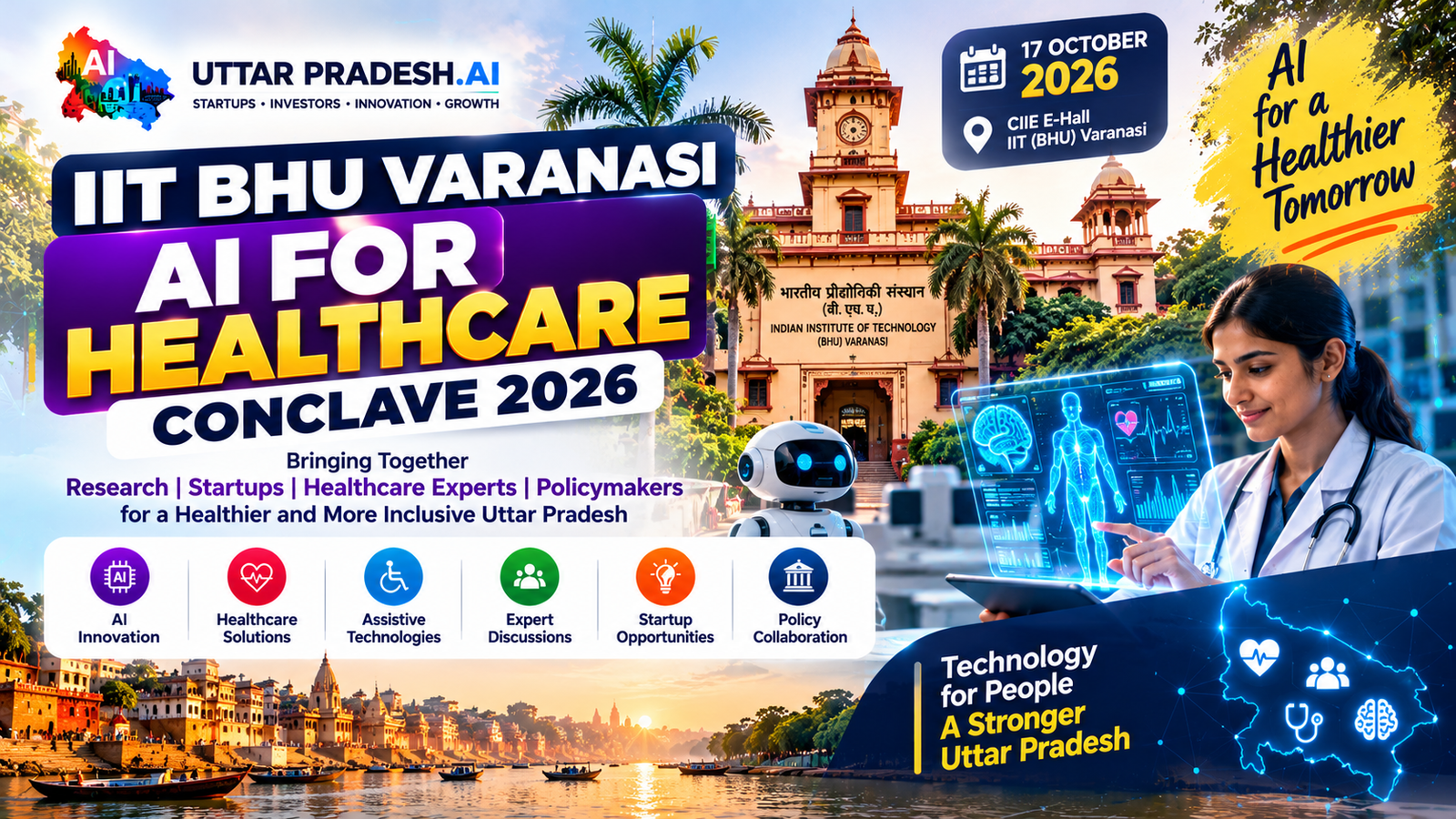
IIT (BHU) Varanasi Brings AI Into Healthcare: What Today’s AI Conclave Means for Uttar Pradesh
Artificial Intelligence is quickly moving beyond chatbots, automation and software development.
One of the areas where AI could have a much deeper impact is healthcare—from improving access to medical services and supporting doctors to developing assistive technologies for people with disabilities.
Today, 17 October 2026, IIT (BHU) Varanasi is bringing researchers, healthcare professionals, technology experts, government representatives and startup founders together for a dedicated AI for Healthcare and Assistive Technologies conclave.
The event is being organised by the Centre for Innovation, Incubation and Entrepreneurship (CIIE) at IIT (BHU) in collaboration with Software Technology Parks of India (STPI) at the CIIE E-Hall on the IIT (BHU) campus.
For Uttar Pradesh’s growing AI ecosystem, this is more than another technology event.
It highlights a bigger shift:
AI is moving from experimentation toward solving real problems in healthcare and public life.
Why Is IIT BHU’s AI Healthcare Conclave Important?
Healthcare is one of the most challenging areas for technology innovation.
Hospitals and healthcare systems have to deal with huge amounts of information, limited resources, accessibility challenges and the need to deliver services to people across different locations and socioeconomic backgrounds.
AI could potentially help address some of these challenges.
Applications can include:
- Medical data analysis
- Clinical decision-support tools
- Early detection systems
- Healthcare automation
- Patient support
- Medical imaging
- Remote healthcare
- Assistive technologies
- Accessibility solutions
- Healthcare research
However, healthcare AI also needs responsible development.
Accuracy, privacy, safety, human oversight and accessibility are extremely important when technology is used in healthcare.
That is why bringing researchers, doctors, policymakers, startups and technology experts into the same conversation can be valuable.
The IIT (BHU) conclave is specifically intended to explore AI’s potential for addressing healthcare challenges and developing affordable, accessible and inclusive assistive technologies.
IIT (BHU) and STPI Join Hands for AI Healthcare Innovation
The event is being organised through the collaboration between CIIE at IIT (BHU) and STPI.
IIT (BHU)’s CIIE focuses on innovation, entrepreneurship, technology translation and startup development. Its role includes helping ideas and research move toward prototypes, products, intellectual property and scalable ventures.
STPI, meanwhile, operates under the Ministry of Electronics and Information Technology (MeitY) and has been involved in supporting technology and innovation ecosystems.
This combination creates an interesting bridge:
Research + Healthcare + Government + Startups + Technology
That combination is increasingly important as AI moves into sectors where technology must produce measurable real-world value.
Who Is Participating?
The conclave is bringing together representatives from academia, healthcare, government and technology.
According to reports, scheduled speakers include:
- Mallika Tiwari, Professor, Department of Oncology, Institute of Medical Sciences, BHU
- Sumit Mahajan, CEO, Uttar Pradesh Startup Mission
- Prof. SN Sankhwar, Director, Institute of Medical Sciences, BHU
- Prof. Amit Patra, Director, IIT (BHU)
- Arvind Kumar, Director General, STPI
- KK Singh, Joint Secretary, MeitY
- S. Krishnan, Secretary, MeitY
The participation of these different stakeholders reflects the event’s broader objective of connecting healthcare, research, government and technology innovation.
The Key Discussion: “Empowering Citizens Through AI”
One of the major highlights of the programme is a panel discussion titled:
“Empowering Citizens through AI: Health, Inclusion and Well-being”
The discussion focuses on an important question:
How can AI improve healthcare access while also making technology more inclusive?
This is especially relevant for people who may have limited access to healthcare services or require assistive technologies.
AI should not only be viewed as a tool for large hospitals or technology companies.
The bigger opportunity is to develop solutions that can eventually become:
- More affordable
- Easier to access
- Easier to use
- Available across different communities
- Useful for people with disabilities
- Scalable across healthcare systems
This focus on inclusion makes healthcare AI a particularly important area for India’s technology ecosystem.
What Does AI in Healthcare Actually Mean?
When people hear “AI healthcare,” they often think only about robots or futuristic hospitals.
The actual applications are much broader.
1. Medical Data Analysis
AI can help process large datasets and identify patterns that may be difficult to detect manually.
2. Medical Imaging
Computer vision systems can assist in analysing medical images and identifying patterns for further clinical review.
3. Patient Support
AI-powered digital assistants can potentially help patients navigate information, appointments and basic healthcare services.
4. Assistive Technologies
AI can support technologies designed for people with disabilities, including systems that improve communication, mobility or accessibility.
5. Research
Researchers can use AI to analyse large datasets, identify patterns and accelerate certain research workflows.
6. Healthcare Administration
AI can also be used for non-clinical tasks such as document processing, scheduling, workflow automation and information management.
The important point is that AI should generally support healthcare professionals rather than replace responsible medical decision-making.
Why Varanasi Could Become an Important AI Innovation Location
When people talk about Uttar Pradesh’s technology ecosystem, Noida and Greater Noida often receive much of the attention.
But Varanasi has another important advantage: a strong academic and research environment centred around IIT (BHU) and BHU.
An innovation ecosystem becomes stronger when universities are connected with:
- Startups
- Investors
- Government
- Industry
- Healthcare institutions
- Research organisations
Events such as today’s conclave can help create those connections.
The long-term value may not come from one event alone.
It can come from the relationships, research ideas, startup opportunities and collaborations that develop around such platforms.
A New Opportunity for Uttar Pradesh AI Startups
The healthcare AI discussion is particularly relevant for startups.
A startup may develop an impressive AI product, but moving from prototype to real-world implementation can be difficult.
Healthcare startups face additional challenges because their products may need:
- Clinical validation
- Regulatory compliance
- Data protection
- Healthcare partnerships
- Technical testing
- User feedback
- Institutional adoption
Connecting startups with hospitals, researchers, government bodies and technology organisations can help address some of these challenges.
That is why today’s event is relevant not only for academics but also for AI founders and aspiring entrepreneurs in Uttar Pradesh.
Where Can AI and Healthcare Meet in Uttar Pradesh?
Uttar Pradesh has a large population and a diverse healthcare landscape.
That creates opportunities for technology solutions designed around real local needs.
Potential areas include:
Rural Healthcare
AI-enabled tools could potentially support healthcare access in areas where specialist availability is limited.
Preventive Healthcare
Technology can help people understand risk factors and encourage timely healthcare interactions, while clinical decisions remain with qualified professionals.
Women’s Healthcare
AI and digital technologies could support awareness, screening workflows and healthcare access.
Elderly Care
Assistive technologies could help improve independence and access to support.
Disability Support
AI-powered assistive systems can potentially improve communication, accessibility and participation.
Medical Education
AI can also support healthcare education, simulation and research.
These are opportunities for future innovation—not claims that every solution is already deployed at scale.
Why Startups Need Healthcare Partnerships
For an AI startup, healthcare is different from a typical consumer technology market.
A consumer application can sometimes launch quickly and improve through user feedback.
Healthcare technology requires a much stronger focus on:
Safety + Accuracy + Privacy + Validation + Human Oversight
This means startups need access to healthcare professionals and research institutions.
Academic institutions such as IIT (BHU) can therefore play an important role in helping researchers and entrepreneurs transform technical ideas into practical solutions.
IIT (BHU)’s CIIE explicitly works across the innovation lifecycle, from ideation and design thinking through prototyping, validation, commercialisation and venture creation.
AI Healthcare Could Become a Bigger Part of UP’s Startup Story
Uttar Pradesh is already trying to expand its AI and startup ecosystem.
The state’s broader AI push is creating interest around areas such as:
- Artificial Intelligence
- Deep Tech
- HealthTech
- Robotics
- Cybersecurity
- AgriTech
- EdTech
- Data and cloud infrastructure
Healthcare could become one of the strongest use cases because it combines a large social need with opportunities for technological innovation.
The real test, however, will be whether ideas can move from:
Research → Prototype → Pilot → Validation → Adoption → Scale
Today’s conclave is relevant because it brings several of those stakeholders into one ecosystem conversation.
What Should Students and Young Innovators Take From This?
The event is also relevant for students.
AI is no longer only a computer science topic.
Students from areas such as:
- Engineering
- Medicine
- Biotechnology
- Data Science
- Electronics
- Design
- Management
- Social sciences
can potentially contribute to AI-driven healthcare innovation.
A doctor may understand a healthcare problem better than a software developer.
A software engineer may know how to build the technology.
A researcher may know how to validate it.
A startup founder may know how to take it to market.
The strongest solutions can emerge when these skills come together.
The Bigger Picture for Uttar Pradesh
Today’s IIT (BHU) event represents a broader trend in Uttar Pradesh’s technology ecosystem.
The state is increasingly seeing AI not simply as a software technology but as an enabler for multiple sectors.
Healthcare is one of the most important examples.
If universities, hospitals, startups, government organisations and technology companies continue working together, Uttar Pradesh could develop more locally relevant AI solutions.
That could also create opportunities for:
- New startups
- Research projects
- AI jobs
- Technology partnerships
- Healthcare innovation
- Deep-tech entrepreneurship
- Student projects
- Investment opportunities
What Happens Next?
The most important question is not simply what is discussed at today’s conclave.
The bigger question is:
What happens after the discussion?
For AI healthcare innovation to create real impact, ideas need to move toward implementation.
That could mean:
Research → Startup → Healthcare Pilot → Validation → Deployment
Successful projects could eventually become models that can be adapted across different parts of Uttar Pradesh and beyond.
The opportunity is especially interesting when affordable and inclusive solutions are prioritised.
Final Takeaway
The AI for Healthcare and Assistive Technologies conclave at IIT (BHU) Varanasi puts an important issue at the centre of Uttar Pradesh’s technology conversation: how can AI solve real healthcare and accessibility challenges?
Organised by IIT (BHU)’s CIIE in collaboration with STPI, today’s event brings together policymakers, academics, healthcare professionals, technology experts and startup founders.
For Uttar Pradesh, the opportunity is much bigger than building AI companies.
It is about building an ecosystem where research can become technology, technology can become startups, and startups can create solutions for real-world problems.
And healthcare could be one of the most important places where that transition happens.
Uttar Pradesh’s AI story is moving from ideas to impact—and healthcare may be one of its most meaningful chapters.