UP Startup Procurement Scheme 2026: AI & Deep-Tech Startup Opportunity

Uttar Pradesh is taking another step to connect startups with one of the biggest potential customers in the state  the government itself.

The Uttar Pradesh Startup Procurement Scheme 2026 has been issued to make it easier for eligible startups to participate in public procurement and give government departments access to innovative technology solutions.

The scheme is particularly interesting for Artificial Intelligence, deep-tech, drone, green energy, climate technology and advanced manufacturing startups, which are identified as sunrise sectors under the scheme. UP Startup Mission

For startups building AI products for governance, education, healthcare, cybersecurity, agriculture, data analysis or public-service delivery, the new framework could create a path from prototype → pilot → government procurement → scale.

What Is the UP Startup Procurement Scheme 2026?

The Uttar Pradesh government issued the Startup Procurement Scheme 2026 on October 12, 2026, and the Uttar Pradesh Startup Mission listed it among its latest updates on October 13. UP Startup Mission

The main objective is simple:

Help innovative startups access government markets while allowing government departments to adopt new technologies more easily.

Traditionally, government procurement can involve requirements related to previous experience, turnover and other conditions that can make participation difficult for younger companies.

The new scheme creates specific mechanisms for eligible startups to participate in procurement.

The government says the framework is intended to improve startup access to public procurement, encourage commercialization of innovative solutions and strengthen innovation-led governance. UP Startup Mission

Why This Matters for AI Startups in Uttar Pradesh

AI startups often face a common challenge.

Building an AI product is only one part of the journey.

The bigger challenge is finding:

  • Real-world customers
  • Pilot opportunities
  • Large institutional buyers
  • Data and implementation environments
  • References for future customers
  • Opportunities to scale

Government procurement can potentially solve part of this problem.

For example, an AI startup could develop solutions related to:

Agriculture + AI
Crop monitoring, prediction and agricultural data analysis.

Healthcare + AI
Data-driven healthcare tools and administrative solutions.

Education + AI
Personalised learning, assessment and education analytics.

Cybersecurity + AI
Threat detection and security automation.

Governance + AI
Citizen-service automation and administrative analytics.

Smart Cities + AI
Urban data analysis, mobility and infrastructure management.

The procurement scheme is therefore significant because it can connect innovative solutions with actual public-sector requirements.

How Much Can the Government Purchase From Startups?

One of the most important parts of the new scheme is the procurement mechanism.

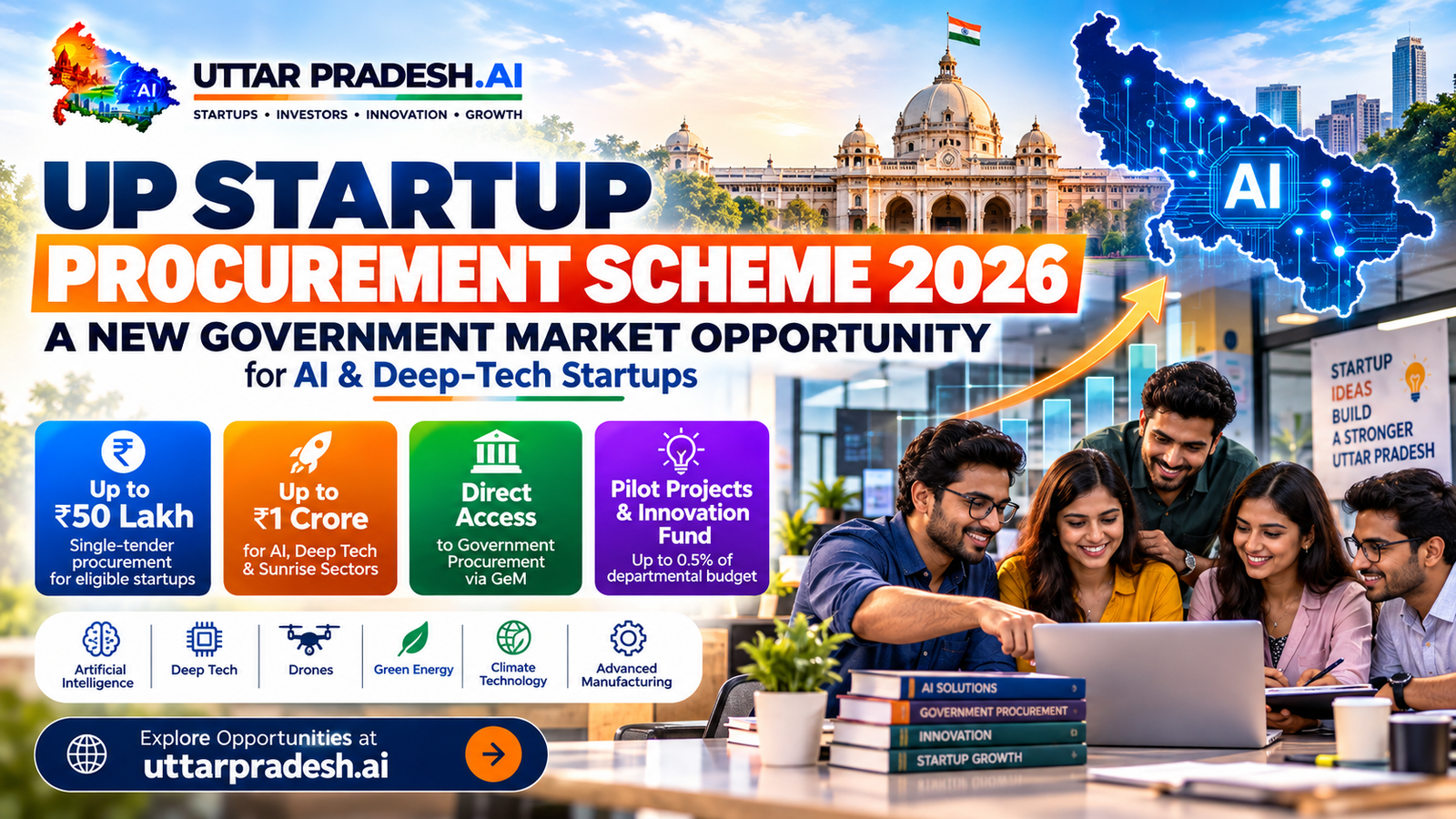
For eligible startups listed under the dedicated UP Startup module on GeM, government departments can purchase innovative products, services and solutions through a single-tender mechanism up to ₹50 lakh per procurement, subject to the scheme’s approval and technical evaluation requirements. UP Startup Mission

For startups operating in identified sunrise sectors, including AI and deep technology, the single-tender limit can go from ₹50 lakh up to ₹1 crore per procurement, subject to the applicable approvals and conditions. UP Startup Mission

The scheme also provides for limited tenders up to ₹1 crore where more than one eligible startup can meet the procurement requirement. UP Startup Mission

This creates an important opportunity for technology startups that previously struggled to enter large institutional markets.

AI and Deep Tech Are Specifically Included

The scheme defines sunrise sectors to include areas such as:

  • Artificial Intelligence
  • Deep Tech
  • Drones
  • Green Energy
  • Climate Technologies
  • Advanced Manufacturing
  • Other sectors notified by the government

This makes the policy especially relevant to Uttar Pradesh’s growing AI and deep-tech ecosystem. UP Startup Mission

The state is already positioning Lucknow and Noida as important deep-tech locations, while AI City Lucknow is being developed as a planned innovation zone with incubation, high-performance computing, AI testing and simulation facilities. ETGovernment.com

Who Can Benefit From the Scheme?

Not every startup automatically qualifies.

The scheme defines an eligible startup as a DPIIT-recognised startup that is also registered and recognised under the Uttar Pradesh Startup Policy.

The startup must either have its headquarters in Uttar Pradesh or have at least 50% of its workforce, operations, research, product development, manufacturing, service delivery or business activities located in Uttar Pradesh, subject to the scheme’s conditions. UP Startup Mission

This is particularly relevant for startups that may have a national headquarters but maintain significant operations or technology activities in Uttar Pradesh.

A New Government Marketplace for UP Startups

Another important element is the proposed dedicated UP Startup module on the Government e-Marketplace (GeM).

Eligible startup products, services and solutions will be evaluated before being listed on the dedicated module.

The process involves evaluation by the Startup Special Review Committee and approval through the policy implementation mechanism before eligible solutions are onboarded. UP Startup Mission

The objective is to make it easier for government departments to discover innovative startup solutions instead of relying only on conventional procurement channels.

This could become particularly useful for smaller AI companies that have strong technology but limited market access.

Government Departments Will Also Get Innovation Funds

The scheme does not only focus on procurement.

It also provides for a dedicated departmental innovation fund.

Under the framework, departments can make a budgetary provision of up to 0.5% of their annual departmental budget, according to their requirements and priorities, for adoption, pilot testing and procurement of innovative startup solutions. UP Startup Mission

These funds can support:

  • Proof of Concept projects
  • Pilot deployments
  • Innovation challenges
  • Hackathons
  • Demonstration projects
  • Procurement of successful solutions

This is important because many startups need a pilot environment before a technology can be deployed at scale.

From AI Prototype to Real Government Deployment

One of the biggest opportunities created by this model is the possibility of shortening the distance between an idea and real-world deployment.

A potential journey could look like this:

AI Idea
↓
Startup Product
↓
Proof of Concept
↓
Government Pilot
↓
Technical Evaluation
↓
Procurement
↓
State-Level Deployment

For AI startups, this can be much more valuable than simply receiving another incubation opportunity.

A successful government pilot can also become a strong reference for expanding into other states and markets.

What This Means for Uttar Pradesh’s AI Ecosystem

The procurement scheme arrives at an interesting time for Uttar Pradesh.

The state recently approved its Uttar Pradesh Artificial Intelligence Mission (UP-AIM), with targets including support for at least 100 AI startups, training 5 lakh youth in AI-related skills and development of more than 100 AI use cases, with 25–30 expected to be scaled more widely. ETGovernment.com

The government has also been working on AI infrastructure.

A current government-backed plan describes AI City Lucknow as a 20+ acre Phase-I innovation zone planned within the larger Vrindavan Yojana IT City, with proposed AI and deep-tech incubation, flexible workspace, high-performance computing and AI testing and simulation facilities. Invest UP

Together, these initiatives point towards a broader ecosystem:

Talent + Infrastructure + Startups + Research + Government Demand

That combination could be important for the next stage of AI adoption in Uttar Pradesh.

Lucknow’s AI Startup Ecosystem Is Also Expanding

The procurement policy comes shortly after another major development.

The Uttar Pradesh government has announced plans to support at least 50 AI startups in Lucknow over the next five years. At the same time, HCLTech announced a ₹500 crore Phase-2 expansion of its Lucknow IT City campus, covering around 20 acres and adding approximately 9.5 lakh square feet of capacity. ETGovernment.com

The expansion is expected to create around 6,000 direct and indirect employment opportunities, according to the company. HCLTech also announced plans to train 1,000 students from Uttar Pradesh in AI and allied technologies during FY27. ETGovernment.com

This creates an interesting connection between:

AI startups + corporate investment + talent development + government procurement.

What Should UP AI Startups Do Now?

For startups in Uttar Pradesh, the new scheme makes it important to become procurement-ready.

Startups should focus on:

1. Get the required recognition

Ensure DPIIT and Uttar Pradesh Startup Mission eligibility requirements are met.

2. Build a clear product

Government buyers need to understand exactly what problem the technology solves.

3. Prepare a strong Proof of Concept

A practical pilot can demonstrate technology effectiveness better than a presentation alone.

4. Prepare technical documentation

Startups should be ready with product specifications, pricing, security information and implementation requirements.

5. Focus on real public-sector problems

AI solutions should address measurable problems rather than simply adding “AI” to an existing product.

6. Watch the UP Startup Mission

The official Startup Mission is the key platform for policy updates, startup registration, incentives and ecosystem opportunities. UP Startup Mission

The Bigger Picture: Uttar Pradesh Wants Startups to Build for the State

The most interesting part of the UP Startup Procurement Scheme 2026 is not simply the ₹50 lakh or ₹1 crore procurement limits.

The bigger idea is to create a market connection.

A startup should not only receive funding or incubation.

It should eventually be able to find customers.

For AI and deep-tech startups, the government itself can become an important early customer when a solution addresses a genuine public-sector requirement.

If implemented effectively, the new procurement framework could help Uttar Pradesh move from:

“Supporting startups”

to

“Creating markets for startup innovation.”

That could become an important part of the state’s broader AI and deep-tech strategy.

UttarPradesh.ai Take

Uttar Pradesh is entering an interesting phase in its technology journey.

The state is simultaneously building AI infrastructure, startup support, talent pipelines, deep-tech hubs and government adoption mechanisms.

The Startup Procurement Scheme 2026 adds another important layer: market access.

For AI founders and technology entrepreneurs in Uttar Pradesh, the opportunity is clear — build solutions that solve real problems, demonstrate measurable impact and become ready for institutional adoption.

The next phase of Uttar Pradesh’s AI story may not only be about how many startups are created.

It may be about how many of those startups can turn their technology into real-world impact.

❓ FAQs

What is the UP Startup Procurement Scheme 2026?

It is a Uttar Pradesh government framework designed to increase eligible startups’ participation in public procurement and help government departments adopt innovative startup solutions. UP Startup Mission

Can AI startups benefit from the scheme?

Yes. Artificial Intelligence and deep technology are included among the identified sunrise sectors under the scheme, subject to eligibility requirements. UP Startup Mission

What is the procurement limit for eligible startups?

Eligible startup solutions can be procured through a single-tender mechanism up to ₹50 lakh per procurement, while eligible sunrise-sector solutions can have a limit of up to ₹1 crore, subject to the scheme’s conditions. UP Startup Mission

Who is eligible?

The scheme is aimed at DPIIT-recognised startups that are also recognised under the Uttar Pradesh Startup Policy, with the required Uttar Pradesh headquarters or operational/workforce presence. UP Startup Mission

Is AI included in Uttar Pradesh’s Startup Policy?

Yes. AI is listed as one of the priority sectors under the Uttar Pradesh Startup Mission’s 2026 ecosystem framework. UP Startup Mission



UP Universities to Get AI Policy: What It Means for Students and Research

Artificial Intelligence is slowly moving from being just a technology trend to becoming part of everyday education.

In a fresh development from Uttar Pradesh, a comprehensive AI policy is being prepared for universities and higher-education institutions across the state.

The proposal was discussed by an AI Policy Advisory Committee formed on the initiative of Uttar Pradesh Governor and Chancellor Anandiben Patel. The committee discussed how AI can be used effectively across higher education.

The proposed policy could cover areas including teaching, research, examinations, data management and university administration.

Why This Is Important

AI is already changing how students learn.

Students can use AI tools to:

  • Understand difficult subjects
  • Generate study ideas
  • Analyse information
  • Learn programming
  • Work with large datasets
  • Improve writing and research
  • Explore new technologies

But universities also need clear guidelines.

Questions around responsible AI use, academic integrity, data privacy and the role of AI in examinations are becoming increasingly important.

A formal policy could give universities a common framework for handling these issues.

AI Will Not Be Limited to Computer Science

One of the interesting aspects of the proposed approach is that AI is being considered across different areas of university operations.

That could mean AI applications in:

Education → Personalised learning and academic support

Research → Data analysis and research assistance

Examinations → Better administrative systems and evaluation support

Administration → Automation and data-driven decision making

Data Management → Better use and organisation of institutional information

This could make AI relevant even for students who are not studying computer science.

Uttar Pradesh Is Building a Larger AI Ecosystem

The university AI policy is arriving at an important time for Uttar Pradesh.

Earlier this month, the state cabinet approved the Uttar Pradesh Artificial Intelligence Mission (UP-AIM). The mission targets support for at least 100 AI startups and training for five lakh young people. It also aims to develop more than 100 AI use cases and establish district AI centres across all 75 districts.

This creates an important connection between education and the wider AI economy.

Universities can become a major source of AI talent, research and innovation for startups and industries.

Lucknow Could Become an Important AI Centre

Uttar Pradesh is also developing the proposed AI City in Lucknow.

According to Invest UP, Phase I of AI City is planned across 20+ acres at Vrindavan Yojana IT City.

The proposed ecosystem includes an AI and DeepTech incubation centre, flexible workspaces, high-performance computing capacity and AI testing and simulation labs. Invest UP

For universities, this type of infrastructure could eventually create opportunities for:

  • Industry projects
  • Research collaboration
  • Startup incubation
  • Student internships
  • AI labs
  • Deep-tech entrepreneurship

Students Could Be the Biggest Beneficiaries

If the policy is implemented effectively, students could see more opportunities to work with real AI technologies.

Imagine a student working on a research project and getting access to better computing resources.

Or a university student developing an AI solution for agriculture, healthcare, traffic management or education.

Or a researcher collaborating with an AI startup based in Lucknow, Noida or another UP city.

This is where a university AI policy can become more than just a document.

It can help connect education with real-world innovation.

AI Skills Are Already Getting More Attention in UP

The latest university policy development also follows other AI-skilling initiatives in the state.

Samsung launched its Samsung Innovation Campus 2026 programme in Uttar Pradesh earlier this month, with 5,000 young people in the state expected to receive industry-relevant AI training. Samsung Global Newsroom

This shows that AI education is becoming a bigger part of the state’s technology and employability conversation.

What Should Universities Focus On?

A useful AI policy should not simply tell students whether they can or cannot use AI.

It should help universities teach students how to use AI responsibly and effectively.

Some important areas could include:

  1. AI literacy for students
  2. Faculty AI training
  3. Responsible AI guidelines
  4. Data privacy and security
  5. Academic integrity
  6. AI-assisted research
  7. Industry collaboration
  8. AI entrepreneurship
  9. Practical AI projects
  10. Access to modern computing infrastructure

The focus should be on preparing students for a workplace where AI will increasingly become a normal productivity tool.

The Bigger Picture

Uttar Pradesh is moving toward a model where AI education, startups, research, infrastructure and government applications can grow together.

The proposed university AI policy could become an important piece of that ecosystem.

If implemented well, universities across the state could become not just places where students learn about AI, but places where AI solutions are researched, built, tested and turned into real businesses and public-use applications.

UttarPradesh.ai Perspective

The future of AI in Uttar Pradesh will depend heavily on its people.

Students + Universities + Startups + Research + Industry = A Stronger AI Ecosystem.

The proposed AI policy for universities is therefore worth watching closely.

At UttarPradesh.ai, we will continue tracking the latest developments in AI, startups, research, technology, funding and innovation across the state.

🌐 Explore the UP AI ecosystem: https://uttarpradesh.ai/

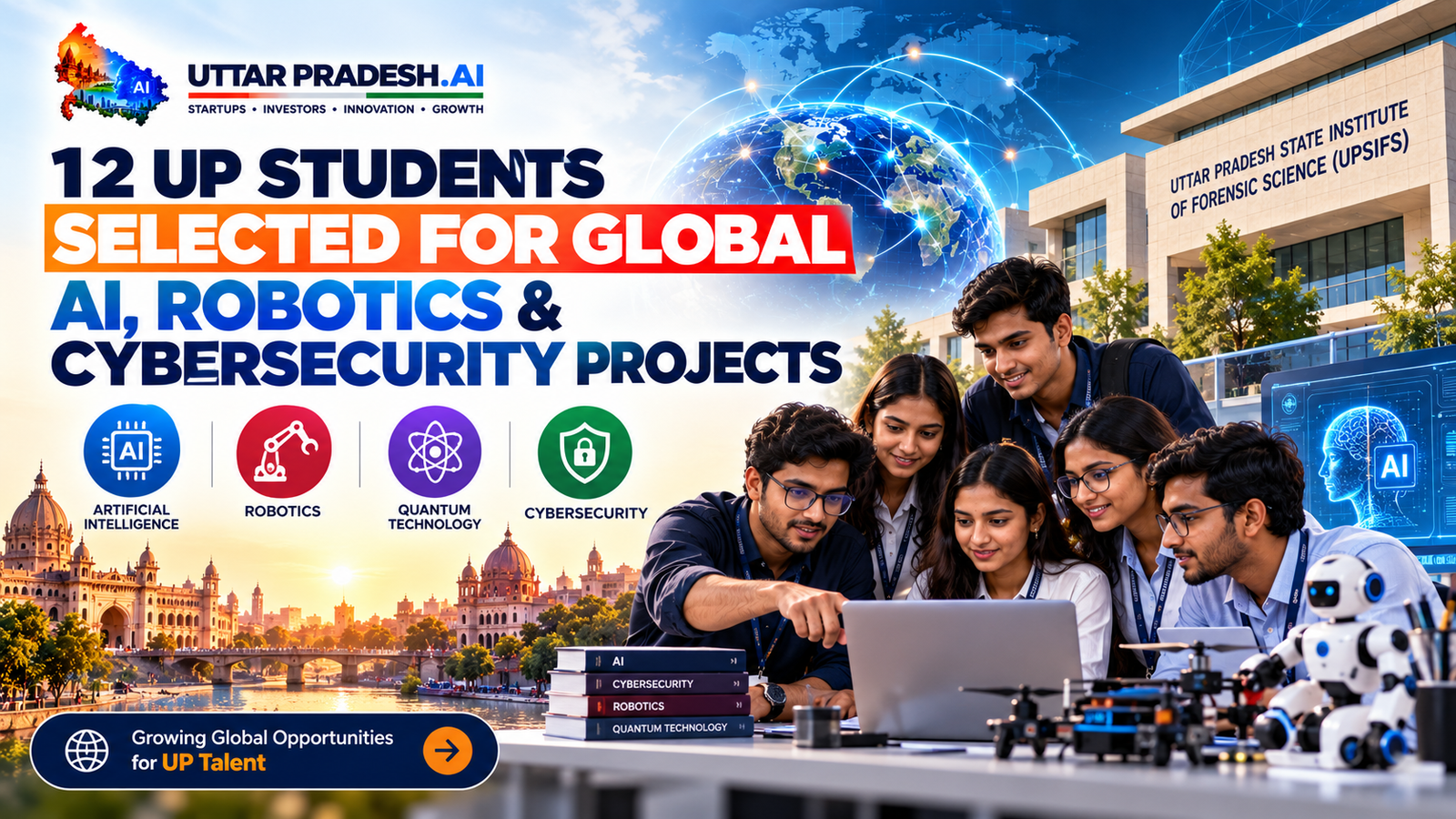
UP Students Selected for Global AI, Robotics & Cybersecurity Projects

Artificial Intelligence is creating new opportunities for students in Uttar Pradesh, and a recent development from Lucknow shows how quickly the state’s technology ecosystem is expanding.

Twelve students from the Uttar Pradesh State Institute of Forensic Science (UPSIFS) have been selected to form “Team 12” for international projects involving Artificial Intelligence, robotics, quantum technology and cybersecurity. The development was reported on October 12, 2026.

For Uttar Pradesh, this is more than just a student achievement. It reflects the growing connection between education, advanced technology and global innovation opportunities.

From Classroom Learning to Global Technology Projects

AI is no longer limited to computer science departments or large technology companies.

Today, AI is being used in areas such as:

  • Cybersecurity
  • Digital forensics
  • Law enforcement
  • Healthcare
  • Education
  • Robotics
  • Quantum computing
  • Data analysis
  • Fraud detection

The selection of Team 12 at UPSIFS is significant because it brings these emerging technologies closer to the field of forensic science and investigation.

Students working in such areas can gain exposure to technologies that are increasingly important for solving complex real-world problems.

Why AI + Cybersecurity Matters

As digital systems grow, cyber threats are also becoming more sophisticated.

Cybercriminals can use advanced techniques to target individuals, businesses and government systems. AI can help security teams analyse large amounts of data, identify unusual activity and detect potential threats more quickly.

The combination of AI, cybersecurity and digital forensics can therefore become an important part of modern investigation systems.

For students, this also creates a new career path.

Instead of looking only at traditional IT jobs, young professionals can explore opportunities in:

AI + Cybersecurity + Forensics + Robotics + Quantum Technology.

Uttar Pradesh Is Building a Larger AI Ecosystem

The Team 12 development comes at a time when Uttar Pradesh is also expanding its wider AI ecosystem.

On October 10, the Uttar Pradesh Cabinet approved the Uttar Pradesh Artificial Intelligence Mission (UP-AIM). The mission aims to support at least 100 AI startups and train five lakh young people in AI-related skills. It also plans to develop more than 100 AI use cases, with 25–30 expected to be taken up for wider implementation.

The mission also proposes AI centres across all 75 districts of Uttar Pradesh, creating opportunities for training, entrepreneurship and technology-based solutions to local problems.

This makes developments like Team 12 even more interesting because they show how AI adoption can extend beyond traditional technology hubs.

Lucknow Is Emerging as an AI Innovation Hub

Lucknow is also being positioned as an important centre for AI and deep-tech development.

The Uttar Pradesh government’s Invest UP platform describes AI City Lucknow as a planned innovation zone designed to bring together AI hardware, computing infrastructure, foundational development and AI-driven solutions.

The first phase is planned across 20+ acres within Vrindavan Yojana IT City. Proposed components include an AI and deep-tech incubation centre, flexible workspaces, high-performance computing capacity and AI testing and simulation labs. Invest UP

This infrastructure could create more opportunities for startups, researchers, students and technology companies.

What This Means for Students

The biggest opportunity may be the changing nature of technology careers.

Students in Uttar Pradesh can increasingly combine their existing academic fields with AI.

For example:

Forensic Science + AI → Digital investigation and evidence analysis

Cybersecurity + AI → Threat detection and security automation

Robotics + AI → Intelligent machines and automation

Law + AI → Legal technology and digital compliance

Healthcare + AI → Diagnostics and data-driven healthcare

Agriculture + AI → Smart farming and crop intelligence

This combination of domain knowledge and AI skills could become one of the most important career advantages for young professionals.

Uttar Pradesh’s AI Story Is Getting Bigger

The recent developments point toward a broader change in Uttar Pradesh.

The state is simultaneously working on:

  • AI skills and training
  • AI startups
  • AI research
  • Digital infrastructure
  • Cybersecurity
  • Robotics
  • Deep-tech innovation
  • AI-enabled governance
  • District-level technology adoption

The goal is not simply to create more technology users. It is to build an ecosystem where students can become innovators, startups can develop products and businesses can adopt AI solutions.

What Comes Next?

The success of initiatives such as Team 12 will ultimately depend on how effectively students get access to mentorship, research opportunities, industry projects and global collaboration.

If these connections continue to grow, Uttar Pradesh could develop a much stronger talent pipeline for AI, robotics, cybersecurity and other emerging technologies.

For students and young innovators, the message is clear:

AI is not just a technology career anymore. It is becoming a skill that can transform almost every professional field.

And Uttar Pradesh is increasingly becoming part of that transformation.

📌 UttarPradesh.ai Take

From local talent to global technology opportunities, Uttar Pradesh’s AI ecosystem is entering an important phase.

At UttarPradesh.ai, we track the latest developments across AI, startups, research, funding, technology, jobs and innovation in the state.

🌐 Explore more: uttarpradesh.ai

Uttar Pradesh AI Mission 2026: 5 Lakh Youth, 100 AI Startups and a New AI Stack

Artificial Intelligence is becoming a bigger part of Uttar Pradesh’s technology and economic development story.

The latest major development came on 10 October 2026, when the Uttar Pradesh Cabinet approved the Uttar Pradesh Artificial Intelligence Mission (UP-AIM).

The mission is designed to build a stronger AI ecosystem across the state by bringing together AI infrastructure, startups, research, skills, computing capacity and government applications.

The targets are ambitious: support at least 100 AI startups, train 5 lakh youth in AI skills and develop or implement more than 100 AI use cases. The Times of India

For Uttar Pradesh, this could become an important step in moving AI from individual projects into a wider state-level ecosystem.

What Is the UP AI Mission?

The Uttar Pradesh Artificial Intelligence Mission is a state-level initiative focused on expanding the use and development of Artificial Intelligence across Uttar Pradesh.

According to the details released after the Cabinet approval, the mission will work on several areas:

  • AI infrastructure
  • High-capacity computing
  • AI startups
  • Research and innovation
  • Skill development
  • AI applications
  • Government technology
  • Responsible AI adoption

The mission will operate as an independent society under the IT and Electronics Department, with a CEO responsible for implementation. The Times of India

In simple terms, UP is trying to create an ecosystem where people can learn AI, build AI products, start AI companies and use AI to solve real problems.

5 Lakh Youth to Get AI Skills

One of the biggest targets under UP-AIM is AI skilling for 5 lakh youth.

This is important because AI development needs more than infrastructure.

It also needs people who know how to:

  • Build AI applications
  • Work with data
  • Develop machine-learning solutions
  • Use generative AI
  • Deploy AI tools
  • Manage AI systems
  • Apply AI to business problems

The mission’s focus on large-scale skilling could therefore help create a broader talent pool for startups, enterprises and government projects. The Times of India

UP Wants 100 AI Startups

Another major target is to support at least 100 AI startups.

This is particularly relevant for founders and entrepreneurs in Uttar Pradesh.

The state wants to strengthen an ecosystem where startups can access:

Infrastructure + Computing + Mentorship + Testing + Government Opportunities

The mission also plans to provide startups and technology partners access to development tools, sandboxes and testing environments connected with the state’s AI infrastructure. ETGovernment.com

This could make it easier for early-stage companies to move from an idea to a working AI product.

What Is the UP AI Stack?

One of the most interesting parts of the mission is the planned UP AI Stack.

The proposed stack will bring together different digital and AI capabilities, including:

  • AI-ready data systems
  • AI operating framework
  • Departmental applications
  • Secure data exchange
  • GPU-based computing facilities

The idea is to create a common technology foundation that government departments can use for AI-based applications. ETGovernment.com

It could also provide an environment where startups and technology partners can develop and test solutions.

More Than 100 AI Use Cases

The government has set a target of developing or implementing more than 100 AI use cases.

However, not every project is expected to be scaled immediately.

The plan is to identify around 25–30 use cases that can be expanded for wider deployment. The Times of India

This approach is important.

Instead of using AI simply because it is a new technology, the focus can be on finding areas where it can deliver measurable results.

Potential areas include:

Healthcare

AI-assisted analysis, hospital operations and health services.

Agriculture

Data-driven farming, crop monitoring and advisory systems.

Education

Personalised learning and AI-based educational tools.

Governance

Faster services, data analysis and citizen support.

Cybersecurity

Threat detection and digital security.

Law Enforcement

Technology-assisted investigation and data analysis.

The actual applications will depend on the projects selected and their implementation.

AI Centres Across All 75 Districts

Another significant part of the plan is the proposed establishment of District AI Centres across all 75 districts of Uttar Pradesh.

This could help take AI beyond major cities such as Lucknow and Noida.

For example, a district-level AI centre could potentially support:

  • AI training
  • Local startups
  • Entrepreneurship
  • Research
  • Digital innovation
  • Local technology projects

This is particularly interesting for Uttar Pradesh because the state has a large number of cities, towns and emerging business centres.

If implemented effectively, district-level infrastructure could help more people participate in the AI economy.

Government Could Become a Customer for Startups

The AI Mission is being supported by another important policy development.

The Cabinet also approved the Uttar Pradesh Startup Procurement Scheme 2026.

Under the proposed framework, eligible startups can get direct procurement opportunities from government departments up to ₹50 lakh.

For specified sunrise sectors—including AI and deep technology—the limit can go up to ₹1 crore, subject to eligibility and prescribed conditions. ETGovernment.com

This changes an important part of the startup equation.

A startup does not only need funding.

It also needs customers.

Government departments can potentially become early customers for technology products that solve real public-sector problems.

A Proposed UP Startup E-Marketplace

The procurement initiative also proposes a dedicated UP Startup e-Marketplace.

The platform is intended to connect startup products with government departments.

Departmental innovation funds could also support:

  • Pilot projects
  • Proofs of concept
  • Technology testing
  • Procurement

This could create a pathway from:

Idea → Prototype → Government Pilot → Deployment → Scale

For AI startups, this could be particularly valuable because many young companies struggle to find their first large institutional customer.

Why This Matters for AI Startups

Building an AI startup requires more than an idea.

Founders need access to:

Computing power
Data
Talent
Mentors
Funding
Testing environments
Customers

The UP AI Mission attempts to bring several of these pieces into one ecosystem.

Uttar Pradesh already has an AI-focused Centre of Excellence in Noida, established under the state’s Start in UP programme with FIRST IIT Kanpur and FICCI as partner. The centre focuses on AI, ICT, IoT, cybersecurity and related technologies. Startup Mission

The new AI Mission could therefore build on an ecosystem that is already developing.

Lucknow’s AI Ambition Is Growing

The AI Mission approval comes shortly after the state announced a separate ambition to develop Lucknow as an AI innovation hub.

The government has said it aims to support 50 AI-based startups in Lucknow over the next five years. The Times of India

This gives Lucknow an increasingly important role in the state’s AI strategy.

The emerging picture is interesting:

Lucknow → AI innovation, startups and talent

Noida/Greater Noida → Technology, data centres, electronics and advanced manufacturing

Together, these ecosystems can support different parts of the AI value chain.

What Does This Mean for Students?

For students, the biggest opportunity may be skills.

The AI economy is creating demand for people who understand:

  • Generative AI
  • Machine Learning
  • Data Science
  • Python
  • AI automation
  • Computer Vision
  • Cybersecurity
  • Robotics
  • Cloud computing

The UP-AIM target of training 5 lakh youth could help increase awareness and access to these skills across the state. The Times of India

Students should not think of AI only as a career in software development.

AI skills can also be useful in:

Healthcare + AI
Agriculture + AI
Finance + AI
Manufacturing + AI
Education + AI
Marketing + AI
Cybersecurity + AI

What Does This Mean for Businesses?

Businesses can potentially benefit from AI in many ways.

A manufacturing company could use AI for quality control.

A retailer could use AI for demand forecasting.

A hospital could use AI-assisted systems.

A logistics company could use AI for route optimisation.

A service business could use AI for customer support.

The real opportunity is not simply “using AI.”

It is using AI to solve a specific business problem.

The Biggest Challenge Will Be Implementation

The targets announced by the government are significant.

But targets alone do not create an AI ecosystem.

The real test will be implementation.

Questions that will matter include:

  • How quickly will District AI Centres become operational?
  • Which AI use cases will be selected?
  • How will startups access computing infrastructure?
  • How will AI training reach students outside major cities?
  • How will government departments adopt AI?
  • How will data privacy and security be managed?
  • How many startup pilots will actually become large deployments?

The success of UP-AIM will ultimately depend on what happens after the announcement.

What Could Uttar Pradesh’s AI Ecosystem Look Like?

If the different initiatives develop together, Uttar Pradesh could gradually build a connected AI ecosystem:

🧑‍🎓 Talent

5 lakh youth targeted for AI skilling.

🚀 Startups

100 AI startups targeted for support.

🖥️ Infrastructure

GPU computing and AI-ready digital infrastructure.

🏢 Government

AI applications across departments.

🧪 Research

Universities and AI Centres of Excellence.

🌐 District Ecosystem

AI Centres planned across 75 districts.

💼 Market

Startup procurement opportunities from government.

This combination could be more important than any single AI project.

UttarPradesh.ai’s View

For UttarPradesh.ai, the latest AI Mission development is particularly important because it connects several parts of the state’s technology ecosystem.

Startups need infrastructure.

Infrastructure needs talent.

Talent needs skills and education.

Startups need customers.

Government needs useful technology.

An effective AI ecosystem connects all of these pieces.

That is also the larger opportunity for Uttar Pradesh.

Conclusion

The approval of the Uttar Pradesh Artificial Intelligence Mission marks an important new stage in the state’s AI journey.

With targets of 100 AI startups, 5 lakh AI-skilled youth, 100+ AI use cases and AI infrastructure across the state, UP is attempting to build a broader AI ecosystem rather than focusing on one individual project. The Times of India

The proposed UP AI Stack, District AI Centres, startup procurement framework and AI development infrastructure could create new opportunities for founders, students, researchers and businesses.

But the most important phase begins now:

Turning AI plans into real products, real skills, real businesses and real impact.

Uttar Pradesh has the scale.

The next challenge is execution.

Follow UttarPradesh.ai for the latest AI, startup, technology and innovation news from Uttar Pradesh.

🌐 UttarPradesh.ai

AI for UP MSMEs: How Artificial Intelligence Could Change Small Businesses in Uttar Pradesh

Artificial Intelligence is no longer limited to large technology companies.

For small and medium businesses, AI is increasingly becoming a practical tool for handling repetitive work, analysing information, improving customer service and making business operations more efficient.

This issue came into focus at the Uttar Pradesh International Trade Show 2026, where Union Minister of State for Commerce and Industry Jitin Prasada highlighted the importance of AI adoption by MSMEs.

Speaking during a session on Uttar Pradesh’s journey from electronics manufacturing towards AI and semiconductor industries, Prasada said MSMEs should look at AI not simply as a technology to adopt, but as a way to improve productivity, operational efficiency and cost competitiveness. (KNN India)

For Uttar Pradesh, this is particularly relevant because the state has a very large MSME base.

Why MSMEs Matter in Uttar Pradesh

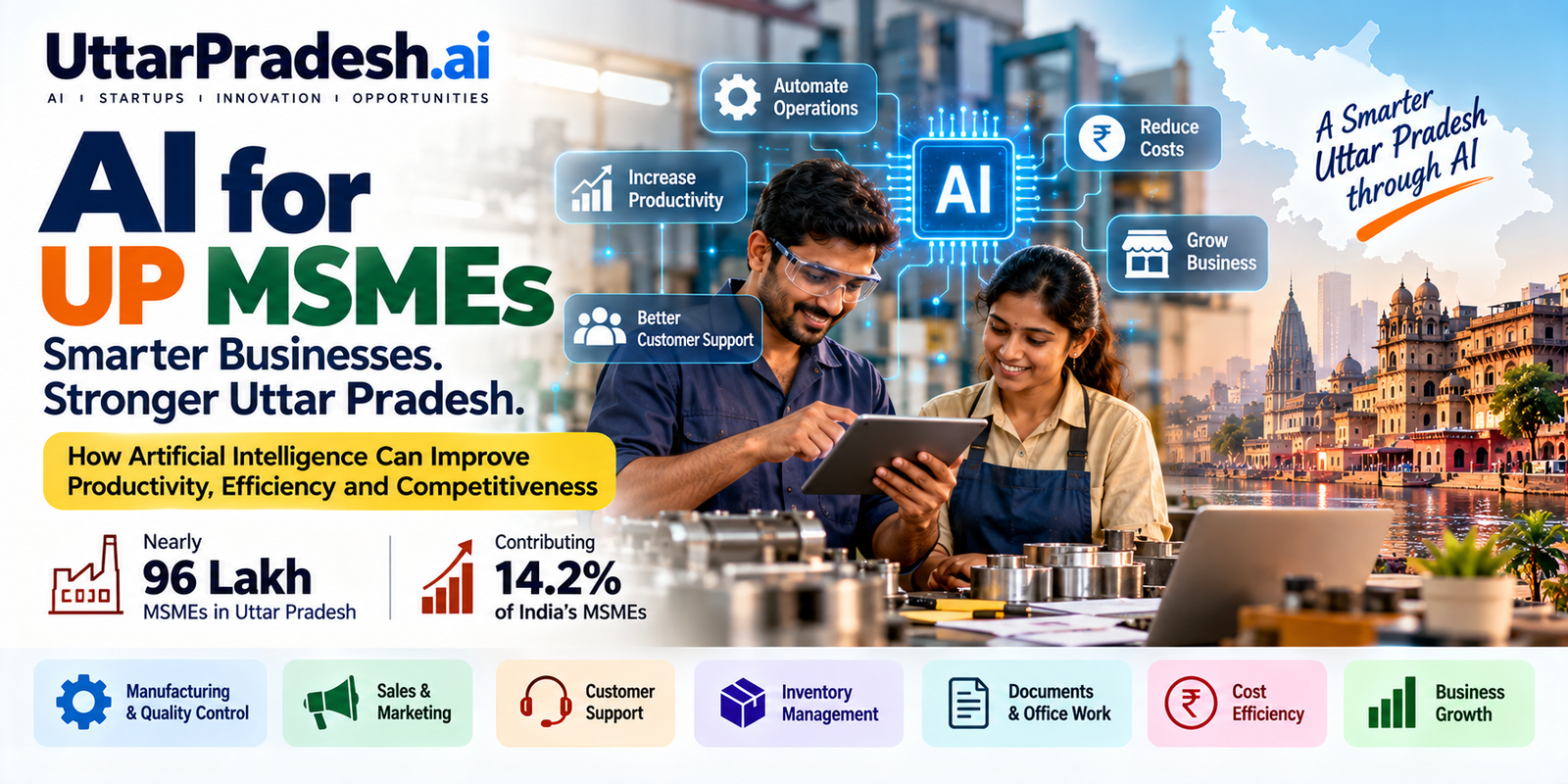
According to Invest UP, Uttar Pradesh has nearly 96 lakh MSMEs, accounting for around 14.2% of India’s total MSME count. (Invest UP)

These businesses operate across a wide range of sectors, including:

  • Manufacturing
  • Engineering
  • Textiles
  • Handicrafts
  • Food processing
  • Electronics
  • Defence-related manufacturing
  • Agriculture
  • IT and IT-enabled services
  • Retail and e-commerce

Many of these businesses are now connected to larger national and international supply chains.

That makes technology adoption increasingly important.

Where Can AI Help an MSME?

AI does not necessarily mean buying an expensive humanoid robot or building a complicated AI model.

For many MSMEs, the first step could be much simpler.

1. AI for Customer Support

Businesses receive repetitive questions every day.

AI-powered chat systems can help answer common questions about:

  • Products
  • Prices
  • Availability
  • Delivery
  • Services
  • Business hours
  • Order status

This can reduce the amount of repetitive work handled manually by employees.

2. AI for Sales and Marketing

Small businesses often have limited marketing teams.

AI tools can help businesses prepare:

  • Social media content
  • Product descriptions
  • Email campaigns
  • Customer messages
  • Ad variations
  • Market research summaries

AI can also help analyse customer behaviour and identify patterns in enquiries.

The final marketing decisions, however, still require human review.

3. AI for Manufacturing

Manufacturing is one area where AI can have practical applications.

Businesses can use computer vision and machine-learning systems for tasks such as:

Quality inspection → Defect detection → Predictive maintenance → Production monitoring

For example, an AI-powered camera system can potentially identify certain product defects during a manufacturing process.

This can be particularly relevant for engineering, electronics, automotive components and other manufacturing businesses.

AI Can Also Help With Inventory

Inventory management can become complicated when businesses handle hundreds or thousands of products.

AI-based systems can analyse historical sales and other business data to help identify:

  • Fast-moving products
  • Slow-moving inventory
  • Seasonal demand
  • Reorder patterns
  • Potential stock shortages

The technology does not eliminate the need for business decisions.

Instead, it can provide data that helps business owners make those decisions faster.

AI for Documents and Daily Office Work

A significant amount of MSME work involves documents.

Invoices, emails, quotations, purchase orders, reports and customer records can consume considerable time.

AI-based document tools can help with:

  • Extracting information
  • Summarising documents
  • Classifying files
  • Drafting responses
  • Searching business records
  • Creating reports

For a small company with a limited administrative team, reducing repetitive documentation work can be useful.

AI Could Help MSMEs Become More Competitive

The recent discussion at UPITS focused on an important question:

What is the actual business value of AI?

According to reporting on Prasada’s remarks, the emphasis was on measurable outcomes such as productivity, efficiency and cost competitiveness rather than AI adoption for its own sake. (KNN India)

That distinction matters.

A business does not necessarily benefit simply because it has an AI tool.

The real question is:

Does the technology solve a real business problem?

For one company, that could mean reducing customer-support workload.

For another, it could mean improving manufacturing quality.

For another, it could mean analysing sales data more quickly.

UP’s MSME Ecosystem Is Already Moving Toward Technology

Technology adoption is already part of Uttar Pradesh’s MSME support framework.

Invest UP’s MSME information notes support for areas such as digital technology adoption, quality certifications, patents and environmentally sustainable manufacturing practices under the state’s MSME Promotion Policy framework. (Invest UP)

The state is also developing industrial infrastructure and supply-chain connectivity around manufacturing clusters.

This creates an environment where digital technologies can become part of the next stage of MSME growth.

From ODOP to AI

One of Uttar Pradesh’s best-known MSME initiatives is One District, One Product (ODOP).

The programme connects district-level products with broader markets.

Invest UP says ODOP 2.0 is placing greater emphasis on areas such as:

  • Technology integration
  • Better packaging
  • Quality standards
  • E-commerce
  • Global market access
  • Common Facility Centres

(Invest UP)

AI could potentially become another technology layer for these businesses.

Imagine a local manufacturer using AI to analyse international customer demand.

Or a food-processing business using data tools to understand seasonal demand.

Or an artisan brand using AI-assisted digital marketing to reach customers outside India.

The technology possibilities are broad, although actual benefits will depend on cost, skills, data quality and implementation.

AI Is Not Only for Noida

Noida and Greater Noida are already important technology and manufacturing centres, but AI adoption does not have to remain concentrated there.

Uttar Pradesh has businesses across cities and districts.

Lucknow, Kanpur, Agra, Meerut, Varanasi, Gorakhpur, Moradabad, Saharanpur and many other regions have businesses that could potentially use AI-based tools.

This makes AI accessibility important.

A small business in a tier-2 or tier-3 city should not necessarily need a large technology department to start using basic AI tools.

The Skills Challenge

Technology alone cannot transform an MSME.

People need to understand how to use it.

That means businesses may need training in:

  • AI basics
  • Data handling
  • Digital tools
  • Cybersecurity
  • Automation
  • Prompting and AI-assisted workflows
  • Data privacy
  • Human review of AI outputs

Prasada also highlighted the importance of preparing young people as AI innovators, researchers and users, and stressed collaboration between industry and institutions such as IIT Kanpur. (Hindustan Times)

This connection between education and industry could become increasingly important as AI adoption grows.

What About Cost?

Cost remains a practical question for smaller businesses.

Not every MSME needs a large AI infrastructure investment.

Businesses can start with relatively simple applications such as:

AI chatbot → Content automation → Document processing → Data analysis → Workflow automation

More advanced applications such as computer vision, industrial robotics or customised AI models can require substantially greater investment.

The right approach therefore depends on the business problem, available data, workforce and expected return.

AI + Manufacturing Could Be Especially Important for UP

Uttar Pradesh is simultaneously trying to expand its electronics and semiconductor ecosystem.

At UPITS, officials discussed the state’s ambitions around electronics, semiconductors, AI and technology. Reports also highlighted investments, data centres and AI laboratories as parts of the broader technology ecosystem. (KNN India)

For MSMEs, this could create opportunities as suppliers and service providers around larger technology and manufacturing companies.

Potential areas include:

  • Electronic components
  • Industrial automation
  • Software
  • Testing
  • Robotics
  • Engineering services
  • Logistics technology
  • Quality-control systems
  • AI-enabled services

Data Centres Will Support the AI Ecosystem

AI applications also require computing infrastructure.

Uttar Pradesh’s Data Centre Policy 2026 promotes AI-ready digital infrastructure and includes incentives related to AI compute and high-performance computing. The policy also aims to encourage green and sustainable data-centre development. (Invest UP)

This infrastructure can support the wider AI ecosystem, including enterprises and technology companies.

The connection can be understood simply:

Data Centres → Computing Power → AI Applications → Businesses → New Services

What Should an MSME Do First?

Businesses don’t need to automate everything at once.

A practical starting point could be:

Step 1 — Find a repetitive problem

Identify a task employees perform repeatedly.

Step 2 — Check whether AI can actually solve it

Not every business problem requires AI.

Step 3 — Start with a small pilot

Test the technology with one workflow.

Step 4 — Measure the result

Look at time saved, cost, accuracy or customer response.

Step 5 — Train employees

Make sure the people using the system understand its limitations.

Step 6 — Scale only if it works

If the pilot delivers measurable value, expand it.

This approach can help businesses focus on outcomes instead of simply adopting technology because it is trending.

What This Means for Uttar Pradesh’s AI Ecosystem

The growing conversation around AI and MSMEs adds another dimension to Uttar Pradesh’s technology story.

The state’s AI ecosystem is developing across several layers:

AI Infrastructure
Data centres and computing.

AI Startups
New companies building AI products.

Research & Education
Universities and technology institutions.

Industry
Manufacturing and enterprise applications.

MSMEs
Smaller businesses adopting AI for everyday operations.

Talent
Students, developers and technology professionals.

Connecting these layers could be important for turning AI technology into broader economic applications.

The Road Ahead

The next phase of AI adoption in Uttar Pradesh may not be defined only by large AI projects.

It could also be defined by thousands of smaller businesses adopting AI for specific tasks.

A manufacturing company improving quality inspection.

A retailer analysing customer demand.

A service company automating enquiries.

An exporter researching international markets.

A local manufacturer using AI-assisted forecasting.

These individual applications may look small, but together they can form a much larger digital transformation.

Conclusion

The recent discussion at UP International Trade Show 2026 has brought attention to a practical side of the AI conversation in Uttar Pradesh: how MSMEs can use AI to improve the way they operate.

The focus is not simply on adopting the latest technology.

It is about finding practical business problems where AI can help improve productivity, efficiency, quality and competitiveness. (KNN India)

With nearly 96 lakh MSMEs across the state according to Invest UP, even gradual AI adoption across smaller businesses could become an important part of Uttar Pradesh’s technology ecosystem. (Invest UP)

The next question is no longer only:

“Is AI coming to Uttar Pradesh?”

It is:

“How will Uttar Pradesh’s businesses use AI in their everyday work?”

UttarPradesh.ai will continue tracking AI, startups, technology, investment, research and innovation developments across the state.

IBM + Yotta Launch Sovereign Agentic AI Platform in Greater Noida: What It Means for Uttar Pradesh

Artificial Intelligence is moving beyond simple chatbots and content-generation tools.

Businesses are now looking at AI agents that can perform tasks, work across business processes and operate inside enterprise environments.

A major development announced on September 29, 2026, brings this trend closer to Uttar Pradesh.

IBM and Yotta Data Services have announced the general availability of a Sovereign Agentic AI Platform for Indian organisations. The platform is built using IBM watsonx Orchestrate and Yotta’s Shakti Cloud, and Yotta’s cloud regions include Greater Noida. (IBM India News Room)

For Uttar Pradesh, the development is significant because Greater Noida is already emerging as an important location for data-centre and AI infrastructure.

What Is Sovereign AI?

In simple words, sovereign AI means giving organisations greater control over where their AI data, computing, models and operations are hosted and managed.

The IBM-Yotta platform is designed to help organisations deploy, run and govern AI agents while keeping data, AI inference and governance controls within India. (IBM India News Room)

This can be important for organisations dealing with sensitive business information, regulated data or workflows where data residency and governance requirements matter.

Instead of simply asking:

“Which AI model should we use?”

companies increasingly need to ask:

“Where does our AI run, where is our data stored, and who controls the infrastructure?”

That is where sovereign AI infrastructure becomes relevant.

What Is an AI Agent?

Traditional AI applications generally respond to a user’s request.

An AI agent can go a step further.

It can potentially:

  • Understand a task
  • Break it into steps
  • Use connected tools
  • Work with business information
  • Perform actions within authorised systems
  • Automate parts of a workflow
  • Operate under defined governance controls

IBM’s watsonx Orchestrate is being used as the agentic control layer in the new platform. It is designed to help organisations deploy, secure, manage and govern AI agents as their use increases. (IBM India News Room)

Why Greater Noida Matters

The platform’s availability through Yotta’s Greater Noida cloud region connects this national AI development directly with Uttar Pradesh’s technology infrastructure. (IBM India News Room)

Yotta operates hyperscale data-centre infrastructure in Greater Noida, alongside its Navi Mumbai operations. Its AI infrastructure includes Shakti Cloud, which provides computing, GPU infrastructure, networking and security capabilities for AI workloads. (ShaktiCloud)

This is important because modern AI requires much more than software.

It needs:

Data Centres + GPUs + Cloud + Networking + Security + AI Models + Talent

Greater Noida is increasingly becoming part of this infrastructure layer.

What Can Businesses Do With the Platform?

According to IBM and Yotta, the platform is designed to support enterprise AI workloads and workflows.

Potential use cases include:

HR Automation

AI agents can assist with repetitive HR workflows and information processing.

Document Processing

Businesses can use AI to process and analyse large amounts of business documentation.

Security Operations

AI agents can support certain security and operational workflows.

Enterprise Automation

The platform can provide an environment for organisations looking to move AI from experimental projects into production use. (The Economic Times)

The exact applications will depend on how individual organisations configure and govern their AI systems.

From AI Experiments to Production

Many organisations have already experimented with generative AI.

The next challenge is taking those experiments into actual business operations.

This means companies need infrastructure that can provide:

  • Security
  • Scalability
  • Computing power
  • Model deployment
  • Data management
  • Monitoring
  • Governance
  • Compliance

IBM and Yotta are positioning their new platform around this transition from AI experimentation to production deployment. (IBM India News Room)

For Indian enterprises, this also connects with the growing discussion around data sovereignty and responsible AI deployment.

Uttar Pradesh’s AI Infrastructure Is Growing

The IBM-Yotta announcement comes at a time when Uttar Pradesh is developing a broader AI and digital infrastructure ecosystem.

The state’s Data Centre Policy 2026 specifically promotes an AI-ready and sustainable data-centre ecosystem.

Invest UP says the policy aims to mobilise ₹2 lakh crore+ in investment and includes incentives for AI compute infrastructure, high-performance computing and data-centre development. (Invest UP)

The policy also promotes renewable-energy adoption and green data-centre development.

This creates an important foundation for future AI applications.

AI City Lucknow Adds Another Piece

Greater Noida is not the only location being developed around advanced technology.

Uttar Pradesh is also planning AI City Lucknow, which is intended to bring AI and deep-tech infrastructure together.

The planned ecosystem includes AI and deep-tech incubation, flexible workspaces, high-performance computing capacity and AI testing and simulation facilities.

Together, Lucknow and the Noida-Greater Noida region represent different parts of the state’s technology ecosystem.

Lucknow → AI, research, incubation and innovation

Noida/Greater Noida → technology, data centres, enterprise infrastructure and industry

What Does This Mean for AI Startups?

AI startups need access to computing infrastructure to develop and test their products.

For example, startups working on:

  • Generative AI
  • Computer Vision
  • Healthcare AI
  • Robotics
  • Industrial AI
  • FinTech
  • AgriTech
  • Cybersecurity
  • Enterprise automation

may require significant computing resources as their products scale.

UP Startup Mission’s current ecosystem framework identifies AI and Deep Tech among its priority sectors and lists support mechanisms for startups and deep-tech ventures. (UP Startup Mission)

Better access to infrastructure can therefore become an important part of the startup ecosystem.

Why This News Matters Beyond Noida

The IBM-Yotta announcement is not only a Greater Noida story.

It reflects a larger change in India’s AI industry.

AI is moving from:

Chatbots → AI Applications → AI Agents → Enterprise AI → AI Infrastructure

This means the demand for data centres, GPUs, cloud platforms, cybersecurity and AI governance is likely to remain an important part of the technology ecosystem.

For Uttar Pradesh, having major AI infrastructure in the Noida-Greater Noida region puts the state directly into this conversation.

The Bigger Picture for Uttar Pradesh

Several technology developments are now coming together.

AI Infrastructure

Data centres and high-performance computing.

AI Innovation

Startups and deep-tech companies.

AI Research

Universities, research institutions and Centres of Excellence.

AI Talent

Students, developers, researchers and technology professionals.

AI Applications

Healthcare, agriculture, education, manufacturing, finance and governance.

AI Investment

Government policies, investors and private-sector projects.

The IBM-Yotta platform adds another layer: enterprise-grade AI deployment infrastructure.

What Could Come Next?

The next phase will be about how businesses actually use AI agents.

Organisations will need to determine:

  • Which business processes can be automated?
  • What data can AI access?
  • How should AI agents be governed?
  • What human approval is required?
  • How should AI decisions be monitored?
  • How can sensitive information remain protected?

These questions will become increasingly important as AI moves from experimentation into everyday business operations.

UttarPradesh.ai’s Take on the Development

The growth of AI infrastructure in Uttar Pradesh creates opportunities for a wider ecosystem of startups, researchers, investors, developers and technology companies.

At UttarPradesh.ai, our focus is on tracking this ecosystem—from AI infrastructure and startups to research, investment, jobs, events and emerging technologies.

The Greater Noida development is another example of how the state’s technology story is expanding beyond traditional IT and electronics toward AI, cloud, data centres and advanced digital infrastructure.

Conclusion

The IBM-Yotta Sovereign Agentic AI Platform, announced on September 29, 2026, brings enterprise agentic AI capabilities together with sovereign cloud and AI infrastructure. Yotta’s Greater Noida region is one of the locations supporting the platform. (IBM India News Room)

For Uttar Pradesh, the development is relevant because Greater Noida is becoming an important part of the state’s wider digital infrastructure ecosystem.

The future AI ecosystem will not be built only around AI applications.

It will also depend on the infrastructure underneath them:

Compute. Cloud. Data Centres. Security. AI Models. Talent. Startups.

And Greater Noida is increasingly becoming part of that infrastructure story.

Follow UttarPradesh.ai for the latest AI, technology, startup and innovation news from Uttar Pradesh.

Uttar Pradesh Brings AI Into Investor Services: What Is Nivesh Suvidha?

Artificial Intelligence is increasingly becoming part of how governments and businesses deliver digital services. In Uttar Pradesh, this trend is now visible in the state’s investment facilitation ecosystem.

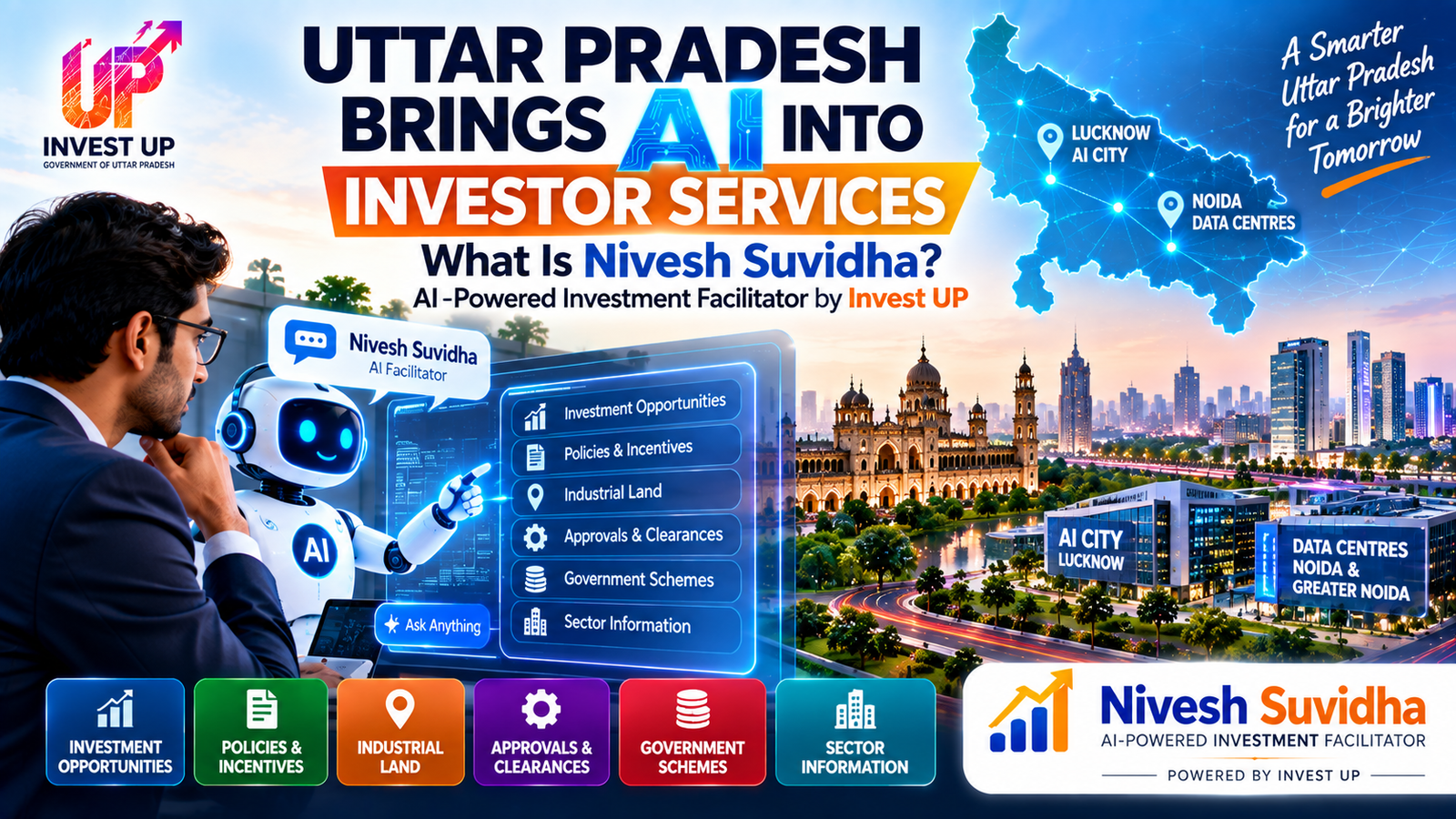
Invest UP, Government of Uttar Pradesh, operates an AI-powered investment facilitator called Nivesh Suvidha. The platform is designed to help investors navigate information about investment opportunities, government policies, incentives, approvals and related services in Uttar Pradesh. (Nivesh Suvidha)

The development is significant because it shows how AI can be used not only for chatbots or content generation, but also for making complex government and investment information easier to understand.

What Is Nivesh Suvidha?

Nivesh Suvidha is an AI-powered investment information facilitator operated by Invest UP.

According to its official website, the platform can help users navigate information related to:

  • Investment opportunities
  • Investment policies
  • Incentive schemes
  • Industrial land
  • Government approvals
  • Investment-related processes
  • Services offered by the Uttar Pradesh government

The AI system generates responses using information from sources including Invest UP, Nivesh Mitra and Nivesh Sarathi. (Nivesh Suvidha)

For an investor who is unfamiliar with Uttar Pradesh’s policies and procedures, an AI-based conversational interface can make the initial information-search process simpler.

Why Is This Important for Uttar Pradesh?

Investment information can involve multiple policies, departments, approval requirements and eligibility conditions.

Traditionally, a business owner may need to search through multiple government websites and documents to understand what applies to a particular project.

An AI facilitator can provide a conversational starting point.

For example, an investor could ask questions about:

“What incentives may be available for my project?”

or

“What approvals may be required to establish this type of business in Uttar Pradesh?”

The facilitator is designed to help users understand such information through an AI-powered interface. (Nivesh Suvidha)

However, there is an important distinction: Nivesh Suvidha provides information; it does not make binding government decisions.

AI Is Becoming Part of UP’s Investment Infrastructure

Nivesh Suvidha is not an isolated development.

Earlier in 2026, Uttar Pradesh introduced Nivesh Mitra 3.0, its next-generation single-window platform for investment approvals and clearances.

Invest UP says Nivesh Mitra 3.0 includes AI-powered support, real-time application updates, a dynamic Common Application Form, GIS-enabled land information and online tracking of investment proposals. (Invest UP)

The platform is designed to bring multiple government processes into a more integrated digital environment.

This creates an interesting progression:

Digital Government → Single Window → AI Assistance → Data-Driven Investor Services

The broader direction is toward using technology to reduce friction in interactions between businesses and government departments.

What Can Investors Use Nivesh Suvidha For?

The AI facilitator is particularly relevant during the information and planning stage of an investment.

1. Understanding Investment Policies

Investors can use the platform to explore information about policies applicable to different sectors and types of projects.

2. Exploring Incentives

Government incentive schemes can have specific eligibility requirements and conditions. Nivesh Suvidha can help users understand the relevant information before they proceed through official channels.

3. Understanding Approvals

Businesses often need multiple approvals before starting or expanding operations.

The facilitator can help users understand the approval-related information available through government systems.

4. Exploring Industrial Opportunities

The platform is also designed to provide information related to industrial land and investment opportunities.

5. Getting Initial Answers Quickly

Instead of beginning with a large collection of documents, users can start with natural-language questions and use the AI system to understand the available information.

But AI Does Not Replace Government Approval

This is one of the most important points for investors.

According to the official Terms of Use, Nivesh Suvidha is not a government official, legal adviser or authorised decision-maker. It cannot make binding decisions regarding eligibility, approvals or entitlements. (Nivesh Suvidha)

The platform also warns that AI-generated information may sometimes be incomplete, incorrect, inconsistent or outdated.

Therefore, investors should use Nivesh Suvidha as an information and guidance layer, while verifying important information through official government channels before making a business decision. (Nivesh Suvidha)

This is an important principle for AI-powered public services generally:

AI can help people find and understand information, but final decisions should remain with the authorised process or authority.

AI City Lucknow Adds Another Layer

The development of AI-powered investor services is happening alongside Uttar Pradesh’s broader plans for AI infrastructure.

Invest UP describes AI City Lucknow as a planned innovation zone intended to bring together different parts of the AI ecosystem.

The proposed Phase I covers 20+ acres within Vrindavan Yojana IT City.

Planned components include:

  • AI & DeepTech incubation
  • AI-focused flexible workspace
  • High-performance computing capacity
  • AI testing and simulation labs
  • Office infrastructure
  • Commercial and supporting facilities (Invest UP)

The idea is to create an environment where AI research, infrastructure, startups and commercial applications can develop together.

Data Centres Will Also Matter for AI

AI requires computing infrastructure.

Recognising this, Uttar Pradesh’s Data Centre Policy 2026 includes provisions related to AI compute infrastructure.

Invest UP says the policy provides booster incentives for eligible AI compute infrastructure and supports green data-centre development and renewable-energy integration. (Invest UP)

This is an important part of the AI ecosystem because applications such as generative AI, large-scale analytics, computer vision and advanced machine learning require substantial computing resources.

The AI ecosystem therefore depends on more than startups.

It also needs:

Compute + Data Centres + Connectivity + Talent + Research + Capital + Applications

Noida and Lucknow Are Taking Different Roles

Uttar Pradesh is also developing a dual-city approach to deep-tech innovation through U-Hub.

According to UP Startup Mission, the planned U-Hub ecosystem will have centres in Noida and Lucknow. (UP Startup Mission)

The Noida centre is focused on areas including:

  • Quantum & advanced computing
  • Semiconductor design
  • Physical AI & robotics
  • Defence technologies
  • Advanced biotechnology

The Lucknow centre is focused on:

  • Applied AI
  • GovTech
  • Industrial AI
  • Healthcare technologies
  • AI-enabled diagnostics
  • Agri-biotechnology (UP Startup Mission)

Together, these initiatives connect AI with several major industries.

What Does This Mean for AI Startups?

For startups, the emerging ecosystem could provide multiple points of interaction with government, research institutions, investors and industry.

Uttar Pradesh’s Startup Policy 2026 specifically identifies Artificial Intelligence, Quantum Computing, Blockchain, SpaceTech, DefenceTech, AgriTech, HealthTech, EdTech and other deep-tech domains among the emerging technologies it seeks to support. (Invest UP)

The policy also lists financial support mechanisms such as prototype grants, seed capital support, sustenance allowance and matching grants, subject to applicable eligibility and conditions. (Invest UP)

For an AI startup, the ecosystem can therefore extend beyond simply finding funding.

It can include:

Research → Incubation → Prototype → Government support → Industry pilot → Investment → Commercialisation

The Bigger AI Story in Uttar Pradesh

The development of Nivesh Suvidha reflects a broader change in the state’s technology ecosystem.

AI is increasingly appearing across different layers:

Government Services

AI-powered assistance for investors and digital governance.

Infrastructure

AI City, data centres and compute infrastructure.

Startups

Support for AI and deep-tech entrepreneurs.

Research

Universities, IITs and innovation centres contributing to technology development.

Industry

AI applications across manufacturing, healthcare, agriculture, education, finance and other sectors.

Talent

Students, developers, researchers and technology professionals building new solutions.

This combination is important because a strong AI ecosystem cannot be created by one project alone.

It requires multiple connected layers.

What Comes Next?

The next phase will be about how effectively these technologies are adopted by actual users.

For AI-powered government services, important questions will include:

  • How many investors use AI-based assistance?
  • How accurately can the systems answer policy-related questions?
  • How quickly can investors move from information to formal applications?
  • How well are AI tools integrated with existing government platforms?
  • Can startups and MSMEs also benefit from easier access to information?
  • How will data privacy and responsible AI practices be maintained?

These factors will determine the practical value of AI-based public services.

UttarPradesh.ai: Tracking the State’s AI Ecosystem

As Uttar Pradesh expands its AI and technology ecosystem, there is a growing need for a dedicated platform that brings these developments together.

UttarPradesh.ai covers:

  • 🤖 AI News
  • 🚀 Startups
  • 🔬 Research & Innovation
  • 💰 Funding & Investors
  • 💼 AI Jobs
  • 📅 Events
  • 🏛️ Government & Policy
  • 🎓 Universities & Education
  • 💡 Emerging Technologies

The platform aims to connect people, companies, researchers, startups and opportunities across the Uttar Pradesh AI ecosystem.

Final Takeaway

Nivesh Suvidha represents a practical example of AI being introduced into Uttar Pradesh’s investment-information ecosystem.

Alongside Nivesh Mitra 3.0, AI City Lucknow, data-centre infrastructure and the U-Hub deep-tech ecosystem, it forms part of a wider technology push across the state. (Nivesh Suvidha)

The important story is not simply that Uttar Pradesh is using AI.

It is that AI is increasingly being connected with government services, investment, infrastructure, startups, research and industry.

That makes the state’s AI ecosystem an area worth watching as new projects and applications develop.

Follow UttarPradesh.ai for the latest AI, startup, technology and innovation news from Uttar Pradesh.


Uttar Pradesh’s AI Push Gains Momentum: From AI Infrastructure to Young Builders

Uttar Pradesh Is Expanding Its AI Ambitions

Uttar Pradesh is increasingly building an ecosystem around Artificial Intelligence, technology, startups and digital infrastructure.

A fresh development on September 26, 2026 highlighted this direction when Union Minister of State for Commerce and Industry Jitin Prasada said Uttar Pradesh is moving beyond electronics manufacturing and expanding its focus towards AI, semiconductors, technology and innovation.

For Uttar Pradesh, the AI story is not limited to software companies. It is gradually connecting compute infrastructure, data centres, startups, research, education and industry.

This could create opportunities for businesses, students, researchers and technology professionals across the state.

AI Infrastructure Is Becoming a Key Focus

One of the major planned projects is AI City Lucknow.

According to Invest UP, the proposed AI City is planned within Vrindavan Yojana IT City in Lucknow. Phase I is planned across 20+ acres and is designed to bring different parts of the AI ecosystem together.

The planned components include:

  • AI & DeepTech incubation facilities
  • AI-focused workspaces
  • High-performance computing capacity
  • AI testing and simulation labs
  • Commercial and supporting infrastructure
  • Office facilities

The objective is to support AI research, development, deployment and commercialization within one ecosystem.

Noida and Greater Noida Add Another Layer

While Lucknow is emerging as an important part of the state’s planned AI ecosystem, Noida and Greater Noida are also becoming important technology locations.

Invest UP has highlighted proposals involving AI compute and data-centre infrastructure in the region.

One major proposal is a planned 1 GW AI compute hub in Greater Noida by AM Green Group, with phased development mentioned for 2028 and 2030. Invest UP also lists a ₹1,600 crore proposal by Sify Technologies for an AI-ready data centre and AI City in Noida. These are proposed investments and should not be confused with already-operational facilities.

This infrastructure matters because modern AI requires significant computing power, storage and data infrastructure.

Uttar Pradesh Data Centre Policy 2026 Supports AI Infrastructure

The state’s Data Centre Policy 2026 also specifically includes AI infrastructure.

Invest UP says the policy aims to encourage an AI-ready and sustainable data-centre ecosystem and includes incentives related to high-performance computing and AI compute infrastructure. The policy also targets greater renewable-energy adoption in new data centres.

This creates an important connection:

AI → Compute → Data Centres → Startups → Applications → Jobs

Without adequate compute and digital infrastructure, large-scale AI development becomes difficult.

Young Developers Are Building AI Solutions

Infrastructure is only one side of the AI ecosystem. People building applications are equally important.

A good example is Hack-e-Awadh, taking place in Lucknow on September 26, 2026.

The one-day event brings together developers, students and working professionals to build practical solutions to real-world problems. Participants work in teams, develop prototypes and demonstrate their solutions on the same day.

The event reflects another important part of Uttar Pradesh’s AI journey: community-led innovation.

AI growth does not happen only through large companies and government projects. Local developer communities, students, startups and independent builders can also contribute to the ecosystem.

AI Opportunities Are Spreading Across Multiple Sectors

The growing AI ecosystem can potentially support applications across industries such as:

Healthcare

AI can support medical imaging, data analysis, patient assistance and healthcare management.

Agriculture

AI can be applied to crop monitoring, forecasting, irrigation and agricultural decision-support systems.

Education

AI-powered learning tools, personalised education and teacher-support technologies are creating new possibilities.

Manufacturing

Computer vision, predictive maintenance and robotics can improve industrial operations.

Governance

AI and data technologies can help departments analyse information and improve service delivery when implemented with appropriate safeguards.

Finance & Business

AI can support fraud detection, customer service, analytics and automation.

What This Means for Uttar Pradesh Startups

For startups, the combination of AI infrastructure, incubation, funding and talent can be particularly important.

The state’s startup ecosystem is also being supported through its 2026 startup-policy framework, while AI and deep-tech have become increasingly visible areas of focus.

This creates opportunities for startups working in areas such as:

Generative AI | Robotics | HealthTech | AgriTech | EdTech | FinTech | DeepTech | Computer Vision | AI Automation

The next stage will be turning these ideas into products that solve real problems.

Why UttarPradesh.ai Matters

As the state’s AI ecosystem grows, there is a need for a platform that connects different parts of this ecosystem.

UttarPradesh.ai aims to bring together:

  • AI news
  • Startups
  • AI research
  • Investors
  • Funding opportunities
  • Jobs
  • Events
  • Government & policy updates
  • Universities and innovation
  • Technology professionals

The goal is to make it easier for people to discover what is happening across Uttar Pradesh’s AI and technology ecosystem.

The Bigger Picture

Uttar Pradesh’s AI development is taking place across multiple locations and layers.

Lucknow is being positioned around AI and deep-tech infrastructure.

Noida and Greater Noida are attracting technology, electronics, data-centre and AI-related proposals.

Kanpur continues to have a strong academic and research ecosystem.

And across the state, students, developers and startups are increasingly participating in technology communities and innovation programmes.

The important question now is not simply whether Uttar Pradesh will use AI.

It is how effectively the state can connect talent + infrastructure + research + startups + industry to create practical AI solutions.

With new infrastructure plans, technology investments and grassroots builder communities developing together, Uttar Pradesh’s AI ecosystem is entering an important phase of growth.

UttarPradesh.ai will continue tracking the startups, technologies, research, investments and AI developments shaping the state’s digital future

UPITS 2026 Begins Tomorrow: What to Expect From Uttar Pradesh’s Global Trade & Innovation Showcase

Tomorrow, Greater Noida will become a meeting point for businesses, startups, manufacturers, buyers, investors and international participants from across different sectors.

The Uttar Pradesh International Trade Show 2026 (UPITS 4.0) is scheduled to begin on 25 September 2026 at India Expo Centre & Mart, Greater Noida, and will continue until 29 September.

The fourth edition of UPITS is jointly organised by the Government of Uttar Pradesh and India Exposition Mart Ltd. The official event platform describes it as a global sourcing platform designed to connect Uttar Pradesh’s products, enterprises and capabilities with domestic and international markets.

But what can visitors, entrepreneurs and technology professionals actually expect when the doors open tomorrow?

There is quite a lot to explore.

A Trade Show With More Than One Story

At first glance, a trade show may sound like a place where companies simply display products.

UPITS 2026 is broader than that.

The official event platform lists exhibitors and sectors covering IT/ITES and electronics, agriculture, food processing, textiles, handicrafts, healthcare, pharmaceuticals, automobile and EV, renewable energy, engineering, infrastructure, logistics, tourism, financial services, education and research, among others.

That means the event brings together several different parts of Uttar Pradesh’s economy.

A visitor interested in technology can explore one set of businesses, while another visitor may be looking for manufacturing, handicrafts, food products, healthcare or export opportunities.

This variety is one of the central features of UPITS 4.0.

1. Startups and New Business Ideas

One of the areas worth watching is the startup and innovation ecosystem.

Startups often need more than funding to grow. They also need customers, partners, distributors, technology connections and market exposure.

A large trade platform can create opportunities for these conversations.

For example, a technology startup may meet an established manufacturer looking for digital solutions.

An emerging product company may find a distributor.

An MSME may discover a technology partner.

An investor may come across a business working in an emerging sector.

These outcomes are not guaranteed, but the event creates a physical environment where such business conversations can happen.

2. AI and Technology Meet Traditional Industries

Artificial Intelligence is increasingly becoming relevant across industries, rather than remaining limited to technology companies.

At UPITS 2026, technology can be viewed in the context of sectors such as:

  • Manufacturing
  • Electronics
  • Agriculture
  • Healthcare
  • EVs
  • Logistics
  • Retail
  • Education
  • Smart infrastructure

The official UPITS exhibitor categories include IT/ITES, electronics, engineering, healthcare, automobile/EV, renewable energy and other sectors where digital technologies can have practical applications.

For Uttar Pradesh’s AI ecosystem, this creates an interesting question:

How can emerging technology solve real problems for traditional businesses?

That conversation is becoming increasingly important for startups, enterprises and technology professionals.

3. ODOP and Uttar Pradesh’s Local Products

UPITS is also expected to showcase the state’s One District One Product (ODOP) ecosystem.

The official event platform specifically includes ODOP-related products among the areas being showcased.

The interesting part is the connection between local products and wider markets.

A product made by a business in one district may find a distributor in another city—or potentially attract interest from an international buyer.

The trade show therefore provides a space where traditional craftsmanship, manufacturing and modern business networks can meet.

4. International Buyers and Global Business Connections

The international dimension is another major feature of UPITS 2026.

The official website currently lists six partner countries:

Austria, Belarus, Japan, Russia, Singapore and Vietnam.

Recent official UPITS preparations also reported that foreign-buyer registrations had been received from 72 countries as of September 11, with registrations continuing at that point.

Current reporting ahead of the event has also highlighted international delegations and business participation from partner countries.

For Uttar Pradesh businesses, international participation can create opportunities to discuss:

Exports • Sourcing • Distribution • Investment • Technology • Partnerships

The outcome of each interaction will depend on the businesses involved, but the international presence gives exhibitors a wider audience.

5. B2B Meetings Could Be a Major Part of the Experience

One thing visitors interested in business should pay attention to is the B2B meeting system.

According to the official UPITS preparatory update, buyers and exhibitors can use the UPITS 2026 App to identify relevant business opportunities and schedule B2B meetings in advance.

This can make the event more structured for businesses.

Instead of simply walking around exhibition halls, a participant can potentially enter the event with specific objectives:

Find a buyer.

Meet a supplier.

Explore a partnership.

Discuss investment.

Find a distributor.

For entrepreneurs and business professionals, preparation before visiting can therefore make a difference.

6. More Than Business: Knowledge and Cultural Programmes

UPITS isn’t limited to exhibition booths.

The official event platform lists knowledge sessions, cultural programmes, live performances, awards, a fashion show and a laser show as part of the event experience.

The event therefore combines business activity with cultural and public-facing programmes.

This is also relevant for visitors who may not be attending specifically for B2B meetings but want to explore products, businesses and the broader identity of Uttar Pradesh.

7. A New Focus on Food and Local Experiences

Another interesting element this year is the promotion of One District, One Cuisine (ODOC) alongside ODOP.

In its September 11 preparatory update, the official UPITS platform said ODOC would receive significant attention and would showcase traditional cuisines and delicacies from Uttar Pradesh.

For visitors, this adds another layer to the event:

Products + Business + Technology + Food + Culture

It also gives local businesses another way to present their district-level identity to a wider audience.

8. Noida and Greater Noida Take Centre Stage

The choice of Greater Noida is significant for the event because the region already has a strong industrial, technology and business presence.

Recent reporting ahead of UPITS 2026 highlighted the importance of Gautam Buddha Nagar in Uttar Pradesh’s export ecosystem. Business Today reported that the district, including Noida, accounted for ₹97,703 crore of the state’s exports in FY 2025–26, based on the figures it cited.

The same report noted that electrical machinery and electronics were Uttar Pradesh’s largest export category among the figures discussed.

This makes Greater Noida a relevant location for an event focused on manufacturing, technology, exports and global business connections.

9. What Should Visitors Look For?

If you are visiting UPITS 2026 tomorrow, don’t try to see everything without a plan.

Think about what you actually want to discover.

For startup founders

Look for customers, investors, distributors and potential industry partners.

For MSMEs

Explore suppliers, technology solutions, export opportunities and new markets.

For technology professionals

Look for AI, IT, electronics, automation, EV and emerging technology businesses.

For buyers

Identify products and suppliers relevant to your requirements.

For students and young professionals

Explore industries, technologies, startups and career-related conversations.

For general visitors

Explore ODOP, handicrafts, food, technology, manufacturing and the cultural programmes.

10. UttarPradesh.ai at UPITS 2026

For UttarPradesh.ai, UPITS 2026 is especially relevant because the platform focuses on the state’s growing AI and innovation ecosystem.

UttarPradesh.ai covers:

AI • Startups • Innovation • Research • Funding • Jobs • Events • Technology

The platform is participating at:

Hall H15 | Booth H15-07/08

The objective is to connect people and opportunities across Uttar Pradesh’s technology ecosystem and highlight developments in AI, startups, research, funding and innovation.

🌐 www.uttarpradesh.ai

For visitors interested in the future of technology in Uttar Pradesh, the booth can be a place to connect with the wider AI and innovation ecosystem.

What Makes UPITS 2026 Interesting?

Perhaps the most interesting aspect of UPITS 4.0 is the combination of very different worlds.

Traditional products + modern technology

MSMEs + startups

Local businesses + international buyers

Manufacturing + AI

ODOP + global markets

Entrepreneurs + investors

The event is effectively bringing these different groups into the same business environment.

That does not automatically translate into business deals, but it creates the opportunity for conversations that may not otherwise happen.

UPITS 2026: Important Details

Event: UP International Trade Show 2026 — UPITS 4.0
Dates: 25–29 September 2026
Venue: India Expo Centre & Mart, Greater Noida
Business Hours: 11:00 AM–3:00 PM
Public Hours: 3:00 PM–8:00 PM

The official UPITS website provides visitor registration, B2B registration and other visitor information.

Final Thoughts

Tomorrow, UPITS 2026 begins in Greater Noida.

For five days, businesses from different parts of Uttar Pradesh will have an opportunity to showcase their products, capabilities and ideas to buyers and stakeholders from India and abroad.

For visitors, the experience can be about discovering something new.

It could be a startup.

A technology solution.

An ODOP product.

A manufacturing company.

A potential business partner.

An international buyer.

Or simply a new idea about what Uttar Pradesh’s business ecosystem looks like today.

The bigger story of UPITS 2026 is therefore not just about the exhibition itself.

It is about connections.

From local products to global markets.

From traditional industries to emerging technology.
From ideas to business opportunities.**

And as the fourth edition opens tomorrow, Greater Noida will be the place where many of those conversations begin.

UPITS 2026 — 25 to 29 September | India Expo Centre & Mart, Greater Noida.

🌐 Follow the Uttar Pradesh AI & innovation ecosystem:
www.uttarpradesh.ai

UP International Trade Show 2026: 10 Things Visitors Should Know Before Going to UPITS 4.0

If you are planning to visit the UP International Trade Show 2026, there is more to know than just the event dates.

UPITS 4.0 is bringing businesses, startups, manufacturers, exporters, buyers, investors and technology companies together at India Expo Centre & Mart, Greater Noida, from 25 to 29 September 2026.

The official UPITS website provides separate registration options for general visitors and B2B buyers, along with visitor information, e-badge access, event schedules and a free shuttle plan.

So, before you head to the venue, here are 10 things worth knowing.

1. Know the Exact Dates

UP International Trade Show 2026 will take place from:

25–29 September 2026

📍 Venue: India Expo Centre & Mart, Greater Noida, Uttar Pradesh

The official UPITS website identifies this as the fourth edition, UPITS 4.0.

2. There Are Different Visiting Hours

This is one of the most important things to check before planning your visit.

For B2B Buyers

11:00 AM – 3:00 PM

For General Visitors

3:00 PM – 8:00 PM

The official registration pages provide these separate timings.

So, if you are visiting mainly for business meetings, make sure you register through the appropriate B2B channel rather than assuming the general visitor timings apply.

3. Register Before You Go

The official UPITS website has a dedicated General Visitor Registration page.

It also provides separate registration for B2B buyers.

The official website’s useful-links section also provides access to:

  • Visitor Registration
  • B2B Buyer Registration
  • E-Badge
  • Visitor Information
  • Event Schedule
  • Free Shuttle Plan
  • Directions

Tip: Complete your registration and keep your e-badge/details ready before travelling to the venue.

4. Don’t Expect Only Traditional Products

One of the interesting things about UPITS is the range of sectors represented.

The official event platform describes UPITS as a global sourcing platform covering a wide range of products and services from Uttar Pradesh.

Visitors can explore areas connected with:

  • AI & Technology
  • IT & ITES
  • Startups
  • MSMEs
  • Manufacturing
  • Electronics
  • Agriculture
  • Food Processing
  • Auto & EV
  • Healthcare
  • Textiles
  • Handicrafts
  • ODOP
  • Renewable Energy
  • Logistics
  • Tourism

That means two visitors can have completely different experiences at the same event depending on what they are looking for.

5. If You Are a Startup Founder, Plan Your Visit Differently

Don’t simply walk through every booth.

Before reaching the venue, decide what you actually want.

Are you looking for:

Customers?

Investors?

Distributors?

Technology partners?

Manufacturing partners?

Export opportunities?

Having a clear objective can make your visit much more useful.

UPITS is designed to bring international buyers, domestic B2B buyers and B2C visitors together with businesses from Uttar Pradesh.

6. International Business Is a Major Part of UPITS

UPITS 2026 has an international focus.

The official website lists six partner countries:

🇦🇹 Austria
🇧🇾 Belarus
🇯🇵 Japan
🇷🇺 Russia
🇸🇬 Singapore
🇻🇳 Vietnam

The event is therefore relevant not only for local businesses but also for companies interested in international sourcing, exports and partnerships.

7. Look Beyond the Main Exhibition Booths

A trade show is not only about seeing products.

Pay attention to:

Business meetings

Knowledge sessions

Networking opportunities

International participation

Industry interactions

Startup conversations

Potential partnerships

The official UPITS platform also provides an event-schedule section for the 2026 edition.

If you are visiting for business, these interactions can be just as important as the exhibition itself.

8. B2B Buyers Should Come With a Clear Requirement

If you are a buyer, don’t simply say:

“Let’s see what is available.”

Instead, prepare a short list.

For example:

  • Product category
  • Required quantity
  • Budget range
  • Quality requirements
  • Delivery requirements
  • Location
  • Import/export requirement
  • Potential partnership model

This can make conversations with exhibitors much more focused.

The official UPITS website specifically positions the event around International Buyers, Domestic B2B Buyers and Domestic B2C Buyers.

9. Plan Your Route Before Reaching Greater Noida

UPITS is being held at:

India Expo Centre & Mart
Knowledge Park-II
Greater Noida, Uttar Pradesh

The official website provides visitor directions and a Free Shuttle Plan among its visitor resources.

The event organisers have also discussed visitor facilities and traffic management ahead of the five-day event, given the expected influx of visitors.

So don’t leave your travel planning until the last moment.

Check:

📍 Venue location
🚗 Route
🚇 Metro/transport options
🚌 Shuttle information
🎟️ Registration
⏰ Visiting hours

10. Don’t Leave Without Exploring the Technology & Startup Ecosystem

For technology enthusiasts and entrepreneurs, one area deserves special attention:

AI + Technology + Startups

Uttar Pradesh’s business ecosystem is increasingly connecting traditional industries with emerging technologies.

Look for businesses working around:

  • Artificial Intelligence
  • Automation
  • Robotics
  • Software
  • Electronics
  • EV technology
  • Digital platforms
  • Healthcare technology
  • Smart infrastructure

For UttarPradesh.ai, this intersection between technology, startups and business is especially important.

UttarPradesh.ai at UPITS 2026

If you are visiting UPITS 2026 and are interested in Uttar Pradesh’s AI and innovation ecosystem, you can also connect with UttarPradesh.ai.

📍 Hall H15
🏢 Booth H15-07/08

UttarPradesh.ai focuses on:

AI • Startups • Innovation • Research • Funding • Jobs • Events • Technology

The platform is working to connect founders, innovators, investors, researchers, students and technology professionals across Uttar Pradesh.

🌐 www.uttarpradesh.ai

A Simple UPITS Visitor Checklist

Before leaving for Greater Noida, save this checklist:

☑️ Register online
☑️ Keep your e-badge/entry details ready
☑️ Check the correct visiting hours
☑️ Plan your route
☑️ Check the event schedule
☑️ Identify sectors you want to explore
☑️ Prepare your business requirements
☑️ Keep visiting cards/contact details ready
☑️ Plan meetings in advance where possible
☑️ Keep time for networking

Final Thoughts

The UP International Trade Show 2026 can be approached in two different ways.

You can simply visit and explore.

Or you can arrive with a plan.

For a startup founder, that plan might be finding customers.

For an MSME, it might be finding distributors.

For a buyer, it could be finding new suppliers.

For an investor, it could be discovering emerging businesses.

And for a technology enthusiast, it could be exploring how AI, automation and innovation are becoming part of Uttar Pradesh’s wider business ecosystem.

UPITS 2026 starts on 25 September 2026 at India Expo Centre & Mart, Greater Noida.

Don’t just visit the trade show. Know what you are looking for.

That one change can make your UPITS experience much more valuable.