AI for UP MSMEs: How Artificial Intelligence Could Change Small Businesses in Uttar Pradesh
Artificial Intelligence is no longer limited to large technology companies.
For small and medium businesses, AI is increasingly becoming a practical tool for handling repetitive work, analysing information, improving customer service and making business operations more efficient.
This issue came into focus at the Uttar Pradesh International Trade Show 2026, where Union Minister of State for Commerce and Industry Jitin Prasada highlighted the importance of AI adoption by MSMEs.
Speaking during a session on Uttar Pradesh’s journey from electronics manufacturing towards AI and semiconductor industries, Prasada said MSMEs should look at AI not simply as a technology to adopt, but as a way to improve productivity, operational efficiency and cost competitiveness. (KNN India)
For Uttar Pradesh, this is particularly relevant because the state has a very large MSME base.
Why MSMEs Matter in Uttar Pradesh
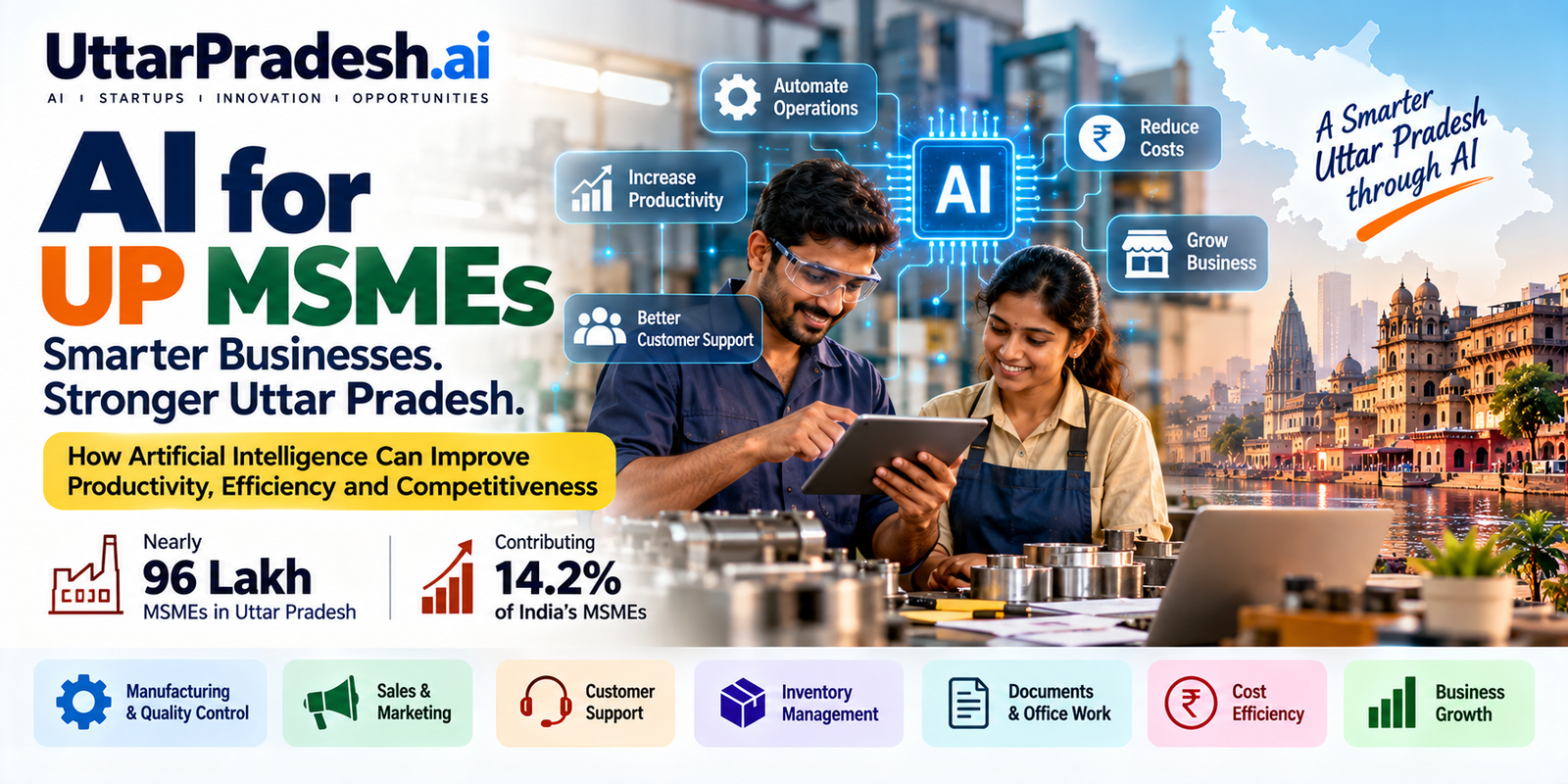
According to Invest UP, Uttar Pradesh has nearly 96 lakh MSMEs, accounting for around 14.2% of India’s total MSME count. (Invest UP)
These businesses operate across a wide range of sectors, including:
- Manufacturing
- Engineering
- Textiles
- Handicrafts
- Food processing
- Electronics
- Defence-related manufacturing
- Agriculture
- IT and IT-enabled services
- Retail and e-commerce
Many of these businesses are now connected to larger national and international supply chains.
That makes technology adoption increasingly important.
Where Can AI Help an MSME?
AI does not necessarily mean buying an expensive humanoid robot or building a complicated AI model.
For many MSMEs, the first step could be much simpler.
1. AI for Customer Support
Businesses receive repetitive questions every day.
AI-powered chat systems can help answer common questions about:
- Products
- Prices
- Availability
- Delivery
- Services
- Business hours
- Order status
This can reduce the amount of repetitive work handled manually by employees.
2. AI for Sales and Marketing
Small businesses often have limited marketing teams.
AI tools can help businesses prepare:
- Social media content
- Product descriptions
- Email campaigns
- Customer messages
- Ad variations
- Market research summaries
AI can also help analyse customer behaviour and identify patterns in enquiries.
The final marketing decisions, however, still require human review.
3. AI for Manufacturing
Manufacturing is one area where AI can have practical applications.
Businesses can use computer vision and machine-learning systems for tasks such as:
Quality inspection → Defect detection → Predictive maintenance → Production monitoring
For example, an AI-powered camera system can potentially identify certain product defects during a manufacturing process.
This can be particularly relevant for engineering, electronics, automotive components and other manufacturing businesses.
AI Can Also Help With Inventory
Inventory management can become complicated when businesses handle hundreds or thousands of products.
AI-based systems can analyse historical sales and other business data to help identify:
- Fast-moving products
- Slow-moving inventory
- Seasonal demand
- Reorder patterns
- Potential stock shortages
The technology does not eliminate the need for business decisions.
Instead, it can provide data that helps business owners make those decisions faster.
AI for Documents and Daily Office Work
A significant amount of MSME work involves documents.
Invoices, emails, quotations, purchase orders, reports and customer records can consume considerable time.
AI-based document tools can help with:
- Extracting information
- Summarising documents
- Classifying files
- Drafting responses
- Searching business records
- Creating reports
For a small company with a limited administrative team, reducing repetitive documentation work can be useful.
AI Could Help MSMEs Become More Competitive
The recent discussion at UPITS focused on an important question:
What is the actual business value of AI?
According to reporting on Prasada’s remarks, the emphasis was on measurable outcomes such as productivity, efficiency and cost competitiveness rather than AI adoption for its own sake. (KNN India)
That distinction matters.
A business does not necessarily benefit simply because it has an AI tool.
The real question is:
Does the technology solve a real business problem?
For one company, that could mean reducing customer-support workload.
For another, it could mean improving manufacturing quality.
For another, it could mean analysing sales data more quickly.
UP’s MSME Ecosystem Is Already Moving Toward Technology
Technology adoption is already part of Uttar Pradesh’s MSME support framework.
Invest UP’s MSME information notes support for areas such as digital technology adoption, quality certifications, patents and environmentally sustainable manufacturing practices under the state’s MSME Promotion Policy framework. (Invest UP)
The state is also developing industrial infrastructure and supply-chain connectivity around manufacturing clusters.
This creates an environment where digital technologies can become part of the next stage of MSME growth.
From ODOP to AI
One of Uttar Pradesh’s best-known MSME initiatives is One District, One Product (ODOP).
The programme connects district-level products with broader markets.
Invest UP says ODOP 2.0 is placing greater emphasis on areas such as:
- Technology integration
- Better packaging
- Quality standards
- E-commerce
- Global market access
- Common Facility Centres
AI could potentially become another technology layer for these businesses.
Imagine a local manufacturer using AI to analyse international customer demand.
Or a food-processing business using data tools to understand seasonal demand.
Or an artisan brand using AI-assisted digital marketing to reach customers outside India.
The technology possibilities are broad, although actual benefits will depend on cost, skills, data quality and implementation.
AI Is Not Only for Noida
Noida and Greater Noida are already important technology and manufacturing centres, but AI adoption does not have to remain concentrated there.
Uttar Pradesh has businesses across cities and districts.
Lucknow, Kanpur, Agra, Meerut, Varanasi, Gorakhpur, Moradabad, Saharanpur and many other regions have businesses that could potentially use AI-based tools.
This makes AI accessibility important.
A small business in a tier-2 or tier-3 city should not necessarily need a large technology department to start using basic AI tools.
The Skills Challenge
Technology alone cannot transform an MSME.
People need to understand how to use it.
That means businesses may need training in:
- AI basics
- Data handling
- Digital tools
- Cybersecurity
- Automation
- Prompting and AI-assisted workflows
- Data privacy
- Human review of AI outputs
Prasada also highlighted the importance of preparing young people as AI innovators, researchers and users, and stressed collaboration between industry and institutions such as IIT Kanpur. (Hindustan Times)
This connection between education and industry could become increasingly important as AI adoption grows.
What About Cost?
Cost remains a practical question for smaller businesses.
Not every MSME needs a large AI infrastructure investment.
Businesses can start with relatively simple applications such as:
AI chatbot → Content automation → Document processing → Data analysis → Workflow automation
More advanced applications such as computer vision, industrial robotics or customised AI models can require substantially greater investment.
The right approach therefore depends on the business problem, available data, workforce and expected return.
AI + Manufacturing Could Be Especially Important for UP
Uttar Pradesh is simultaneously trying to expand its electronics and semiconductor ecosystem.
At UPITS, officials discussed the state’s ambitions around electronics, semiconductors, AI and technology. Reports also highlighted investments, data centres and AI laboratories as parts of the broader technology ecosystem. (KNN India)
For MSMEs, this could create opportunities as suppliers and service providers around larger technology and manufacturing companies.
Potential areas include:
- Electronic components
- Industrial automation
- Software
- Testing
- Robotics
- Engineering services
- Logistics technology
- Quality-control systems
- AI-enabled services
Data Centres Will Support the AI Ecosystem
AI applications also require computing infrastructure.
Uttar Pradesh’s Data Centre Policy 2026 promotes AI-ready digital infrastructure and includes incentives related to AI compute and high-performance computing. The policy also aims to encourage green and sustainable data-centre development. (Invest UP)
This infrastructure can support the wider AI ecosystem, including enterprises and technology companies.
The connection can be understood simply:
Data Centres → Computing Power → AI Applications → Businesses → New Services
What Should an MSME Do First?
Businesses don’t need to automate everything at once.
A practical starting point could be:
Step 1 — Find a repetitive problem
Identify a task employees perform repeatedly.
Step 2 — Check whether AI can actually solve it
Not every business problem requires AI.
Step 3 — Start with a small pilot
Test the technology with one workflow.
Step 4 — Measure the result
Look at time saved, cost, accuracy or customer response.
Step 5 — Train employees
Make sure the people using the system understand its limitations.
Step 6 — Scale only if it works
If the pilot delivers measurable value, expand it.
This approach can help businesses focus on outcomes instead of simply adopting technology because it is trending.
What This Means for Uttar Pradesh’s AI Ecosystem
The growing conversation around AI and MSMEs adds another dimension to Uttar Pradesh’s technology story.
The state’s AI ecosystem is developing across several layers:
AI Infrastructure
Data centres and computing.
AI Startups
New companies building AI products.
Research & Education
Universities and technology institutions.
Industry
Manufacturing and enterprise applications.
MSMEs
Smaller businesses adopting AI for everyday operations.
Talent
Students, developers and technology professionals.
Connecting these layers could be important for turning AI technology into broader economic applications.
The Road Ahead
The next phase of AI adoption in Uttar Pradesh may not be defined only by large AI projects.
It could also be defined by thousands of smaller businesses adopting AI for specific tasks.
A manufacturing company improving quality inspection.
A retailer analysing customer demand.
A service company automating enquiries.
An exporter researching international markets.
A local manufacturer using AI-assisted forecasting.
These individual applications may look small, but together they can form a much larger digital transformation.
Conclusion
The recent discussion at UP International Trade Show 2026 has brought attention to a practical side of the AI conversation in Uttar Pradesh: how MSMEs can use AI to improve the way they operate.
The focus is not simply on adopting the latest technology.
It is about finding practical business problems where AI can help improve productivity, efficiency, quality and competitiveness. (KNN India)
With nearly 96 lakh MSMEs across the state according to Invest UP, even gradual AI adoption across smaller businesses could become an important part of Uttar Pradesh’s technology ecosystem. (Invest UP)
The next question is no longer only:
“Is AI coming to Uttar Pradesh?”
It is:
“How will Uttar Pradesh’s businesses use AI in their everyday work?”
UttarPradesh.ai will continue tracking AI, startups, technology, investment, research and innovation developments across the state.