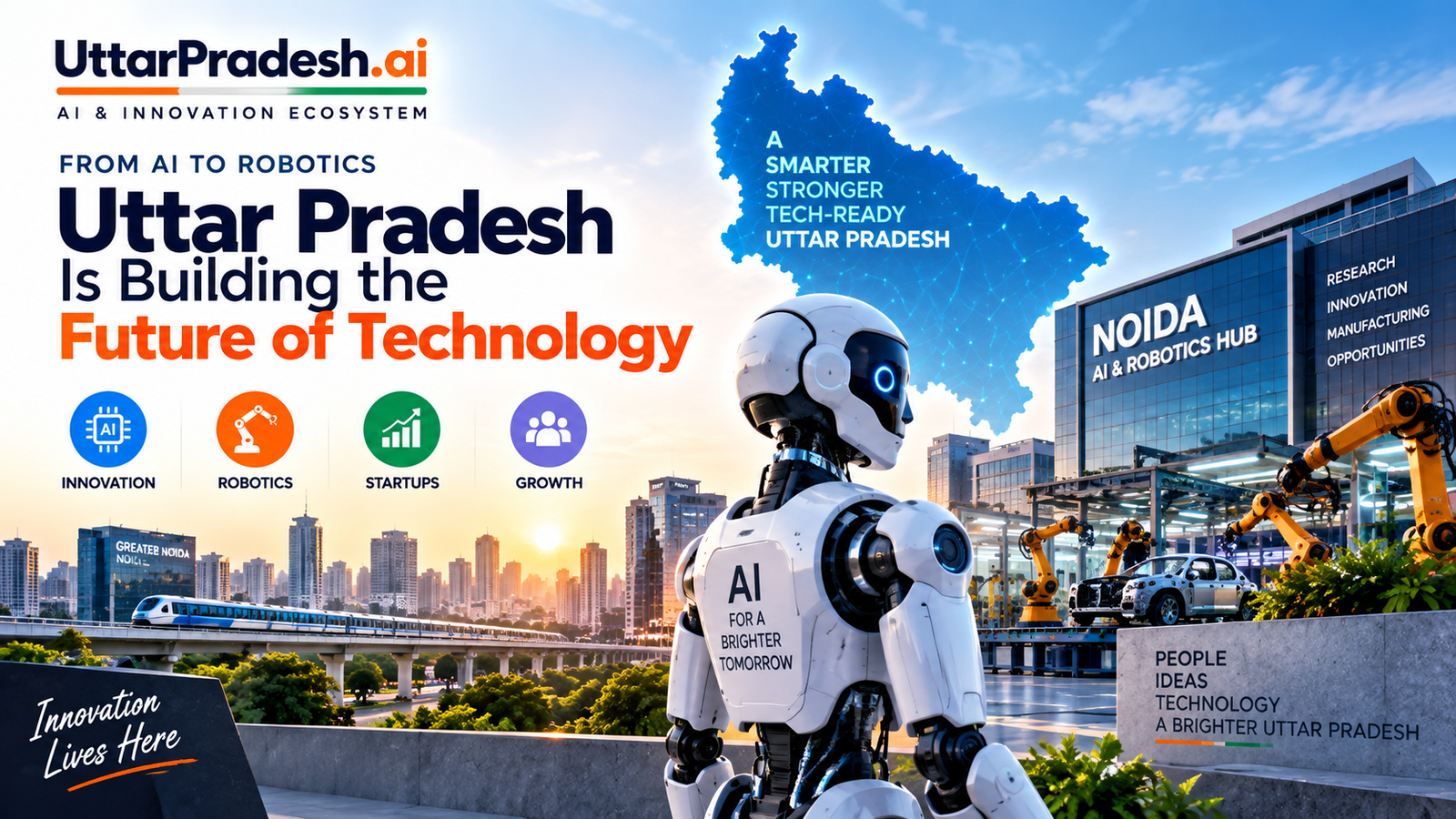
Noida AI & Robotics Hub: How Uttar Pradesh Is Building the Future of Technology
Artificial Intelligence is moving beyond chatbots and software applications. Today, AI is increasingly being combined with robotics, advanced computing, automation, sensors and industrial systems.
Uttar Pradesh is also developing its technology ecosystem around these emerging areas. Noida and Greater Noida are becoming important locations for advanced technology and robotics, while Lucknow is being developed as another major centre for AI and deep-tech innovation.
In July 2026, the Uttar Pradesh government highlighted plans for a large robotics hub in Noida, while Invest UP reported that the state was pitching a robotics cluster in Noida.
For startups, researchers, manufacturers and technology professionals, this could create new opportunities across AI, robotics, automation, electronics and deep-tech.
Why Noida for AI and Robotics?
Noida already has a strong technology and industrial base, along with its proximity to Delhi NCR.
This gives the region an important combination:
- Technology companies
- Manufacturing facilities
- Engineering talent
- Startup ecosystem
- Research institutions
- Access to the Delhi-NCR market
- Connectivity with investors and businesses
The state government has also identified emerging technologies such as AI, robotics, IoT, drones and advanced manufacturing as areas for research, innovation and skill development.
This makes Noida a natural place to explore the connection between software intelligence and physical machines.
India’s Robotics Opportunity
Robotics is no longer limited to traditional manufacturing.
Modern robots can work with AI to understand environments, process information and perform increasingly complex tasks.
Possible applications include:
Manufacturing:
Robots can support assembly, inspection, packaging and quality-control processes.
Healthcare:
Robotics can assist with medical procedures, rehabilitation and hospital operations.
Agriculture:
AI-powered machines can potentially support crop monitoring, precision agriculture and automated operations.
Warehousing:
Autonomous systems can help move, sort and manage goods.
Defence and security:
Robotics and autonomous systems are increasingly relevant to surveillance, logistics and other applications.
Smart infrastructure:
AI and robotics can also contribute to transportation, inspection and infrastructure management.
The important change is that robotics is becoming increasingly connected with AI, sensors, computer vision and advanced computing.
A Robotics Cluster Could Change the Startup Landscape
A dedicated robotics ecosystem can offer more than physical infrastructure.
For startups, the biggest challenge in robotics is often moving from an idea to a working product.
A startup may need:
- Prototyping facilities
- Testing laboratories
- Engineering expertise
- Hardware suppliers
- AI and software talent
- Manufacturing partners
- Investors
- Industry customers
Bringing these elements closer together can make the product-development process easier.
Uttar Pradesh’s existing startup ecosystem is also expanding its focus towards emerging technologies. The Uttar Pradesh Startup Policy 2026 specifically includes Artificial Intelligence, Quantum Computing, Blockchain, SpaceTech, DefenceTech and other deep-tech sectors.
Noida and Lucknow: Two Different Pieces of the Same Ecosystem
One interesting part of Uttar Pradesh’s technology strategy is that innovation is not being concentrated in just one city.
The state’s U-Hub Deep-Tech initiative is planned around a dual-city model involving Noida and Lucknow.
According to the Uttar Pradesh Startup Mission, the Noida centre is expected to focus on areas including:
- Quantum & Advanced Computing
- Semiconductor Design and OSAT
- Physical AI & Robotics
- Defence Technologies
- Advanced Biotechnology
The Lucknow centre is focused on areas such as:
- Applied AI
- GovTech
- Industrial AI
- Healthcare Technologies
- AI-enabled Diagnostics
- Agri-Biotechnology
This creates an interesting possibility: Noida can develop strengths in physical AI, robotics and advanced hardware, while Lucknow develops complementary strengths in applied AI and AI-driven solutions.
AI City Lucknow Adds Another Layer
Uttar Pradesh is also planning an AI City in Lucknow.
Invest UP describes the project as a purpose-built innovation zone designed to bring important parts of the AI ecosystem together. The planned Phase-I area is 20+ acres within the larger Vrindavan Yojana IT City.
The proposed components include:
- AI & DeepTech incubation
- Flexible AI-focused workspaces
- High-performance computing
- AI testing and simulation laboratories
- Office infrastructure
- Commercial and amenity facilities
This is significant because robotics requires more than robots themselves. Modern robotics depends on AI models, computing power, simulation, computer vision, data and testing infrastructure.
Infrastructure Will Be Critical
AI and robotics require strong digital infrastructure.
AI models need computing resources. Robotics companies need testing environments. Industrial AI applications require reliable connectivity and data infrastructure.
Uttar Pradesh’s Data Centre Policy 2026 includes support for AI-ready infrastructure, high-performance computing and AI research clusters. It also includes an AI Compute Booster Incentive for eligible high-performance AI infrastructure.
This infrastructure layer could become important as companies move from experimentation to commercial AI applications.
Opportunities for Startups
The development of AI and robotics infrastructure can create opportunities for different types of startups.
For example:
1. Robotics Startups
Companies developing industrial, warehouse, agricultural or service robots.
2. AI Software Companies
Businesses developing computer vision, machine learning, automation and intelligent decision-making systems.
3. Industrial Automation
Solutions that help factories improve productivity, quality control and operational efficiency.
4. Drone & Autonomous Systems
AI-enabled drones and autonomous systems for industrial and commercial applications.
5. Semiconductor & Hardware
Companies working on chips, sensors, embedded systems and robotics components.
6. Simulation & Digital Twins
Technology that allows companies to test machines and industrial processes digitally before deployment.
Funding and Startup Support
Technology infrastructure is only one part of building a startup ecosystem. Funding and mentorship are equally important.
Under the Uttar Pradesh Startup Policy 2026, eligible startups can access support such as sustenance allowance, prototype grants, seed capital and matching grants, subject to the policy’s conditions. The policy also provides for a ₹1,000 crore Fund of Funds and a ₹400 crore Startup Corpus Fund.
The state is also planning 20 new Centres of Excellence over five years and expanding incubator support through a hub-and-spoke model.
For deep-tech startups, this type of support can be particularly relevant because hardware and research-based businesses often require more time and capital before reaching the market.
IIT Kanpur and the Noida Connection
Noida’s emerging deep-tech ecosystem also has an academic and research connection.
The Uttar Pradesh government’s AIIDE Centre of Excellence in Noida was entrusted to FIRST IIT Kanpur, with a focus on AI, machine learning, IoT, cybersecurity and augmented reality.
The programme is designed to support startups through incubation, mentorship, infrastructure and access to technical expertise.
This kind of university-industry connection can be important for deep-tech companies because research ideas often need access to laboratories, technical mentors and industry networks before becoming commercial products.
What Could This Mean for Jobs?
The growth of AI and robotics will not only create opportunities for robotics engineers.
The ecosystem can require professionals in:
- Artificial Intelligence
- Machine Learning
- Robotics Engineering
- Computer Vision
- Embedded Systems
- Electronics
- Semiconductor Design
- Data Science
- Cybersecurity
- Cloud Computing
- Product Management
- Industrial Automation
- Research & Development
- Sales and Business Development
There will also be demand for people who understand both technology and business.
For students in Uttar Pradesh, this creates a reason to look beyond traditional IT careers and explore emerging technology fields.
The Bigger Picture for Uttar Pradesh
The robotics push is part of a wider technology ecosystem being developed across the state.
The state is simultaneously working on areas including:
AI → Robotics → Semiconductor → Data Centres → Deep Tech → Startups → Research → Manufacturing
These areas are interconnected.
For example, a robotics company may require AI models, semiconductor components, cloud or edge computing, sensors, manufacturing partners and skilled engineers.
That means the development of one technology sector can create demand in several others.
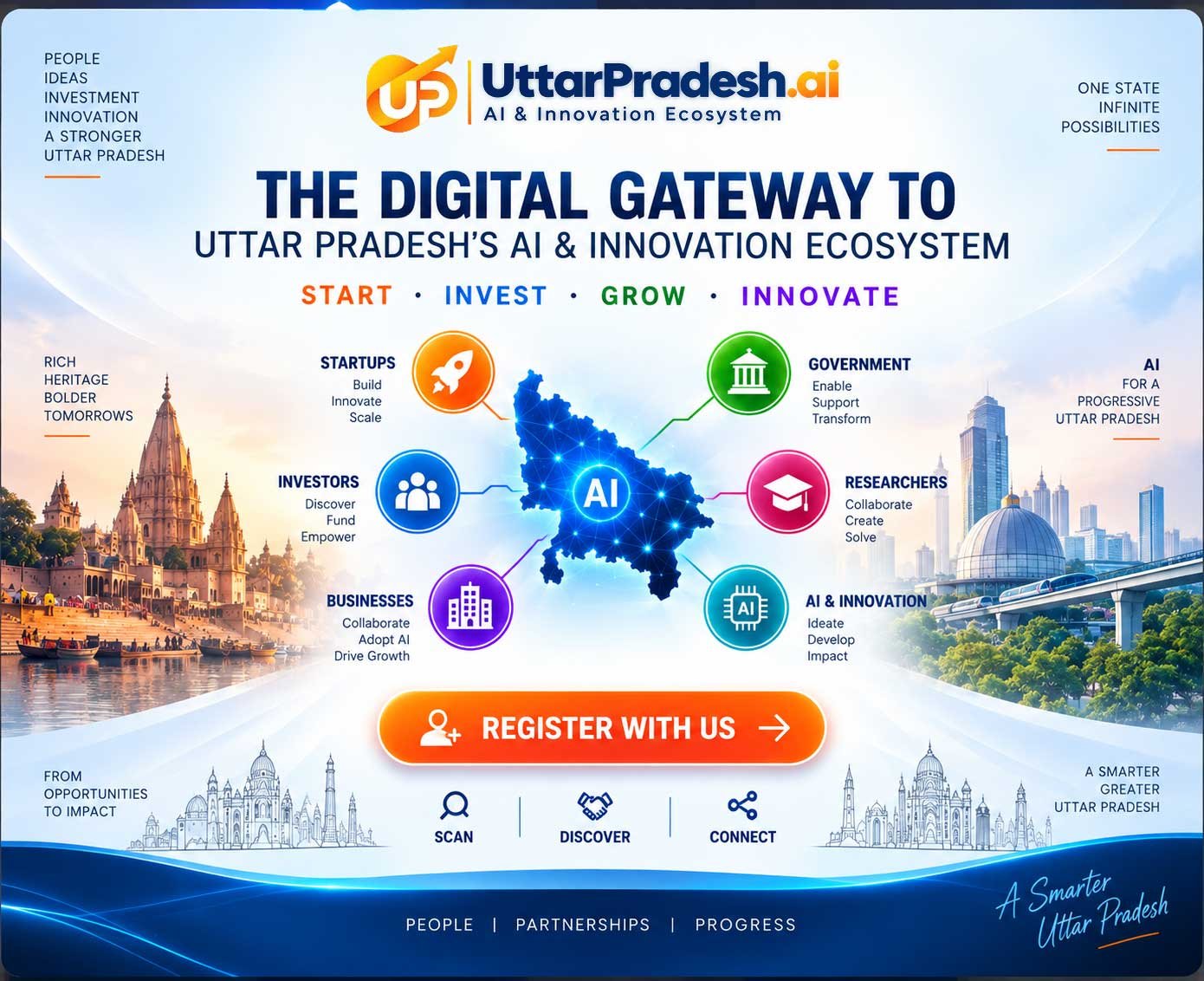
Where UttarPradesh.ai Fits In
For an ecosystem like this to grow, infrastructure alone is not enough.
People need access to information.
Startups need visibility. Investors need to discover new companies. Students need information about opportunities. Researchers need platforms to showcase their work. Businesses need to know about new technologies and government initiatives.
This is where UttarPradesh.ai can play a connecting role.
The platform can bring together:
- AI news
- Startup stories
- Innovation updates
- Funding opportunities
- AI jobs
- Research
- Events
- Government initiatives
- Technology companies
- Founder and investor stories
The objective is simple: make Uttar Pradesh’s AI and innovation ecosystem easier to discover.
What Comes Next?
The development of a robotics and AI ecosystem will take time.
Building laboratories, startups, research capabilities, skilled talent and manufacturing capacity is a long-term process.
The real measure of success will ultimately be what gets built: new products, new companies, research breakthroughs, industrial applications and skilled technology professionals.
For Uttar Pradesh, the combination of Noida’s technology and industrial ecosystem, Lucknow’s planned AI infrastructure, deep-tech initiatives and startup support creates a developing technology network across the state.
And if that network successfully connects ideas with research, research with startups, and startups with industry, Uttar Pradesh could develop a much broader base for AI and robotics innovation.
Final Thoughts
The AI story in Uttar Pradesh is becoming bigger than software alone.
With Noida’s emerging robotics focus, Lucknow’s planned AI City, deep-tech initiatives, startup programmes and expanding digital infrastructure, the state is building several pieces of a larger technology ecosystem.
The next phase will be about execution — turning plans and infrastructure into real companies, useful technologies, skilled talent and products that can compete beyond Uttar Pradesh.
From AI to robotics, the technology ecosystem is taking shape — and Uttar Pradesh is becoming an important place to watch.