IIT Kanpur and UP Government Expand AI Training Programme to 900 Educators Across Uttar Pradesh
Artificial Intelligence is quickly becoming an important part of modern education, and Uttar Pradesh is taking another step towards preparing its educators for this technology-driven future.
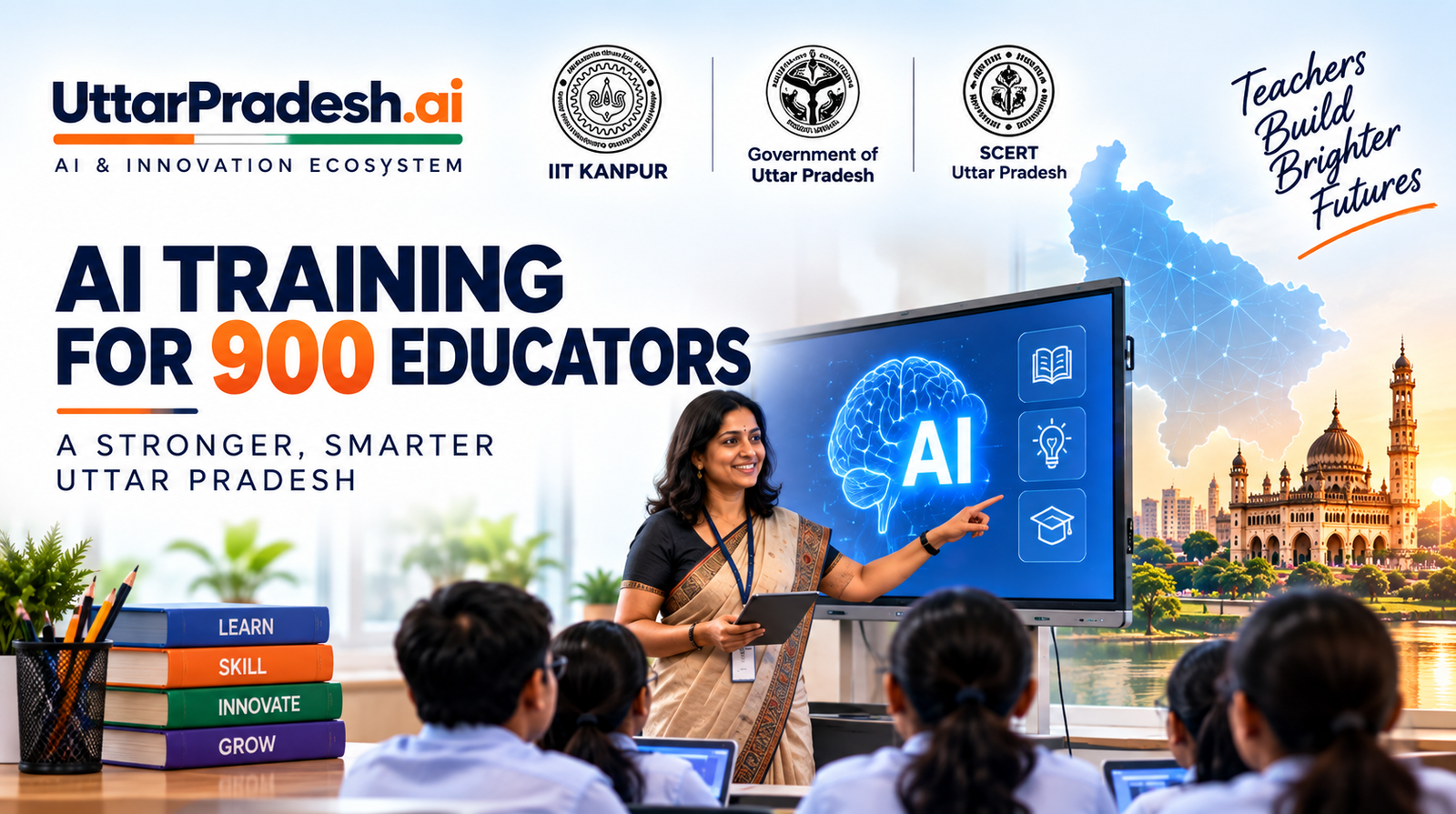
IIT Kanpur, in collaboration with the Government of Uttar Pradesh and the State Council of Educational Research and Training (SCERT), has expanded its Digital Literacy & Computational Thinking Concepts for Teachers (DLCCAI) programme to secondary education.
Under the expanded programme, 900 participants will receive training in digital literacy, computational thinking, Artificial Intelligence and technology-enabled teaching. The participants include secondary school teachers, lecturers from District Institutes of Education and Training (DIETs), and officials from SCERT’s associated units.
The announcement, made on September 18, 2026, represents another development in Uttar Pradesh’s wider effort to strengthen digital and AI capabilities within the education system.
What Is the DLCCAI Programme?
The DLCCAI programme has been designed to help teachers become more comfortable with digital technologies, computational thinking, coding and Artificial Intelligence.
Instead of focusing only on theoretical knowledge, the programme follows a hands-on and application-oriented approach.
The new programme will run for eight weeks and combine classroom training at IIT Kanpur with online learning, mentoring and practical assignments.
The 900 participants will be divided into six batches of 150 participants each. The initial phase includes a five-day residential training programme at IIT Kanpur, followed by online learning and mentoring. The programme will conclude with a two-day showcase involving project presentations, peer learning and assessment.
Participants who successfully complete the required quizzes, assignments, projects and final presentation will receive a joint certificate from SCERT Uttar Pradesh and IIT Kanpur.
What Will Teachers Learn?
The programme covers much more than Artificial Intelligence.
Teachers will receive training in basic digital skills, productivity tools, spreadsheets, Google Workspace, digital communication, cybersecurity and digital citizenship.
The curriculum also introduces:
- Artificial Intelligence
- Computational thinking
- Block-based programming
- Scratch
- Basic Python
- EdTech tools
- Digital teaching resources
- Robotics
- Technology-enabled teaching
Participants will also get practical exposure to tools such as ChatGPT, Google Classroom and Khan Academy, with an emphasis on using technology for lesson planning, content creation, assessment and professional productivity.
The programme also includes a practical robotics component involving robot assembly and sensor-based activities, followed by a robotics challenge designed to encourage problem-solving and inquiry-based learning.
Why AI Training for Teachers Matters
AI is changing the way students learn and access information.
Students today can interact with AI tools, generate content, explore new subjects and use digital platforms for learning. This creates a new challenge for educators: teachers also need to understand these technologies well enough to use them effectively and responsibly.
Training teachers can therefore have a wider impact than simply teaching them how to use a new software tool.
An AI-aware teacher can potentially use technology for:
Lesson Planning:
AI tools can assist teachers in preparing lesson structures, examples and classroom activities.
Content Creation:
Teachers can create digital learning materials and supplementary resources more efficiently.
Assessment:
Technology can support the creation and analysis of assessments.
Personalised Learning:
Digital tools can help educators explore different approaches for students with different learning needs.
Teacher Productivity:
Routine academic and administrative tasks can potentially be made more efficient with appropriate digital tools.
The DLCCAI programme specifically connects AI and digital tools with the everyday academic and administrative responsibilities of teachers.
From Digital Literacy to AI Literacy
One of the important aspects of this programme is that it does not treat AI as an isolated subject.
The programme starts with basic digital foundations and gradually moves towards computational thinking, coding, AI and robotics.
This approach is particularly relevant because the programme is designed even for participants who may have limited or no previous exposure to computers, coding or AI.
The idea is simple: before expecting educators to introduce advanced technology into classrooms, they need confidence with the fundamentals.
This could make AI adoption more practical at the school level.
This Is Not the First AI Training Initiative by IIT Kanpur
The expansion to secondary education builds on earlier work.
According to IIT Kanpur, the DLCCAI programme previously trained 750 primary school teachers and helped enable technology-supported learning that reached more than 10,000 students.
The programme has now been expanded to secondary education, increasing its reach across Uttar Pradesh’s school education system.
IIT Kanpur’s earlier teacher-training initiative, launched in 2025, also focused on digital literacy, computational thinking, coding and AI for government school teachers across Uttar Pradesh.
This shows that the latest 900-participant programme is part of a continuing effort rather than a standalone training event.
AI Education Is Becoming a Bigger Focus in Uttar Pradesh
The development comes at a time when Artificial Intelligence is receiving increasing attention across Uttar Pradesh’s education ecosystem.
At AI Manthan 2.0 in Kanpur earlier in September 2026, discussions focused on expanding AI education, research and implementation across universities.
Following the summit, two steering groups were announced to work on AI policy and implementation in universities.
The broader direction is therefore becoming visible across multiple levels of education:
Schools → Teachers → Universities → Researchers → Startups → Industry
This could eventually create a stronger pipeline of AI-aware students, researchers and entrepreneurs.
Preparing Students for an AI-Driven Future
Perhaps the biggest potential impact of teacher AI training will be on students.
Teachers are one of the most important links between technology and the classroom.
If educators understand AI, coding and computational thinking, they can introduce students to these concepts in a structured way.
The objective does not necessarily have to be to turn every student into a programmer or AI engineer.
Instead, students can develop basic understanding of:
- How AI works
- How AI tools should be used
- Computational thinking
- Problem-solving
- Digital citizenship
- Responsible use of technology
- Creativity and innovation
These skills could become increasingly useful as AI becomes part of workplaces and everyday digital services.
What It Means for Uttar Pradesh’s AI Ecosystem
The development is also relevant beyond education.
A successful AI ecosystem needs three major components:
Infrastructure + Technology + Talent
Infrastructure provides computing and digital resources.
Technology companies and startups build solutions.
And skilled people create, operate and adopt those solutions.
Teacher training contributes to the talent and awareness layer of this ecosystem.
When students are introduced to computational thinking and AI at an earlier stage, some of them may eventually move into higher education, research, technology careers or entrepreneurship.
In that sense, today’s teacher training could contribute to tomorrow’s AI workforce.
The Role of IIT Kanpur
IIT Kanpur’s involvement gives the programme an academic and technical dimension.
The institute is responsible for implementing the programme through its Office of Outreach Activities and Department of Design, in collaboration with SCERT and the Government of Uttar Pradesh.
The programme also combines classroom learning, online learning, mentoring and practical assignments rather than relying entirely on traditional classroom lectures.
This blended model allows participants to continue learning after their initial training at IIT Kanpur.
What Could Come Next?
The expansion to 900 educators is an important step, but the larger question will be how effectively the training translates into classroom practice.
The long-term impact could depend on factors such as:
- Continued teacher support
- Access to digital infrastructure
- Availability of AI-enabled learning resources
- Regular skill updates
- Responsible AI practices
- Integration with school curriculum
- Student participation in AI and technology projects
AI is evolving quickly, so one-time training may not be enough. Continuous learning and mentoring could become increasingly important for educators.
Uttar Pradesh’s AI Education Journey
Uttar Pradesh is increasingly building different parts of its AI ecosystem—from government initiatives and university programmes to startup development, research and skill-building.
The IIT Kanpur–UP Government–SCERT collaboration adds another important layer: preparing educators to work with AI and digital technologies.
Training 900 educators across six batches is a concrete step toward building AI awareness within the secondary education system.
The bigger opportunity is not simply teaching teachers about Artificial Intelligence.
It is about helping create classrooms where students learn to understand technology, question it, experiment with it and use it responsibly.
As Uttar Pradesh continues to develop its AI ecosystem, education and skill development will remain an important foundation.
The future of AI in Uttar Pradesh will depend not only on the technology the state builds, but also on the people it prepares to use and create that technology.
About UttarPradesh.ai
UttarPradesh.ai is an AI and innovation ecosystem platform focused on Uttar Pradesh, covering AI news, startups, research, funding, jobs, events, government initiatives and emerging technology.