AI Needs Proper Training Before Its Use in Space Technology, Experts Highlight in Lucknow
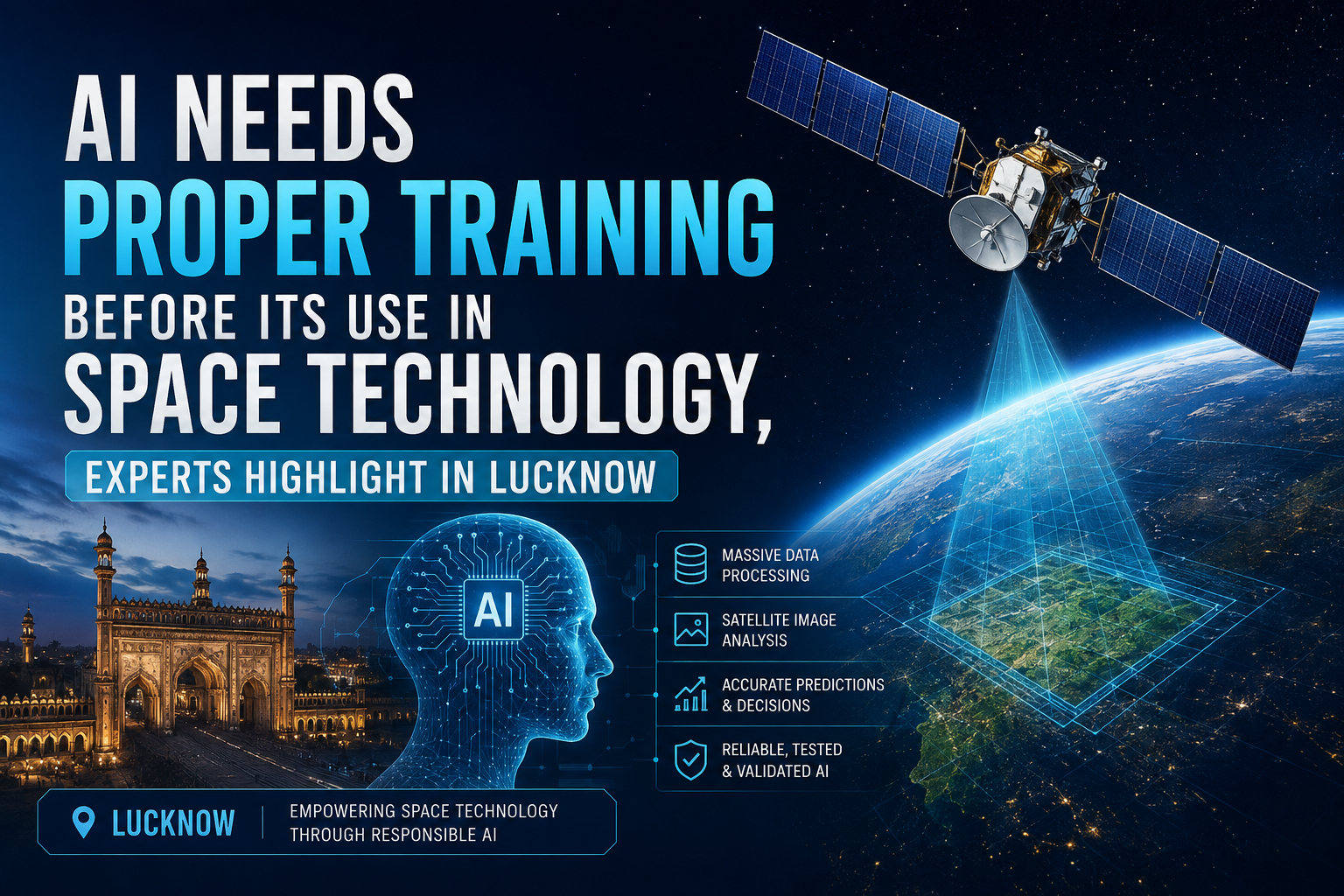
Artificial Intelligence is rapidly emerging as an important technology for the space sector,
with its ability to process massive volumes of data and support faster decision-making.
However, experts have stressed that AI systems must be properly trained and validated before
they are deployed in critical space-related applications.
The issue was highlighted during a technology-focused discussion in
Lucknow, where experts examined the growing role of Artificial Intelligence
in space technology, satellite systems and remote sensing.
AI Can Help Handle Massive Space Data
Modern satellites generate enormous amounts of information every day. Analysing this data
manually can be time-consuming and requires significant human resources.
AI can help automate several parts of this process by identifying patterns, analysing
satellite imagery and extracting useful information from large datasets.
AI-powered systems could potentially support applications such as:
- Satellite image analysis
- Remote sensing
- Weather and environmental monitoring
- Detection of unusual satellite behaviour
- Data classification and processing
- Mission planning and decision support
By processing information at much greater speed, AI could help researchers and space
professionals make faster and more informed decisions.
Proper Training Is Critical
Despite the growing possibilities, experts have cautioned against using AI systems without
adequate training.
AI models learn from the data provided to them. If that data is incomplete, inaccurate or
poorly structured, the system may produce unreliable results.
This becomes particularly important in space technology, where even a small error can have
significant consequences.
Experts therefore emphasised the need for
high-quality datasets, extensive testing and continuous validation before
AI systems are deployed for critical space applications.
Human Expertise Still Remains Important
The growing use of AI does not mean that human expertise will become unnecessary.
Instead, AI can work alongside scientists, engineers and researchers to improve efficiency
and assist with complex data analysis.
Human oversight can help identify errors, verify AI-generated results and ensure that
decisions involving critical space operations are not based solely on automated systems.
This combination of AI capabilities and human expertise could become an
important part of the future of space technology.
AI and the Future of Remote Sensing
Remote sensing is one area where AI has significant potential.
Satellite images contain valuable information about land, agriculture, climate,
infrastructure and environmental changes. AI can analyse these images and identify patterns
that may be difficult to detect manually.
For a country like India, these capabilities could support applications ranging from
environmental monitoring and disaster management to agricultural planning and urban development.
Why AI Skills Matter for India’s Space Sector
As India’s space ecosystem continues to expand, the demand for professionals with knowledge
of both AI and space technology is also expected to increase.
Students, researchers and technology professionals with skills in machine learning,
data science, computer vision and satellite data analysis could play an important role
in developing the next generation of space applications.
This also creates opportunities for universities and educational institutions to introduce
interdisciplinary programmes that combine artificial intelligence with space science and engineering.
Lucknow’s Growing Technology Ecosystem
The discussion in Lucknow also highlights the city’s growing engagement with emerging technologies.
From Artificial Intelligence and automation to advanced research and digital innovation,
Uttar Pradesh is witnessing increasing interest in technologies that could shape the state’s future economy.
As AI adoption expands across sectors, initiatives involving education, research, startups
and industry collaboration could help Uttar Pradesh develop a stronger technology ecosystem.
The Road Ahead
Artificial Intelligence has the potential to transform the way space data is collected,
processed and interpreted. But its success will depend not only on sophisticated algorithms
but also on accurate data, proper training, rigorous testing and responsible deployment.
Experts believe that AI should be treated as a powerful tool that works alongside human
intelligence rather than as a replacement for it.
With the right approach, AI could contribute significantly to India’s ambitions in space
technology while opening new opportunities for research, innovation and skilled employment.
Key Takeaway
The growing use of AI in space technology presents enormous opportunities, but reliability
must remain a priority. Properly trained AI systems, combined with human expertise and
rigorous validation, could help India unlock the full potential of Artificial Intelligence
in the space sector.