Uttar Pradesh Plans India’s First Robotics Hub in Noida
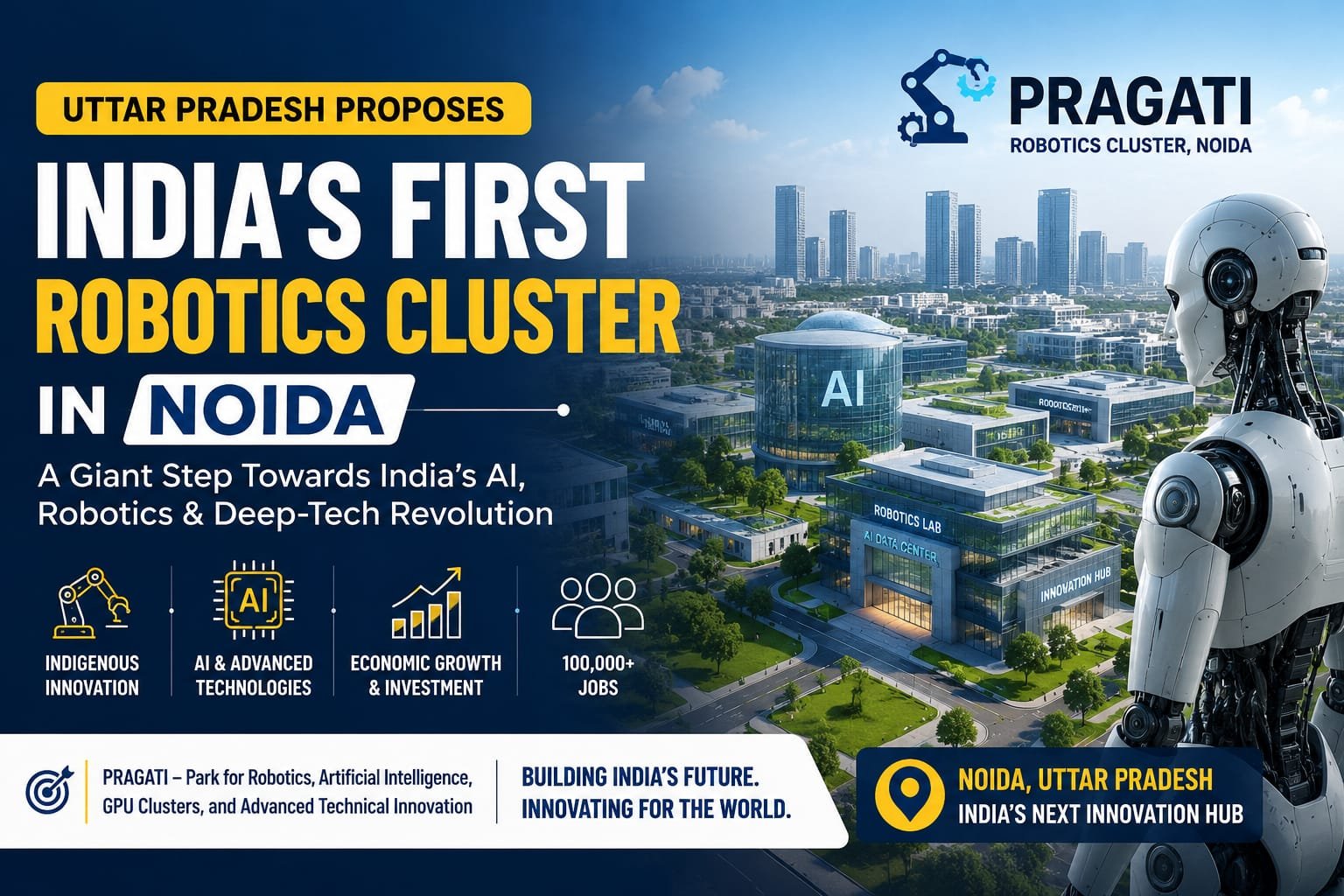
Uttar Pradesh Proposes India’s First Robotics Cluster in Noida
Uttar Pradesh is taking a major step toward becoming India’s next artificial intelligence and robotics powerhouse. The state government has proposed the establishment of India’s first dedicated robotics cluster in Noida, aiming to reduce the country’s dependence on imported robotics technologies while strengthening domestic innovation.
The proposed initiative reflects the state’s long-term vision of creating a globally competitive ecosystem for robotics, AI, advanced manufacturing, and deep-tech innovation. By bringing research institutions, startups, manufacturers, investors, and technology experts under one roof, Uttar Pradesh hopes to accelerate technological growth and position Noida as one of India’s leading innovation hubs.
Why This Robotics Cluster Matters
Artificial intelligence and robotics are transforming industries worldwide—from healthcare and manufacturing to logistics and defense. However, India still relies heavily on imported robotics systems and high-end automation technologies.
To address this challenge, the Uttar Pradesh government has proposed a dedicated robotics cluster that will support indigenous innovation, encourage local manufacturing, and strengthen India’s position in the global robotics market.
The initiative aligns with national goals such as Make in India, Digital India, and Atmanirbhar Bharat while creating new opportunities for businesses, startups, researchers, and skilled professionals.
What is PRAGATI?
The proposed robotics cluster is part of an ambitious project called PRAGATI (Park for Robotics, Artificial Intelligence, GPU Clusters, and Advanced Technical Innovation).
Spread across approximately 75 acres in Noida, PRAGATI is designed as an integrated ecosystem where innovation, research, testing, manufacturing, and commercialization can take place within a single campus.
The proposed facilities include:
- Robotics testing and certification centers
- AI computing infrastructure
- High-performance GPU clusters
- Motion capture laboratories
- Advanced manufacturing facilities
- Rapid prototyping labs
- Physical AI data centers
- Startup incubation centers
- Research and development spaces
Instead of creating separate facilities, the project aims to connect every stage of robotics development—from idea generation and research to testing, manufacturing, and commercial production.
Creating a Strong AI and Robotics Ecosystem
One of the biggest strengths of the proposed robotics cluster is its collaborative approach. The Uttar Pradesh government plans to bring together key stakeholders from across the AI and robotics ecosystem to encourage innovation and accelerate technological development.
The initiative will connect:
- AI startups
- Robotics companies
- Universities
- Research institutions
- Investors
- Technology experts
- Manufacturing industries
This integrated ecosystem can help reduce development costs, improve collaboration, and accelerate the commercialization of innovative technologies. By bringing diverse organizations together, the cluster aims to create a supportive environment for research, product development, and business growth.
Rather than working independently, organizations will be able to share infrastructure, research facilities, testing centers, and advanced computing resources, making innovation faster, more efficient, and cost-effective.
Economic Impact and Job Creation
The proposed robotics cluster is expected to become a major economic driver for Uttar Pradesh. By promoting innovation, advanced manufacturing, and AI-driven technologies, the initiative aims to strengthen the state’s economy while creating new opportunities for businesses and skilled professionals.
Government projections estimate that the initiative could:
- Generate more than 100,000 direct and indirect jobs.
- Contribute over ₹2,000 crore in gross value addition during the next five years.
- Attract both domestic and international investments.
- Support India’s growing advanced manufacturing industry.
- Encourage deep-tech entrepreneurship and startup innovation.
These projections highlight Uttar Pradesh’s ambition to become a national hub for emerging technologies, high-value manufacturing, and AI-powered industrial growth, while creating long-term economic benefits for the state.
Strengthening India’s Robotics Industry
Robotics adoption is growing rapidly across the world, transforming industries through automation, artificial intelligence, and smart technologies. From healthcare to manufacturing, organizations are increasingly investing in robotics to improve efficiency, productivity, and innovation.
Key sectors benefiting from robotics include:
- Healthcare
- Manufacturing
- Defence
- Warehousing
- Agriculture
- Smart logistics
- Electronics production
Although India has significant growth potential in robotics and automation, the country still depends on imported robotics components and advanced automation solutions for many industries.
By establishing a dedicated robotics cluster in Noida, Uttar Pradesh aims to strengthen domestic manufacturing, encourage the development of AI-powered robotics hardware and automation systems, and reduce reliance on imported technologies. This initiative could play an important role in building a more self-reliant and globally competitive robotics ecosystem for India.
Why Noida?
Noida has rapidly emerged as one of India’s fastest-growing technology and manufacturing destinations. Its modern infrastructure, strategic location, and expanding innovation ecosystem make it an ideal choice for establishing a large-scale robotics and AI cluster.
The city already offers:
- Strong electronics manufacturing infrastructure
- A growing startup ecosystem
- Excellent connectivity through expressways
- Upcoming Jewar International Airport
- Proximity to Delhi-NCR
- An expanding data center ecosystem
- Access to a highly skilled technical workforce
These advantages make Noida a strategic location for developing a world-class AI and robotics ecosystem. The proposed cluster is expected to attract global technology companies, investors, startups, and research institutions, further strengthening Uttar Pradesh’s position as a leading innovation and manufacturing hub.
The Road Ahead
Although the robotics cluster is currently at the proposal stage, it reflects Uttar Pradesh’s strong commitment to advancing artificial intelligence, robotics, and other emerging technologies. If approved and implemented successfully, the initiative could transform the state’s innovation ecosystem and strengthen India’s position in the global technology landscape.
The project has the potential to:
- Accelerate AI research and commercialization.
- Promote indigenous robotics innovation.
- Strengthen India’s manufacturing capabilities.
- Create thousands of high-skilled jobs.
- Position Uttar Pradesh as a leader in AI, robotics, and deep-tech innovation.
More than just an infrastructure project, this initiative represents a long-term vision to build a future-ready technology ecosystem that encourages innovation, supports entrepreneurship, attracts global investment, and drives sustainable economic growth across Uttar Pradesh.
Final Thoughts
The proposed PRAGATI Robotics Cluster in Noida has the potential to transform India’s AI and robotics ecosystem. By bringing together advanced research, cutting-edge manufacturing, AI infrastructure, startups, and industry experts under one roof, Uttar Pradesh is taking a significant step toward becoming a leading technology and innovation hub.
If implemented successfully, the project could reduce India’s dependence on imported robotics technologies, strengthen domestic manufacturing, create high-skilled employment opportunities, and position Noida as a global destination for AI-driven innovation and advanced robotics. The initiative reflects Uttar Pradesh’s long-term vision of building a future-ready, self-reliant, and globally competitive technology ecosystem.