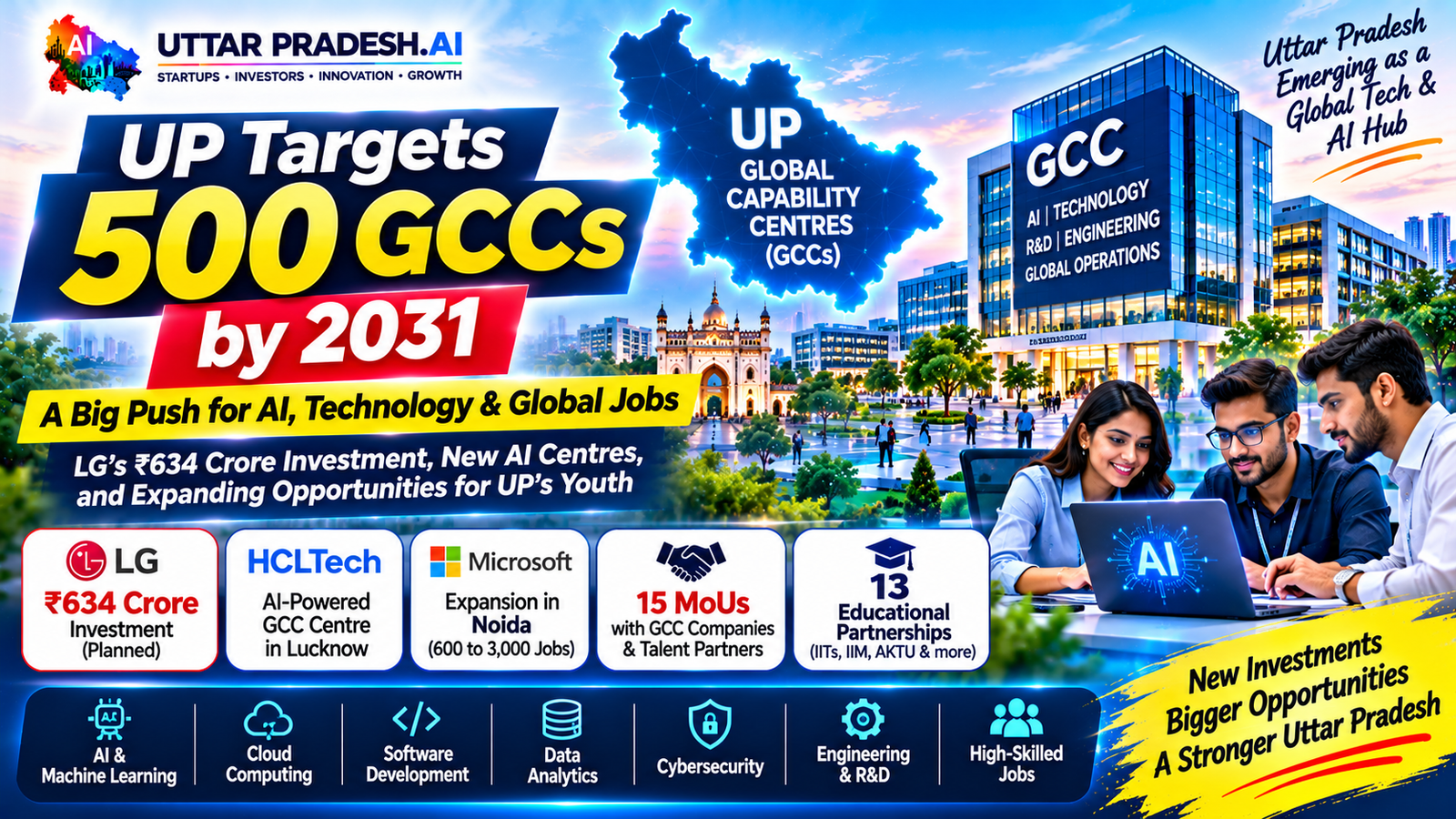
Uttar Pradesh Targets 500 Global Capability Centres by 2031: How AI and Technology Could Create New Career Opportunities
Uttar Pradesh is taking another major step towards becoming a technology and innovation-driven economy. The state has announced an ambitious target of attracting more than 500 Global Capability Centres (GCCs) by 2030–31. The plan is expected to bring new technology investments, strengthen research and development, and create high-skilled employment opportunities.
The announcement was made at the GCC Innovation Summit 2026 in Lucknow, where government representatives, technology companies, investors and educational institutions discussed the future of global business operations in Uttar Pradesh.
The focus is not limited to setting up new offices. The state wants to attract companies working in artificial intelligence (AI), software development, engineering, data analytics, cloud computing, cybersecurity and advanced technology.
For young professionals and students, this could open new career opportunities without having to move to traditional technology hubs such as Bengaluru, Hyderabad or Pune.
What Are Global Capability Centres (GCCs)?
Global Capability Centres are specialised offices established by multinational companies to manage important business and technology operations.
In the past, many companies mainly used these centres for customer support and back-office work. Today, their role has changed significantly.
Modern GCCs are involved in activities such as:
- Artificial Intelligence and Machine Learning
- Software and product development
- Data analytics and business intelligence
- Cloud computing and cybersecurity
- Engineering and research and development
- Financial technology and digital operations
- Automation and advanced technology development
For example, a global company may establish a GCC in India to develop software, manage international technology operations, build AI-powered products or conduct research for its global business.
This is why GCCs are becoming an important part of the technology and innovation economy.
Why Does Uttar Pradesh Want 500 GCCs?
Uttar Pradesh has a large workforce, a growing network of educational institutions and improving infrastructure. The government wants to use these advantages to attract companies looking for skilled professionals and suitable locations for technology operations.
At the GCC Innovation Summit 2026, Chief Minister Yogi Adityanath highlighted the state’s ambition to become a destination for advanced technology, research and development, and innovation-led businesses.
The summit also saw 15 MoUs signed with GCC companies and talent development partners. Partnerships were established with 13 educational institutions to improve industry-academia collaboration and prepare students for future technology jobs.
The idea is to build an ecosystem where companies, universities, startups and skilled professionals can work together.
LG’s ₹634 Crore Investment Plan and 500+ Job Opportunities
One of the major announcements at the summit came from LG Electronics.
The company outlined a planned investment of ₹634 crore in its Eco Solutions Global Capability Centre. The proposed centre will focus on heating, ventilation and air-conditioning (HVAC) systems, heat pump technology and advanced product development.
The company aims to create more than 500 high-value jobs through talent development and training. It also indicated plans to expand research into AI-based cooling technologies for data centres.
This development is particularly interesting because AI infrastructure requires significant computing power, and data centres need efficient cooling systems to operate reliably.
As demand for AI computing grows, technologies related to energy efficiency, cooling and advanced engineering are also becoming increasingly important.
HCLTech and AWS Bring AI Capabilities to Lucknow
Lucknow is also emerging as an important location in the state’s technology plans.
HCLTech has launched an AI-powered GCC Centre of Excellence at its Lucknow campus in collaboration with Amazon Web Services (AWS).
The initiative aims to support the development of GCCs by providing access to advanced cloud and computing capabilities.
HCLTech already has an established presence in Lucknow, with around 1,500 employees at its campus, according to company representatives at the summit.
The collaboration is significant because modern AI development depends on access to computing infrastructure, cloud platforms, technical expertise and skilled professionals.
Such initiatives can also help local talent gain experience in technologies that are increasingly used by global businesses.
Microsoft’s Noida Campus Shows the Potential of Technology Investment
Noida has already established itself as an important technology and business destination in Uttar Pradesh.
At the summit, Microsoft India Development Center representatives discussed the company’s experience of expanding its operations in the city.
According to the company’s representative, the Noida centre grew from around 600 employees in its first year to nearly 3,000 within three years.
The campus involved an investment of approximately ₹2,500 crore.
This example shows how investment in technology infrastructure can contribute to employment and help build a stronger business ecosystem around a location.
For Uttar Pradesh, the next challenge is to encourage more companies to establish similar operations across other cities.
Lucknow, Noida and Other Cities Could Benefit
Noida and Greater Noida already have an established base of technology companies, office spaces and corporate operations.
However, the state’s GCC ambitions also create opportunities for other cities.
Lucknow: With existing IT infrastructure, educational institutions and HCLTech’s presence, Lucknow could attract more technology and business operations.
Kanpur: The city’s engineering institutions and industrial background could support opportunities in product development, research and technology services.
Gorakhpur: The city could benefit from new investment and employment opportunities as companies explore locations beyond established technology centres.
Varanasi and Prayagraj: Their educational institutions and growing talent base could contribute to future technology and research activities.
The actual growth in each city will depend on infrastructure, company investment decisions, skilled talent and the successful implementation of government policies.
What Does This Mean for Students and Young Professionals?
One of the biggest potential benefits of GCC expansion is the creation of high-skilled jobs.
Students pursuing B.Tech, BCA, MCA, MBA, computer science, engineering and other technology-related courses could find new opportunities as companies expand their operations.
Some of the skills likely to be in demand include:
- Artificial Intelligence and Machine Learning
- Python and software development
- Data Science and Data Analytics
- Cloud Computing and DevOps
- Cybersecurity
- Robotics and Automation
- Product Management
- Business Analytics
However, having a degree alone may not be enough. Students will also need practical knowledge, project experience, communication skills and the ability to work with modern technology.
Educational institutions can play an important role by updating their courses, introducing industry-focused training and encouraging students to work on real-world technology projects.
Why Industry-Academia Partnerships Matter
A major part of the GCC plan is connecting companies with universities and educational institutions.
During the summit, partnerships were established with institutions including IIT Kanpur, IIT Roorkee, IIM Lucknow, IIT (BHU) Varanasi, Aligarh Muslim University, MNNIT Allahabad, Lucknow University, IIIT Allahabad, IIIT Lucknow and Dr APJ Abdul Kalam Technical University, among others.
These partnerships are intended to improve industry-linked research, technology training and workforce development.
This is important because companies need professionals who can solve practical problems, not just understand theoretical concepts.
If these partnerships lead to meaningful internships, research projects, specialised training and industry exposure, students across the state could benefit.
How AI Is Changing the Future of GCCs
Artificial intelligence is changing the way global companies operate.
Businesses are increasingly using AI to automate routine tasks, analyse large amounts of data, improve customer experiences and develop new products.
Modern GCCs are also moving towards more advanced responsibilities. Instead of only supporting business operations, they are increasingly involved in product engineering, AI development, digital transformation and research.
For Uttar Pradesh, this creates an opportunity to attract companies that want to build technology capabilities rather than simply establish conventional office operations.
The white paper titled The True Economics of AI Adoption in GCCs, prepared through a deep-tech innovation collaboration between HCLTech and IIT Kanpur, was also released at the summit.
Its focus on the economics of AI adoption reflects the growing importance of artificial intelligence in the future of global business operations.
The Challenges Uttar Pradesh Must Address
Attracting 500 GCCs is an ambitious target. Achieving it will require more than investment announcements and policy incentives.
The state will need to focus on several important areas:
1. Industry-ready talent: Companies need professionals with practical knowledge of AI, software, engineering, cloud and data technologies.
2. Strong digital infrastructure: Reliable electricity, high-speed connectivity, data infrastructure and access to advanced computing facilities will be essential.
3. Faster project execution: Investors need clear approval processes, predictable policies and timely support.
4. Strong university partnerships: Educational institutions must connect academic learning with actual industry requirements.
5. Long-term business confidence: Companies need a stable environment in which they can operate, expand and invest over several years.
The success of the GCC initiative will ultimately depend on how effectively these requirements are addressed.
What Happens Next?
Uttar Pradesh has set a clear direction: attract more global companies, strengthen its technology ecosystem and create opportunities for skilled professionals.
The announcements made at the GCC Innovation Summit 2026 provide an indication of growing interest from technology companies and investors.
However, the target of 500 GCCs is a future goal, not a count of centres already operating in the state. Investment proposals, MoUs and planned job creation will need to translate into operational projects and actual employment.
The coming years will show whether Uttar Pradesh can turn this ambition into a strong technology and innovation ecosystem.
Conclusion
Uttar Pradesh’s ambition to attract more than 500 Global Capability Centres by 2030–31 could become an important development for the state’s technology sector.
With investments from companies such as LG, the presence of Microsoft and HCLTech, and partnerships with leading educational institutions, the state is building a foundation for more advanced business and technology operations.
For students, startups and technology professionals, the biggest opportunity will be to prepare for the skills that global companies need.
If investment plans are successfully implemented and local talent receives the right training, Uttar Pradesh could become a much stronger destination for AI, technology, research and high-value employment.
The real success of this initiative will not be measured only by the number of GCCs announced, but by the quality of jobs, innovation and opportunities they create.
Frequently Asked Questions (FAQs)
1. What is Uttar Pradesh’s target for Global Capability Centres?
Uttar Pradesh aims to attract more than 500 Global Capability Centres by 2030–31.
2. What is a Global Capability Centre?
A GCC is a centre established by a company to manage specialised business functions such as software development, AI, research, data analytics, engineering and digital operations.
3. How much is LG planning to invest in its GCC in Uttar Pradesh?
LG Electronics outlined a planned investment of ₹634 crore in its Eco Solutions GCC, with the aim of creating more than 500 high-value jobs.
4. Which technology companies are expanding their presence in Uttar Pradesh?
Companies discussed at the GCC Innovation Summit included LG Electronics, Microsoft, HCLTech and Smartworks, among others.
5. How can AI students benefit from GCC expansion?
Students with skills in AI, machine learning, Python, data science, cloud computing and cybersecurity could benefit from future employment and training opportunities.
6. Which cities in Uttar Pradesh could benefit from GCC development?
Noida, Greater Noida, Lucknow, Kanpur and Gorakhpur are among the cities being considered for expanding the state’s technology and GCC ecosystem.
7. Is the target of 500 GCCs already achieved?
No. It is a government target for 2030–31. The number of operational centres will depend on future investments and project implementation.
About UttarPradesh.ai
UttarPradesh.ai covers artificial intelligence, startups, technology, innovation, government initiatives and emerging opportunities across Uttar Pradesh. Follow us for updates on the state’s growing AI and technology ecosystem.