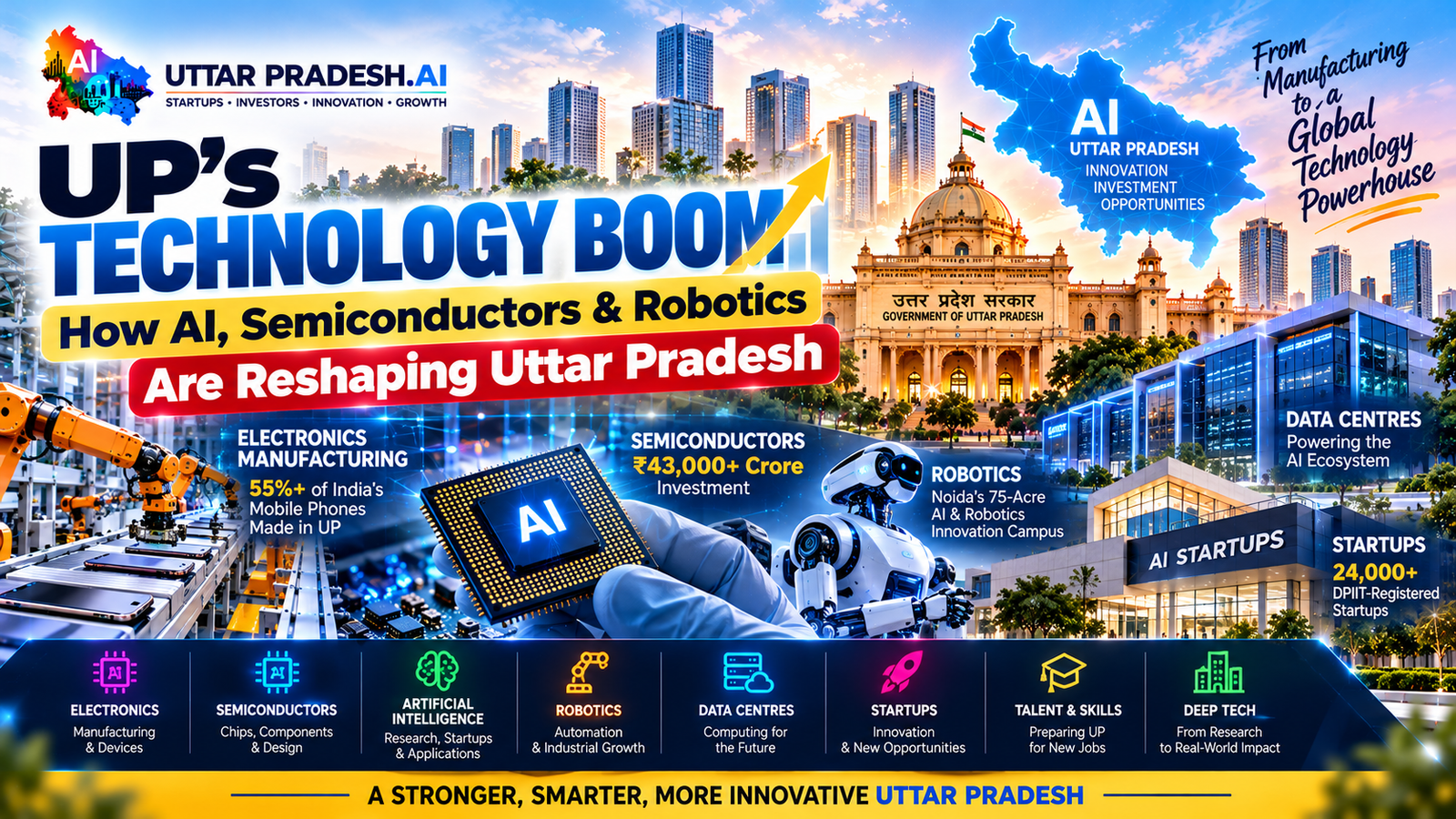
UP Technology Boom 2026: AI, Semiconductors & Robotics Transform Uttar Pradesh
From Electronics to AI: Uttar Pradesh Is Building a New Technology Economy
Uttar Pradesh is increasingly becoming more than a large manufacturing and services market. The state is building a broader technology ecosystem where electronics manufacturing, semiconductors, artificial intelligence, robotics, data centres, startups and skilled talent are beginning to connect with each other.
Recent developments show how quickly this ecosystem is expanding. According to a report published on October 20, 2026, Uttar Pradesh has attracted more than ₹43,000 crore in electronics-sector investment, with more than 3 lakh employment opportunities generated. The report also says that more than 55% of India’s mobile phones are manufactured in the state. The Times of India
For Uttar Pradesh, the bigger story is not just mobile manufacturing. It is the transition from assembly and electronics towards semiconductors, AI, robotics and deep technology.
Why Is Uttar Pradesh Becoming a Technology Hub?
Several factors are coming together.
The state has a large talent pool, major industrial regions, improving connectivity, proximity to the National Capital Region, a growing startup ecosystem and increasing investment in technology infrastructure.
The Gautam Buddha Nagar–Noida–Greater Noida region has become particularly important for electronics and emerging technology, while Lucknow is developing a stronger presence in IT, AI and deep tech.
The combination creates an interesting technology corridor:
Manufacturing + Electronics + Semiconductors + AI + Data Centres + Startups + Talent
This interconnected ecosystem could become one of the most important drivers of Uttar Pradesh’s future technology economy.
₹43,000 Crore Electronics Ecosystem
Electronics manufacturing is currently one of the strongest pillars of Uttar Pradesh’s technology growth.
Recent reporting says more than 200 companies are operating in the state’s electronics sector, with investments exceeding ₹43,000 crore and more than 3 lakh employment opportunities generated. The Times of India
The sector goes beyond smartphones.
It includes:
- Mobile phones
- Consumer electronics
- Electronic components
- Appliances
- Drones
- Solar-related products
- Testing and packaging
- Supporting manufacturing services
- Technology supply chains
This matters because a mature electronics ecosystem can create opportunities for thousands of smaller businesses around large manufacturers.
For startups, this means opportunities in areas such as component technology, industrial software, automation, logistics, quality control, robotics and AI-powered manufacturing.
Uttar Pradesh Is Moving Towards Semiconductors
The semiconductor industry could become the next major chapter in the state’s technology journey.
Invest UP’s official semiconductor information lists the HCL-Foxconn semiconductor project near Jewar with an approved investment of approximately ₹3,706 crore. The facility is designed for display-driver chip manufacturing, with a stated capacity of 20,000 wafers per month and 36 million units per month.
The state has also notified the Uttar Pradesh Semiconductor Policy 2024, aimed at attracting semiconductor manufacturing, ATMP/OSAT, compound semiconductor, silicon photonics, sensor-fab and design-related investments. Invest UP
In June 2026, the Union government and Uttar Pradesh government also laid foundation stones for electronics manufacturing projects worth approximately ₹6,750 crore at Jewar, including advanced printed circuit board manufacturing. The Ministry of Electronics & IT said the projects could help bring significant PCB production that was previously imported into domestic manufacturing. Press Information Bureau
Why does this matter for AI?
Because AI needs hardware.
AI servers require advanced processors, memory, networking equipment, power systems and cooling infrastructure. Robotics also depends on sensors, chips, controllers and electronic components.
That means the semiconductor and electronics ecosystem can eventually support the physical infrastructure required for the AI economy.
Noida’s AI and Robotics Opportunity
Noida and Greater Noida are emerging as important locations in this technology transformation.
A proposal for PRAGATI, a 75-acre integrated robotics and AI innovation campus in Noida, has been reported as an effort to bring robotics manufacturers, AI startups, research institutions, testing facilities and component suppliers together. The proposed ecosystem includes AI computing infrastructure, GPU clusters, rapid prototyping, robotics testing and R&D facilities. The Times of India
The idea is significant because robotics is moving beyond traditional industrial automation.
The next generation of robotics will increasingly combine:
Robotics + AI + Computer Vision + Sensors + Edge Computing + Physical AI
This can create applications across manufacturing, logistics, agriculture, healthcare, defence, warehouses and smart infrastructure.
For startups in Uttar Pradesh, such infrastructure could provide a pathway from prototype to commercial product.
Lucknow Is Building Its AI & Deep-Tech Identity
While Noida is becoming an important electronics and advanced-manufacturing centre, Lucknow is developing its own identity around AI, IT and deep technology.
In October 2026, the Uttar Pradesh government announced plans to support at least 50 AI startups in Lucknow over the next five years. At the same time, HCLTech launched Phase 2 of its Lucknow IT City project with an investment of around ₹500 crore.
The expansion is expected to include a new IT building with capacity for approximately 5,000 seats.
The state’s plans also include positioning Lucknow as a hub for:
- Artificial Intelligence
- Semiconductors
- Cybersecurity
- Computing
- Deep tech
- Technology startups
This creates an opportunity to connect universities, startups, technology companies, researchers and investors.
Deep-Tech Hubs Could Connect Research With Startups
Another important development is the planned U-Hub deep-tech ecosystem.
According to reporting on the initiative, specialised deep-tech hubs are planned in Lucknow and Noida, with focus areas including AI, quantum computing, semiconductors, robotics and advanced biotechnology. The Noida hub is expected to focus on areas such as advanced computing, semiconductor design, physical AI and robotics. The Times of India
This is important because deep-tech startups often need more than funding.
They need:
- Research infrastructure
- Testing facilities
- Computing resources
- Technical mentors
- Industry partnerships
- Prototyping support
- Access to investors
Connecting these pieces can help research move from laboratories into real-world products.
Startups Could Be the Biggest Beneficiaries
Technology infrastructure alone does not create an innovation ecosystem.
Startups are equally important.
Recent reports put Uttar Pradesh’s DPIIT-registered startup count at more than 24,000. The Times of India
This growing startup base creates opportunities in areas such as:
- AI SaaS
- HealthTech
- FinTech
- AgriTech
- EdTech
- Robotics
- Cybersecurity
- Semiconductor design
- Drones
- Industrial automation
- ClimateTech
- DeepTech
The next challenge is helping more of these companies move from early-stage ideas to scalable businesses.
AI Needs Data Centres Too
Another important part of the ecosystem is digital infrastructure.
As AI applications become more computationally intensive, access to reliable computing infrastructure becomes increasingly important.
Data centres support:
- Cloud computing
- AI workloads
- Enterprise software
- Digital platforms
- Financial services
- E-commerce
- Government applications
- Research
Recent reporting has highlighted investment in Uttar Pradesh’s data-centre sector alongside the state’s electronics and semiconductor expansion.
This creates a potential technology cycle:
Electronics → Computing → Data Centres → AI → Robotics → New Startups
The stronger each part becomes, the more useful the overall ecosystem can become.
Talent Will Decide the Next Stage
Infrastructure and investment are only one part of the equation.
The long-term success of Uttar Pradesh’s technology economy will depend heavily on skilled people.
The state is already seeing new initiatives around AI training and emerging technologies. For example, Samsung announced its Innovation Campus 2026 programme in Uttar Pradesh, under which 5,000 young people are expected to receive industry-relevant AI training.
Meanwhile, recent developments around IIT Kanpur’s Noida campus are also putting greater emphasis on entrepreneurship and deep-tech commercialisation. IIT Kanpur announced the Gautam School of Innovation & Entrepreneurship, backed by a ₹180-crore commitment, with programmes focused on turning technology research into market-ready products and startups. The Indian Express
This research-to-startup connection could become extremely important.
What Could This Mean for Young People in UP?
The technology boom could create opportunities beyond conventional IT jobs.
Future opportunities may include:
- AI engineers
- Robotics engineers
- Semiconductor engineers
- Chip designers
- Data scientists
- Cybersecurity professionals
- AI product managers
- Hardware entrepreneurs
- Automation specialists
- Deep-tech researchers
- Drone technology professionals
- AI trainers and educators
The growth of manufacturing and technology together also creates opportunities for people who combine engineering + business + AI skills.
The Bigger Picture: From Manufacturing to Innovation
The most important change is that Uttar Pradesh’s technology story is becoming broader.
Earlier, the focus was largely on attracting manufacturing.
Today, the ecosystem is increasingly expanding towards:
Manufacturing → Electronics → Semiconductors → Computing → AI → Robotics → Deep Tech → Startups
That transition could help Uttar Pradesh participate in higher-value technology activities rather than remaining only a large consumer or manufacturing market.
Recent state and industry developments show that this transition is already underway, although many projects are still at different stages of development and execution.
What Role Can UttarPradesh.ai Play?
As Uttar Pradesh’s technology ecosystem grows, there is a growing need for better visibility and information.
UttarPradesh.ai can serve as a digital platform connecting the ecosystem by bringing together:
- AI news
- Startup stories
- Innovation updates
- AI companies
- Funding opportunities
- Research
- Events
- AI jobs
- Government initiatives
- Emerging technology
The objective is simple: make Uttar Pradesh’s AI and innovation ecosystem easier to discover.
For startups, researchers, students, investors and technology professionals, visibility can be as important as infrastructure.
Conclusion
Uttar Pradesh’s technology story is entering an interesting phase.
The state is no longer looking at electronics, AI, semiconductors and robotics as completely separate industries. Increasingly, these technologies are becoming part of one larger ecosystem.
With more than ₹43,000 crore reported in electronics investment, a growing semiconductor ecosystem, expanding AI and robotics plans, thousands of startups and new investments in skills and research, Uttar Pradesh has the ingredients to become a significant technology and innovation hub.
The real opportunity now is to connect these pieces.
Because the future of technology in Uttar Pradesh may not be built by one industry — it could be built by the ecosystem connecting them all.
FAQ
1. Is Uttar Pradesh becoming an AI hub?
Yes. The state is developing AI-related infrastructure, startup support, deep-tech hubs, computing facilities and talent programmes, particularly around Lucknow and Noida.
2. Why is Noida important for Uttar Pradesh’s technology sector?
Noida and Greater Noida already have a strong electronics and industrial base and are being positioned for advanced manufacturing, robotics, AI and semiconductor-related activity.
3. Is there a semiconductor project in Uttar Pradesh?
Yes. Invest UP lists an approved HCL-Foxconn semiconductor project near Jewar with an investment of ₹3,706 crore.
4. How many startups are there in Uttar Pradesh?
Recent reports cite more than 24,000 DPIIT-registered startups in the state.
5. What are the major technology sectors growing in UP?
Major areas include electronics, semiconductors, AI, robotics, data centres, IT, cybersecurity, deep tech and technology-driven startups.
6. Where can I follow AI and technology developments in Uttar Pradesh?
You can follow the latest Uttar Pradesh AI, startup, research, funding and technology updates on UttarPradesh.ai.